

Did you know over 200,000 nursing candidates enter high-security testing centers each year? Many are unsure about basic rules. This is a common worry for students facing their final test.
Students often wonder if they can bring writing materials to help with complex questions. You might be thinking: Can I take notes during the NCLEX? We aim to clear up any confusion about these rules.
Knowing these rules early is essential for staying calm. We want you to feel prepared and confident at your Pearson Professional Center. Our guide will tell you what to expect on exam day. This way, you can focus on doing your best.
Key Takeaways
- Official testing centers provide specific erasable boards for your scratch work.
- Personal paper, pens, or pencils are strictly prohibited inside the testing room.
- You must return all provided writing materials before leaving your station.
- Understanding these rules helps reduce stress and improves your focus.
- Always check the latest candidate bulletin for any updates to testing policies.
Understanding the NCLEX Exam Format
The NCLEX is more than a test; it’s a deep check of your clinical judgment. It’s not like school tests that you just memorize. This test shows if you can make smart, safe choices in real nursing situations.
The exam is highly adaptive. It changes its level of difficulty based on how you do. This means the test gets harder or easier as you answer questions.
Types of Questions on the NCLEX
You’ll see many different types of questions. They’re all designed to test your critical thinking. The test includes more than just simple multiple-choice questions. It also has interactive parts to make it feel more like real patient care.
Some common question types are:
- Case studies that ask you to look at complex patient data.
- Drag and drop tasks for putting nursing actions in order.
- Fill-in-the-blank questions, often for calculating drug doses.
- Hot spot items where you point out specific areas on an image.
- Matrix or grid questions that test your ability to sort information.
- Multiple response questions that ask for all correct answers.
Exam Duration and Structure
The exam’s length can seem intimidating at first. It uses Computerized Adaptive Testing (CAT). This means it stops when it’s sure of your skill level with 95% confidence.
You’ll face a variable number of questions. The board sets a range. But, you have a maximum time limit to finish the whole test.
It’s important to pace yourself well during the exam. Stay calm and focused. This will show your true nursing skills without feeling rushed.
Note-Taking Regulations for the NCLEX
Are you wondering if you can take notes during the NCLEX? It’s a big question for those getting ready. We aim to clear up what’s allowed so you can feel complete confidence on test day.

Official Guidelines from Pearson VUE
Pearson VUE has extremely strict rules to keep the exam fair. You can’t bring your own paper, pens, or electronic devices into the room. These rules help make sure everyone has a fair chance.
If you’re caught with something you shouldn’t have, it’s serious. You might have to leave and lose your exam fee. It’s important to leave your stuff in the locker to avoid trouble.
Specific Items Allowed in the Testing Room
You can’t bring your own stuff, but the center provides what you need. They give you tools to help with tough questions or math. This way, everyone gets the same chance to show what they know.
Here’s what you’ll usually find:
- A laminated note board or booklet for jotting down thoughts.
- A specialized marker that works with the provided board.
- An eraser or a way to clear your notes as you progress.
Don’t forget to give these back to the admin when you leave. Using these tools is the only way to take notes during the exam. By sticking to these rules, you can focus on showing off your nursing skills.
Importance of Effective Note-Taking
Creating a personal study system changes how you learn. You can’t take your NCLEX exam notes into the test room. But writing them down helps your brain a lot. Active learning is key to success.
Enhancing Memory Retention
When you mix information together, you go beyond just memorizing. Try to think of how you’d use the info in real life. This active learning helps you connect theory to practice.
“The secret of getting ahead is getting started.”
Good note-taking tips for the NCLEX make your brain work harder. This builds the thinking skills you need for the exam. You’re not just writing down facts; you’re training to think like a nurse.
Organizing Information for Study
Well-organized NCLEX preparation notes help you study topics like pharmacology and physiology better. A structured system lets you spot what you don’t know. Many find online classes help a lot with this.
Focus on NCLEX note organization to make your study sessions better. Use colors or mind maps to link ideas. This makes it easier to remember details when it counts.
Strategies for Study Without Note-Taking
Without personal notes for the NCLEX, we must find new ways to learn. We need to move from just reading to actively engaging with the material. Using NCLEX test note strategies helps build the mental skills needed to pass on the first try.
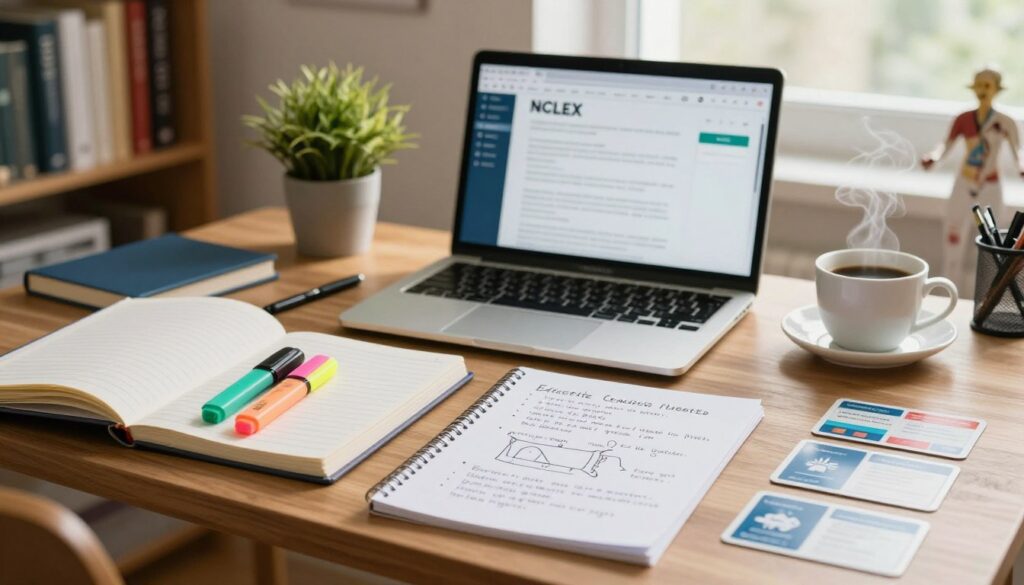
Utilizing Study Guides and Resources
You don’t have to write everything down to remember important nursing ideas. Instead, use top-notch study guides that break down complex topics into simple visuals. Online video tutorials can also help you understand clinical judgment without needing NCLEX study notes.
When you go over these materials, try explaining them out loud. This method helps you remember better and makes sure you really get the information. You can also check out different test-taking strategies to boost your exam score.
Practice Tests and Question Banks
Practicing is key to getting ready. We recommend doing practice questions every day. This makes you get used to the exam’s unique way of asking questions. It’s more effective than just looking at NCLEX study notes.
Every practice session should feel like the real test. By looking at why some answers are right and others are wrong, you improve your critical thinking. Learning these NCLEX test note strategies will make you feel confident and ready for the test.
Tips for Staying Focused During the NCLEX
Your ability to stay focused during the NCLEX depends on managing your environment and stress levels. We believe that mental preparation combined with physical comfort is key. This ensures you perform at your best. By planning ahead, you can tackle the testing process with confidence and clarity.
Managing Test Anxiety
Feeling nervous before such a big milestone in your nursing career is normal. We suggest practicing test-taking strategies that focus on patient safety and the least invasive interventions first. This systematic approach helps reduce anxiety when faced with multiple correct-looking options.
When you face a tough question, take a deep breath and focus on the clinical priority. Remember, you’ve prepared for this moment through hard study. Staying grounded in your clinical knowledge will help you keep your momentum throughout the exam.
Creating a Comfortable Testing Environment
Physical comfort is key to concentrating for long periods. If there’s a technical delay longer than 30 minutes at the test center, you have rights. You can choose to wait for the issue to be resolved or reschedule your exam without an additional fee.
Knowing your rights helps you stay calm if technical problems arise. Arrive early to get familiar with the testing station and adjust your chair or lighting if needed. Having a clear plan for these situations ensures you remain in control of your testing experience.
| Strategy | Primary Benefit | Implementation |
|---|---|---|
| Clinical Prioritization | Reduces decision fatigue | Select least invasive options first |
| Deep Breathing | Lowers heart rate | Use during 30-second breaks |
| Technical Awareness | Prevents panic | Know your rights regarding delays |
| Positive Visualization | Boosts confidence | Focus on successful outcomes |
What to Do if You Forget Your Study Materials
Forgetting your study guides on exam day can be stressful. But, remember, your hard work and dedication have already prepared you well. You’ve spent hours studying, and that knowledge is in your mind, ready to use.
Quick Reference Resources
Without physical notes, use the clinical reasoning skills you learned in nursing school. Focus on the basics of patient safety and nursing actions. These are the key ideas for every question.
If you’re unsure, simplify the situation by explaining it in your own words. Think about the main safety issue for the patient. This approach is often better than last-minute cramming, which can confuse you.
Techniques for Reassuring Yourself
It’s just as important to manage your stress as it is to know your clinical stuff. If you’re feeling overwhelmed, try deep breathing exercises to calm down. Visualizing yourself doing well on the exam can also boost your confidence.
Believe in the study strategies you used with your cohort. You’re more ready than you think, and your critical thinking skills will help you get through the test. Use the table below to change your mindset during the exam.
| Mindset Type | Focus Area | Expected Outcome |
|---|---|---|
| Panic-Driven | Missing materials | Increased anxiety |
| Strategy-Driven | Clinical reasoning | Improved focus |
| Confidence-Driven | Past preparation | Steady performance |
Alternatives to Note-Taking
We think that building a strong mental framework is key to tackling test challenges. You can’t bring physical items to the exam, so you must use your mind. Many students use NCLEX study notes to prepare, but the test needs you to think actively.
Utilizing Mental Strategies
Learning mental strategies can boost your performance under pressure. Try to mentally picture each clinical scenario. This helps you spot the difference between expected and unexpected patient outcomes.
By training your mind to process information this way, you get better at making key clinical judgments. These NCLEX test note strategies help you practice like you’re in the real test. Regular practice makes recalling information easier.
Visualizing Information
Active visualization is a technique that makes processing patient charts and vital signs better than just memorizing. Instead of written lists, create a mental picture of the patient’s condition. This connects symptoms to possible nursing actions.
The table below shows how mental prep compares to traditional study methods:
| Method | Primary Benefit | Exam Application |
|---|---|---|
| Traditional Notes | Information retention | Limited to study phase |
| Mental Visualization | Clinical judgment | Used during the exam |
| Active Synthesis | Pattern recognition | Faster decision making |
Using these techniques in your routine helps you go beyond just memorizing. You build critical thinking skills needed for exam success. Remember, your brain is your most powerful tool for reaching your nursing goals.
Collaborating with Peers for Preparation
You don’t have to face nursing boards alone. Working with your peers can make a big difference. Together, you can tackle the NCLEX challenges more effectively.
Sharing perspectives on complex questions is easier with a team. This way, you can learn from each other’s strengths.
Study Groups and Discussion Boards
Starting a study group can make tough topics easier. When you share your NCLEX preparation notes, you get new ideas. This teamwork keeps everyone motivated and accountable.
“Coming together is a beginning, staying together is progress, and working together is success.”
Here are some benefits of joining a study group:
- Clarifying complex medical terms through group talks.
- Practicing on key exam topics with each other.
- Getting better at NCLEX note organization by seeing how others do it.
Online Forums and Resources
Online forums are great if you can’t meet in person. They offer a lot of shared knowledge and support. You can find threads on NCLEX preparation notes to help you study better.
Being part of these online communities helps you improve your NCLEX note organization. You’ll find others who are also looking for support and motivation. By joining, you become part of a network of future nurses ready to pass the exam.
Common Misconceptions About Note-Taking
Let’s debunk the myths about the NCLEX and its strict testing environment. Many candidates arrive with outdated beliefs that can actually hurt their performance.
Clarifying Myths Surrounding the NCLEX
One common myth is that certain test-taking tricks, like always choosing the longest answer, will guarantee success. We need to clear up that these strategies don’t work. The exam tests your clinical judgment, not your pattern-spotting skills.
Another myth is about NCLEX note-taking policies. Many students think they can bring their own scratch paper or study notes into the testing room. But, all personal items must be stored in a locker, and you can’t bring anything into the exam area.
Understanding Exam Expectations
The NCLEX focuses on critical thinking, not just memorization or guessing. Relying on myths instead of solid preparation wastes valuable time. Knowing the real NCLEX note-taking rules helps you focus on what’s important for your licensure.
We’ve made a quick comparison to show you the difference between myths and real exam requirements.
| Common Myth | The Reality | Impact on Success |
|---|---|---|
| Always pick “C” | Randomized answers | Lowers your score |
| Bring your own notes | Strictly prohibited | Risk of disqualification |
| Longest answer is correct | Distractors are common | Misleads your judgment |
| Memorize patterns | Critical thinking required | Essential for passing |
By following the official NCLEX note-taking policies, you protect your integrity and future career. Spend your time on evidence-based study methods that boost your confidence and clinical knowledge.
Final Thoughts on Note-Taking
Your journey to become a licensed nurse is a big step. You worked hard in clinical rotations and classes. Even though you can’t use NCLEX exam notes in the test, your knowledge is your best tool.
Trust the clinical judgment you built up in nursing school. Using your own knowledge is better than looking for quick answers on test day.
Preparing for Your Exam Day
Get ready to relax before going to the Pearson VUE center. Reviewing key concepts one last time will help you understand tough nursing topics better.
Good note-taking tips for the NCLEX are key to your study habits. They help you organize your thoughts and make sense of hard medical terms.
Emphasizing Confidence and Knowledge
Your success comes from thinking critically with every question. Have faith in your preparation and stay sharp on the clinical scenarios shown on your screen.
After you finish the test, your official results will come from your state nursing board. We wish you the best as you move forward in your nursing career.