


Ever wondered if your clinical judgment is ready for the nursing board exam? Many students feel overwhelmed by complex scenarios that require quick, life-saving decisions. Learning NCLEX prioritization skills is more than just memorizing facts. It’s about thinking like a seasoned nurse under pressure.
We offer a clear, step-by-step guide to tackle these tough assessments with confidence. By understanding the logic behind each choice, you can improve your test strategy. It might help to review expert tips on these specific scenarios to sharpen your clinical reasoning. For more support, check out online classes to prepare for the NCLEX-RN. Let us make it easier so you can focus on making safe, effective decisions for your future patients.
Key Takeaways
- Prioritize client safety by using the nursing process and Maslow’s hierarchy.
- Apply the ABC framework to address airway, breathing, and circulation needs first.
- Distinguish between assessment and implementation to choose the correct initial action.
- Utilize structured study resources to build consistent clinical logic.
- Practice with adaptive testing to mirror the actual exam environment.
Understanding NCLEX Prioritization Questions
Many nursing students wonder, “How do I answer NCLEX prioritization questions?” These questions are tough because they test your ability to think critically. Success on the exam depends on your capacity to apply nursing knowledge to real-world situations.
What are Prioritization Questions?
Prioritization questions are at the analysis level. They test your deep understanding. Instead of simple definitions, you face a scenario where you must decide the most critical action first. You act like the nurse at the bedside, deciding who needs your help most.
When you wonder, “How do I answer NCLEX prioritization questions?” look for signs of urgency. These questions often ask you to compare patients or actions to find the most urgent one. You need to dig deep to understand each patient’s needs.
The Importance of Prioritization
Prioritization is key to safe nursing practice. In a fast-paced clinical setting, you often have to handle many tasks at once. Mastering this skill ensures you protect patient safety and prevent serious harm.
Developing critical thinking skills early is vital for your career. To stay organized, consider these factors when evaluating a patient’s status:
- Patient Stability: Is the patient’s condition changing quickly?
- Potential for Harm: Could waiting to act cause harm?
- Complexity of Care: Does the situation need your immediate action or can it wait?
By practicing these steps, you’ll become more confident in any situation. Remember, knowing “How do I answer NCLEX prioritization questions?” is the first step to becoming a competent and safe nurse.
The ABCs of Nursing Prioritization
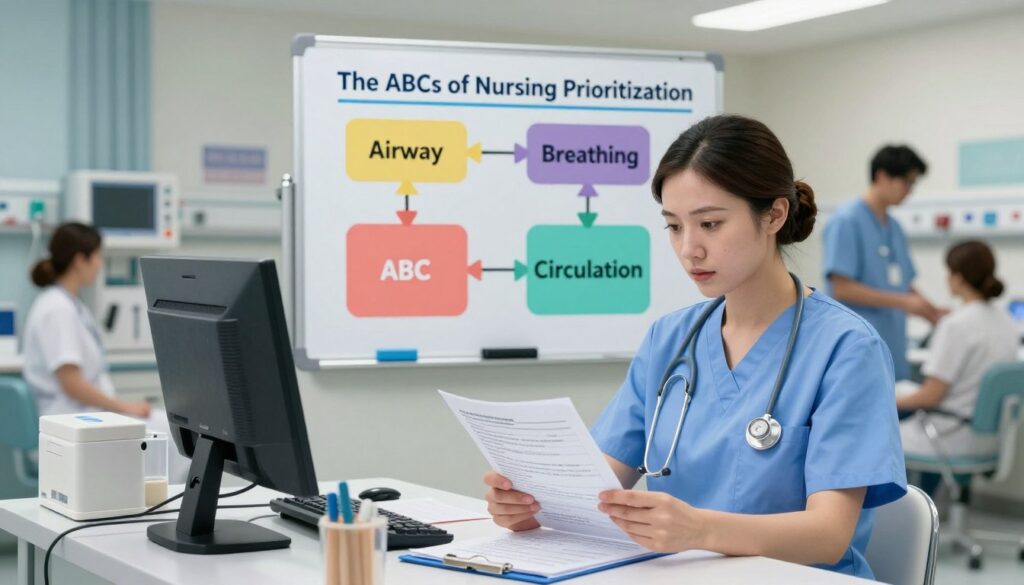
When you face complex clinical scenarios, the ABC framework is your guide. It helps us stabilize patients by tackling the most critical issues first. By mastering these NCLEX prioritization strategies, you can quickly spot who needs your urgent help during exams.
Airway, Breathing, Circulation
The ABC acronym means Airway, Breathing, and Circulation. These are the essential pillars of life. If any of these fail, the patient’s condition can worsen fast, making them a top priority.
First, we check the airway to make sure it’s clear. Then, we look at the breathing to see if oxygen and ventilation are good. Lastly, we focus on circulation by checking heart rate, blood pressure, and organ perfusion to ensure blood flow.
Applying the ABCs to Patient Scenarios
Using this framework means a systematic approach to every clinical question. When you face a scenario, think which option is the most urgent for the patient’s survival. If a patient’s airway is blocked, fix that first, before worrying about pain or education.
Practice these methods often to boost your confidence. For extra help, check out online classes to help you get ready for the cna and improve your clinical skills. Regular practice with these NCLEX prioritization strategies keeps you calm and focused when it counts.
Remember, the ABCs are not just for exams; they’re critical skills for nursing in real life. By focusing on these life-saving functions, you give your patients the safest and most effective care every day.
Maslow’s Hierarchy of Needs in Nursing
Looking for NCLEX prioritization tips? Maslow’s theory is key. It helps us sort patient needs by urgency. We start with the most basic needs first.
Overview of Maslow’s Theory
Maslow’s hierarchy is like a pyramid. The base has the most basic needs. These physiological needs—like air, water, and food—are the top priority for patients.
After these needs are met, we move up the pyramid. Clinical nursing standards show the order:
- Physiological: Needs like breathing, eating, and staying healthy.
- Safety: Needs for physical safety, health, and financial security.
- Love and Belonging: Needs for social connections and family support.
- Esteem: Needs for confidence and respect from others.
- Self-Actualization: Needs to reach one’s full personal growth.
Applying Maslow’s to Prioritization
When you see many right answers on your exam, use this hierarchy. Always put physical survival first to keep patients safe.
“The hierarchy of needs is a powerful tool for nurses to distinguish between what a patient wants and what a patient truly needs to survive.”
For example, if a patient can’t breathe, their need for air is more important than comfort or information. These NCLEX prioritization tips help you know what to do first.
Remember, clinical judgment is critical. The pyramid is a guide, but always think about your patient’s situation before deciding.
Recognizing Urgency vs. Non-Urgency
The difference between passing and failing the NCLEX often comes down to how you sort patient needs. It’s key to spot clinical urgency well. By learning these prioritization techniques for NCLEX, you can handle tough scenarios with ease.

Identifying Life-Threatening Situations
Look for keywords like “first,” “best,” or “initial response.” in exam questions. These hint at life-threatening issues. You need to act fast to fix problems like airway blockages or severe bleeding.
Stuck on these scenarios? Try online classes for experiential learning. They let you practice spotting critical signs. Focus on these high-risk patients to prevent serious problems.
Non-Urgent Patient Concerns
Not all symptoms need urgent action. Some are important for long-term health but aren’t urgent. These include teaching patients, making them comfortable, or managing chronic conditions that aren’t life-threatening.
It’s important to learn to ignore these less urgent issues. If a patient is stable, they’re not as high a priority. This way, you stay focused on those who really need you.
The Role of Safety in Patient Care
Mastering NCLEX prioritization means keeping everyone safe. Safety is the base of good nursing. We make choices that protect patients to get the best results.
Safety as a Priority
When we talk about being great at nursing, we mean stopping errors and dangers. Our main goal is to keep risks low and protect patients from harm. This is key when you’re mastering NCLEX prioritization, as the right answer often means the safest action first.
“Safety is not just a policy; it is a culture that we must embody in every interaction with our patients.”
We check the area for dangers before doing anything. Keeping safety in mind keeps patients safe during their recovery.
Strategies to Enhance Patient Safety
We use certain ways to make care better and safer. Using standard precautions helps fight infections. We also use safety steps to stop falls and other injuries.
Here are important steps for your daily work:
- Always check who the patient is with two different ways.
- Keep the area clean to avoid slips and falls.
- Wash hands well before and after touching patients.
- Make sure call lights are easy for patients to reach.
By doing these things, you’re really mastering NCLEX prioritization. These steps show you know how to keep patients safe in tough situations. Remember, a safe patient can heal better.
Analyzing Patient Data and Situations
The best students treat every question like a puzzle. They look at the whole picture before making a decision. By studying NCLEX prioritization examples, you learn to find important clues that others might miss.
Reviewing Patient History and Current Condition
Start by comparing the patient’s past to their current state. Look for subtle changes in vital signs or mental status. These changes can show a decline more than a single reading.
When reviewing the data, ask if the current findings match the patient’s diagnosis. For example, if a heart failure patient shows lung crackles, that’s a big change. Spotting these patterns is key when studying NCLEX prioritization examples.
Importance of Data in Decision Making
The nursing process starts with a detailed assessment. You need all the information before planning care. Rushing without all the facts can lead to incorrect clinical decisions.
We suggest you slow down and check the facts in the question. By combining the history with the current assessment, you make better choices. Remember, accurate data interpretation is what makes a good nurse great, when dealing with complex NCLEX prioritization examples on your exam.
Utilizing the Nursing Process for Prioritization
When solving clinical problems, a structured approach is key. The nursing process helps you organize your thoughts and plan the right steps. These prioritization techniques for NCLEX make tackling tough exam questions easier.
Assessment, Diagnosis, Planning
The nursing process starts with assessment. This is your top priority. You need to collect all important data first. Skipping this step is not an option, unless the patient is in urgent danger.
After gathering data, you move to diagnosis and planning. Here, you pinpoint health issues and set goals. Effective planning ensures your actions are focused and safe for the patient.
“Clinical judgment is the result of critical thinking and the application of the nursing process to patient care.”
Implementing Nursing Interventions
In the implementation phase, you carry out your planned actions. This is where you apply your prioritization techniques for NCLEX by tackling urgent needs first. Remember, evaluation is the last step to check if your actions were effective.
The table below shows how these steps guide your decision-making during an exam:
| Nursing Step | Primary Focus | Exam Goal |
|---|---|---|
| Assessment | Data Collection | Identify the baseline |
| Diagnosis | Problem Identification | Define the priority |
| Planning | Goal Setting | Determine the outcome |
| Implementation | Action Taking | Execute the intervention |
| Evaluation | Outcome Review | Assess effectiveness |
By following these steps, your care stays systematic and focused on the patient. Learning these prioritization techniques for NCLEX will keep you calm and focused during the exam. Always rely on the process to guide your clinical decisions.
Common NCLEX Prioritization Strategies
Managing a patient load is more than just using your clinical skills. NCLEX prioritization strategies help you organize your work for the whole shift. These methods ensure you give safe and efficient care to all patients.
Top-down Approach
The top-down approach looks at your patient assignment through a hierarchy of need. You start with the most critical needs that need your immediate attention. This way, you focus on the most urgent patients first.
This method helps you avoid getting sidetracked by less important tasks. By using NCLEX prioritization strategies, you manage your time better. You tackle the toughest clinical problems first, keeping you focused.
Delegation and Supervision
Delegation and supervision are key to good nursing management. You need to know the scope of practice for your team to assign tasks safely. You can give routine tasks to others, but you’re always responsible for checking the work.
Good supervision means giving clear instructions and checking the work. When you delegate well, your team works more efficiently. Using NCLEX prioritization strategies shows you can lead a team while keeping patient safety high.
Practice Questions for Mastery
Mastering clinical decision-making needs regular and focused practice. Students who spend time on NCLEX prioritization practice feel better prepared for tough patient scenarios. This practice turns book knowledge into real-world judgment.
Resources for NCLEX Practice
Finding the right tools is key to getting licensed. Use platforms with high-quality question banks that feel like the real exam. These tools let you practice without the stress of the actual test.
Choose programs that explain each answer in detail. Knowing why a choice is right or wrong is essential. This helps you understand the logic needed for safe patient care.
How to Use Practice Questions Effectively
To make the most of your study time, mimic the real exam. Many tests now include “trend items” that track patient changes. Practice these to improve your NCLEX prioritization practice skills.
When faced with these questions, organize the data first. Carefully review the patient’s history, current health, and recent notes. This method helps you avoid missing important details.
After each question set, check how you did. Look for patterns in your mistakes. By consistently improving, you’ll feel more confident on exam day.
Tips for Success on NCLEX Exam Day
Passing the NCLEX needs a mix of clinical knowledge and mental toughness. Your success depends on how you stay focused during the test.
Using good NCLEX prioritization tips helps you tackle tough scenarios with confidence. Practice deep breathing to stay calm during your study time.
Proven Test-Taking Strategies
Read each question carefully to find the main issue before looking at answers. Use a systematic way to rule out wrong options fast. This sharpens your NCLEX skills and keeps you focused during the exam.
Managing Stress for Peak Performance
Getting ready physically is key to your mental clarity. Make sure to get enough sleep the night before at a Pearson VUE testing center. Stay hydrated and eat well to help your brain during the long test.
Believe in the hard work you’ve put into your nursing education. We’re sure you’ll show your skills and start a successful healthcare career.