
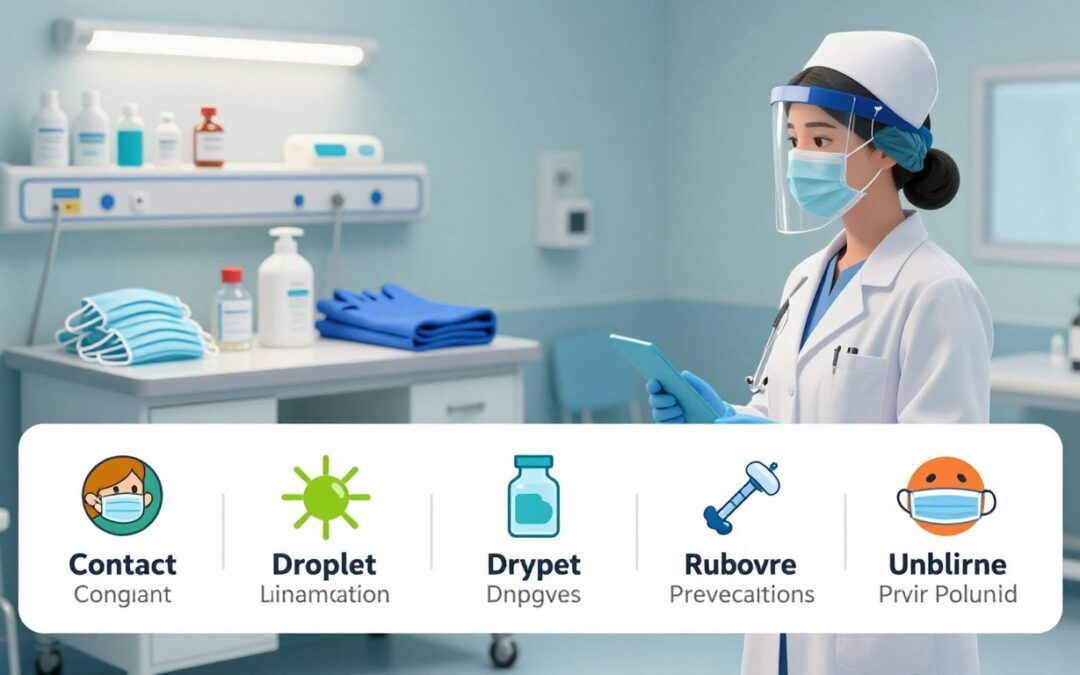
Did you know nearly 1.7 million patients in the U.S. get infections in hospitals every year? This shows how important infection control is for nurses. Learning these safety rules is not just for passing a test. It’s about keeping the people you care for safe.
Many students wonder, How do I remember isolation precautions for NCLEX? The answer is simple. Break down complex rules into easy-to-follow patterns. Organizing them by how infections spread makes learning easier and more effective.
We’re here to make studying easier for you. By using a clear NCLEX review isolation precautions plan, you’ll feel more confident. Let’s make these tough rules your biggest clinical strength.
Key Takeaways
- Infection control is vital for patient safety and exam success.
- Categorizing transmission types simplifies complex clinical guidelines.
- Logical patterns help reduce study stress and improve retention.
- Consistent practice builds confidence in clinical decision-making.
- Mastering these protocols is essential for your nursing career.
Understanding Isolation Precautions
Learning about infection control is key for nurses. We need to know how to keep patients safe in hospitals. This knowledge is the first step.
Standard precautions are the first line of defense. We treat all blood, body fluids, and broken skin as if they could be infectious. This rule helps keep everyone safe in the hospital.
What Are Isolation Precautions?
Isolation precautions are extra steps we take when standard precautions aren’t enough. They help stop the spread of serious infections. These precautions are for patients who might have or are known to have contagious diseases.
When you study for the isolation precautions NCLEX exam, remember these steps are built on top of standard precautions. They are essential for handling equipment, where patients sit, and what protective gear we wear.
Importance of Isolation Precautions
These precautions are more than just exam material. They are life-saving measures that protect patients and healthcare workers from infections.
Following these rules closely helps lower the chance of getting infections in hospitals. Knowing the isolation precautions NCLEX standards helps you give better care. It also keeps you and your team safe.
Categories of Isolation Precautions
Infection control has three main categories of isolation protocols. These are based on how germs spread. Knowing these is key for doing well on the NCLEX exam isolation precautions. By understanding how germs move, we can keep patients and ourselves safe from infections.
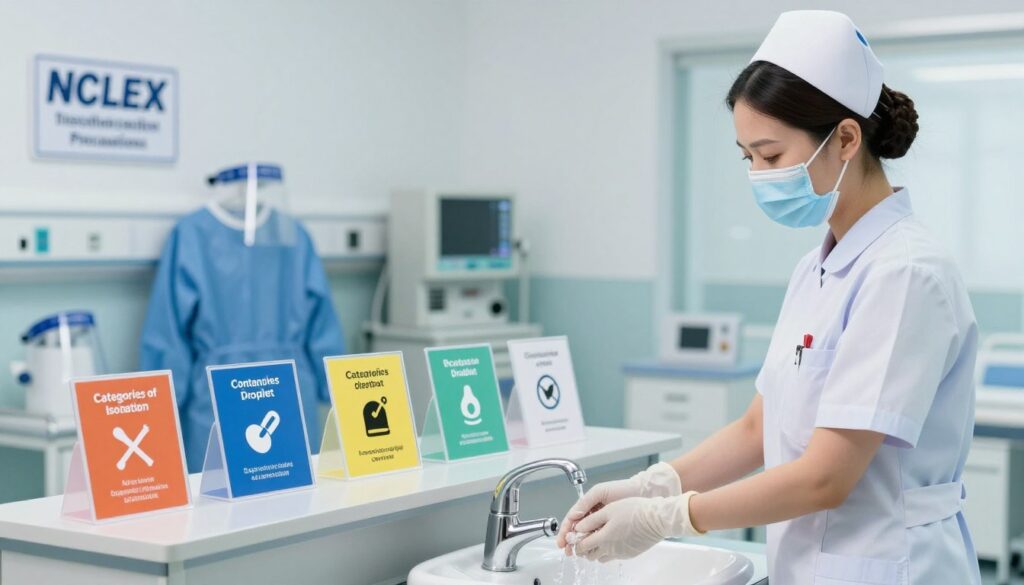
Contact Precautions
Contact precautions aim to stop germs from spreading through touch. We use them for patients with MRSA or C. diff. To prevent bacteria, we wear gloves and gowns when we enter their room.
Droplet Precautions
Droplet precautions are for diseases that spread through big respiratory particles. These particles don’t go far, usually less than three feet. For influenza, mumps, rubella, and pertussis, we use a surgical mask to stay safe.
Airborne Precautions
Airborne precautions are for germs that can travel far when in the air. These tiny particles need special ventilation and strong respiratory protection. We use these for diseases like tuberculosis, measles, and varicella to stop infectious droplets from being breathed in.
| Precaution Type | Transmission Route | Required PPE |
|---|---|---|
| Contact | Direct/Indirect | Gloves, Gown |
| Droplet | Large Particles | Surgical Mask |
| Airborne | Small Particles | N95 Respirator |
It’s important to know these categories for your NCLEX exam isolation precautions prep. By understanding how germs spread, you’ll be more confident in clinical situations.
Key Differences Between Precautions
Understanding the differences between transmission-based precautions is key for passing NCLEX isolation precautions. These categories often blend in real-world settings, but the exam demands clear distinctions. Mastering these differences ensures patient safety and shows you’re ready for nursing.
Contact vs. Droplet
Contact precautions are for infections spread through touch. Droplet precautions target pathogens in respiratory particles within three feet. Contact precautions focus on the patient’s environment, while droplet precautions target the respiratory area.
Stuck on these differences? Useful mnemonics can help. Remember, contact precautions need gowns and gloves, while droplet precautions use surgical masks.
Airborne vs. Droplet
Airborne pathogens are tiny and stay in the air longer, needing special ventilation. Droplet particles are heavier and settle fast, not needing air filtration. This is the main difference.
“Safety in the clinical environment is not just about following rules; it is about understanding the science behind the barrier.”
Understanding the PPE Required
For passing NCLEX isolation precautions, airborne protocols are the strictest. They require an N95 respirator and a negative pressure room. For extra help, look into online classes.
| Precaution Type | Primary PPE | Room Requirement |
|---|---|---|
| Contact | Gown and Gloves | Private Room |
| Droplet | Surgical Mask | Private Room |
| Airborne | N95 Respirator | Negative Pressure |
By focusing on these details, you’ll feel more confident when passing NCLEX isolation precautions. Always check your PPE to protect yourself and patients well.
Remembering Isolation Precautions
Let’s dive into some effective ways to remember isolation precautions for your NCLEX exam. Nursing students often feel overwhelmed by the amount of information needed for safety. By using study tips for NCLEX isolation precautions, you can make complex data easier to remember.
Mnemonics to Assist Memory
A good NCLEX isolation precautions mnemonic is a quick way to recall disease classifications under pressure. These tools help you remember important details when you’re in the exam room.
For droplet precautions, try the SPIDERMAN mnemonic. It helps you remember Sepsis, Pertussis, Influenza, Diphtheria, Epiglottitis, Rubella, Mumps, Adenovirus, and Meningitis. For contact precautions, use MRS WEE to remember Multidrug-resistant organisms, Respiratory infections, Skin infections, Wound infections, Enteric infections, and Eye infections.
- Multidrug-resistant organisms
- Respiratory infections
- Skin infections
- Wound infections
- Enteric infections (like C. diff)
- Eye infections (conjunctivitis)
Using Visual Aids
Visual aids help connect theory to practice. Color-coded charts or diagrams make information easier to organize than plain text.
Make your own posters or digital flashcards with icons for PPE like gowns, gloves, and N95 respirators. Seeing the equipment with each transmission route helps you choose the right answer during the exam.
Engaging in Interactive Learning
Being active in your studies is better than just reading. Join group study sessions to explain these concepts to others.
Use digital apps with interactive quizzes or games. These tools give you instant feedback, helping you correct any mistakes. Staying active and engaged will boost your confidence when you face these topics on the exam.
Practical Applications
Learning by doing is the best way to master infection control. Just knowing the terms is not enough. Applying your knowledge in real situations boosts your confidence for the exam and your career.
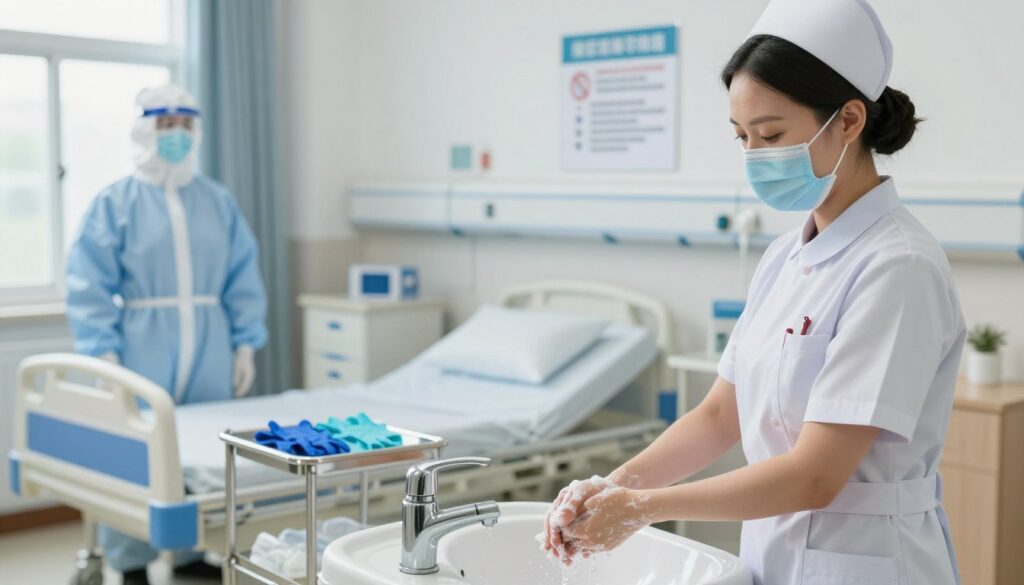
Imagine you’re at the patient’s bedside. This mental picture helps you focus on what to do quickly in a busy hospital.
Clinical Scenarios
A patient with a dry cough and low fever comes to the emergency room. You need to decide if they need airborne or droplet precautions fast.
If it’s tuberculosis, you must use airborne precautions. This means putting the patient in a special room and wearing a mask.
Below is a table to help you match symptoms with the right precautions for safety.
| Patient Symptom | Suspected Condition | Required Precaution |
|---|---|---|
| Severe diarrhea | C. difficile | Contact |
| Sneezing and coughing | Influenza | Droplet |
| Persistent cough | Tuberculosis | Airborne |
| Open wound drainage | MRSA | Contact |
Role-playing Exercises
Role-playing sharpens your critical thinking skills. Acting out scenarios with a partner helps you communicate well and keep safety standards high.
Practice putting on and taking off PPE correctly in a simulated high-pressure situation. Precision is key to avoid contamination.
Remember the steps you take. Ask yourself if you washed your hands before entering and if you removed your gown correctly. These drills make your actions automatic during the exam.
Infection Control Guidelines
Learning about infection control is key to becoming a top nurse. We focus on safety for patients and staff. Following set rules helps us give the best care.
The Role of the CDC
The Centers for Disease Control and Prevention (CDC) leads health safety in the U.S. They offer evidence-based guidelines that are the top standard for medical care. These rules help protect healthcare workers from risks when they interact with patients.
Studying for exams means understanding these guidelines are not just ideas. They are the scientific consensus on stopping disease spread. Knowing these is critical for NCLEX prep.
Hospital Policies
The CDC sets the national rules, but hospitals make their own policies. These policies make sure everyone follows the same safety steps. It’s our job to learn these rules to keep everyone safe.
Hospital policies often match national standards for safety and compliance. By learning these NCLEX infection control precautions, you’re ready for clinical challenges. Remember, following these rules is part of being a nurse.
Common Pitfalls in Isolation Precautions
Understanding isolation precautions can be tricky. Even with a good NCLEX isolation precautions mnemonic, it’s easy to miss important exceptions. These exceptions are key on the exam.
We aim to help you spot these common mistakes. This way, you can feel more confident during your exams. Remember, safe and effective patient care is at stake.
Misunderstanding the Transmission Routes
Many students make a big mistake by not knowing all the exceptions to hygiene rules. For instance, they think alcohol-based hand sanitizer works for everything.
But, Clostridioides difficile (C. diff) needs soap and water for hand cleaning. Alcohol-based sanitizers can’t kill these spores. So, washing hands is a must.
“The greatest danger in times of turbulence is not the turbulence; it is to act with yesterday’s logic.”
Inadequate Use of PPE
Students often get points taken away for not using personal protective equipment (PPE) right. Not following the correct steps can lead to contamination. This messes up the whole isolation effort.
Make sure to practice putting on and taking off PPE until it’s second nature. When you mix these skills with your NCLEX isolation precautions mnemonic, you’ll lower your chance of mistakes. This is true for both clinical rotations and the final exam.
- Always perform hand hygiene before and after removing gloves.
- Ensure your gown is tied securely to prevent exposure.
- Remove your mask last to avoid inhaling pathogens during the doffing process.
Case Studies
We learn a lot from past healthcare challenges. Looking at how facilities handled crises helps us appreciate NCLEX infection control precautions today. These precautions keep our patients safe.
Online classes for experiential learning let us practice these skills safely. This way, we connect theory with real-world hospital situations.
Analyzing Real-Life Scenarios
Small mistakes can cause big problems. Past outbreaks show that not using PPE well spreads diseases.
Healthcare updates its policies because of these lessons. We learn to spot safety breaches early. This is key for NCLEX infection control precautions.
Lessons Learned from Outbreaks
Outbreaks have taught us to improve isolation management. Clear communication and strict guidelines are our best defenses. Every policy change comes from past lessons.
The table below shows how past challenges shaped nursing standards:
| Outbreak Event | Primary Failure | Resulting Policy Change |
|---|---|---|
| Early SARS Crisis | Delayed isolation | Standardized triage protocols |
| MRSA Clusters | Hand hygiene gaps | Mandatory contact precautions |
| Ebola Response | PPE training deficits | Enhanced donning/doffing drills |
These case studies show our actions as nurses matter. Mastering NCLEX infection control precautions is not just for exams. It’s about saving lives.
Preparing for the NCLEX
Preparing for the NCLEX exam isolation precautions can seem daunting. But breaking it down into smaller parts can boost your confidence. Focus on key strategies to grasp these nursing concepts before the test.
Study Tips and Tricks
Using visual flashcards is a great study tip for NCLEX isolation precautions. Create cards that link diseases with the right PPE and room. This helps your brain quickly recall information under pressure.
Active recall is also a strong tool. Try explaining a pathogen’s transmission route out loud. This method strengthens your memory and spots any knowledge gaps in NCLEX exam isolation precautions.
Recommended Study Materials
Adaptive Qbank platforms are a good choice. They give instant feedback and adjust difficulty based on your progress. Regular use of these platforms helps track your improvement.
Also, look for resources with summary tables or flowcharts. These make it easy to see the differences between contact, droplet, and airborne transmission. Staying organized with these study tips for NCLEX isolation precautions will prepare you for any infection control question.
Practice Questions
Testing your knowledge through active recall is a top way to get ready for nursing exams. We’ve put together these scenarios to help you get better at isolation precautions NCLEX standards. This will boost your confidence for the big day.
Sample NCLEX Questions on Isolation
Imagine this: A patient with active tuberculosis (TB) is admitted to the medical-surgical unit. What essential nursing action is needed to keep everyone safe?
- Place the patient in a private room with negative pressure airflow.
- Ensure all staff members wear a standard surgical mask upon entry.
- Limit the patient’s fluid intake to prevent respiratory secretions.
- Use contact precautions for all physical assessments.
This question tests your ability to pick the right transmission-based precaution. Knowing these details is key to your NCLEX review isolation precautions strategy.
Discussion on Answer Choices
The right answer is option 1. Patients with active TB need airborne precautions. This means they should be in a room with negative pressure and healthcare workers should wear N95 respirators.
Option 2 is wrong because a standard surgical mask can’t block the small TB particles. Option 3 is not related to infection control. And option 4 is the wrong type of precaution altogether.
| Condition | Precaution Type | Key PPE Requirement |
|---|---|---|
| Tuberculosis | Airborne | N95 Respirator |
| Influenza | Droplet | Surgical Mask |
| MRSA | Contact | Gloves and Gown |
| Varicella | Airborne/Contact | N95 and Gown/Gloves |
Knowing these differences helps you avoid mistakes during the exam. Always choose the right intervention based on the specific transmission route.
Resources for Further Learning
Building a strong library of study materials is key to understanding patient safety. Your main textbooks give you a good start. But, looking into more resources helps you dive deeper into infection control. It’s important to find materials that fit your learning style.
Books and Online Courses
Quality supplemental materials can really help you remember isolation protocols. Many find that interactive platforms make complex ideas clearer. For structured learning, check out online classes to help you get ready for the NCLEX-RN, focusing on infection control.
Specialized nursing review books are also great. They often have detailed illustrations of PPE use. These visuals are perfect for quick reviews before work. Make sure to pick resources that update often to keep your knowledge current.
Official Guidelines and Websites
Keeping up with the latest clinical standards is important for healthcare pros. The Centers for Disease Control and Prevention (CDC) website is the top source for isolation guidelines in the U.S. Bookmark their pages on transmission-based precautions for authoritative information at any time.
Professional nursing organizations also offer valuable resources. They publish newsletters and webinars that simplify policy changes. Using these official sources keeps your knowledge up-to-date and accurate. Regularly checking these sites will boost your confidence as you prepare for your career.
| Resource Type | Primary Benefit | Best For |
|---|---|---|
| Review Books | In-depth theory | Conceptual understanding |
| Online Courses | Interactive practice | Exam preparation |
| Official Websites | Latest guidelines | Clinical accuracy |
| Nursing Journals | Evidence-based research | Advanced learning |
Conclusion
You now have the tools to handle complex clinical settings with ease. By using these mnemonics and PPE protocols in your studies, you build a strong foundation for patient safety.
Reviewing Essential Strategies
We covered the key elements of infection control to help you succeed. You learned how to sort out transmission routes and use the correct protective gear for every patient interaction. These habits are key for passing NCLEX isolation precautions with confidence.
Your Path to Success
Consistency is the key to your growth. We suggest you go back to these concepts often as you get ready for your exams. You might wonder, how do I remember isolation precautions for NCLEX? The answer is in practicing and applying these rules to real-life situations.
Your hard work in learning these standards shows your dedication to quality nursing care. We believe in your ability to do well on your upcoming tests. Keep moving forward as you strive for your professional goals.