

Did you know nearly 15% of nursing graduates feel unprepared on exam day? A tight deadline can be daunting, but we can make a structured emergency plan. Instead of memorizing every textbook page, we’ll focus on key content and smart testing.
This method helps us tackle our weak spots efficiently. We suggest using trusted NCLEX study tools to feel confident on test day. This guide is our detailed plan to success, teaching us vital test-taking strategies without exhaustion.
Key Takeaways
- Prioritize high-yield topics over rote memorization to maximize limited time.
- Complete 75 to 200 practice questions daily to build testing stamina.
- Review rationales for every question, regardless of whether the answer was correct.
- Maintain physical health through sleep and exercise to manage pre-exam anxiety.
- Use reliable platforms to simulate the actual testing environment effectively.
Understand the NCLEX Exam Structure
Success on the NCLEX starts with knowing the exam’s structure and environment. It’s a computer adaptive test, meaning questions get harder or easier based on our answers. Learning these NCLEX exam techniques helps us tackle each question with confidence.
Key Areas of Focus
The exam focuses on four main client needs categories. We need to study hard for Safe and Effective Care Environment and Physiological Integrity. These are the heart of nursing.
Don’t forget about Health Promotion and Maintenance and Psychosocial Integrity. Reviewing all these areas helps us understand nursing fully. This method is a key NCLEX test-taking strategy.
Types of Questions
The NCLEX has more than just multiple-choice questions. We’ll see “Select All That Apply” (SATA), fill-in-the-blank, and ordered response items. Knowing these formats helps us feel prepared.
Scoring Mechanism
It’s important to understand how the computer scores our answers. The system checks if we’re consistently above the passing standard. Learning this helps us focus on what really matters.
Every correct answer makes the next question harder. If we stay calm and use our NCLEX test-taking strategies, we show our skills well. This way, we can handle the test’s adaptive nature confidently.
Create a Study Schedule
We can make our last two weeks of prep better by following a strict plan. A detailed NCLEX study plan helps us cover all needed material without feeling too much stress. This way, we can tackle tough nursing topics with confidence.
Daily Goals
To use our time wisely, we need to set clear goals for each day. We focus on our “Red Zones,” where we scored low. This ensures we’re tackling our weaknesses head-on.
Having daily goals keeps us on track and stops us from getting sidetracked. If we struggle with certain topics, online classes can help. They offer extra support for a strong NCLEX study schedule.
Time Allocation per Subject
Our strategy balances reviewing content with practicing questions. We spend time reading, then answering questions to solidify our learning. This way, we apply what we know to real nursing situations.
We aim to spend sixty percent of our time on practice questions and forty percent on content review. This mix helps us learn to think like a nurse. Sticking to a daily routine helps us remember better during this busy time.
Incorporating Breaks
Even the most focused students need breaks to avoid burnout. We’ll take short breaks often to keep our minds sharp. These breaks are key to staying focused all day.
Good NCLEX cramming strategies focus on quality over quantity. Taking ten-minute breaks every hour lets our brains process information. Remember, rest is just as important as study when aiming for a big milestone.
Utilize NCLEX Review Books
We have only two weeks to prepare for the NCLEX. So, we need to pick the best resources. We should focus on NCLEX preparation tips that help us understand deeply, not just memorize.
Recommended Texts
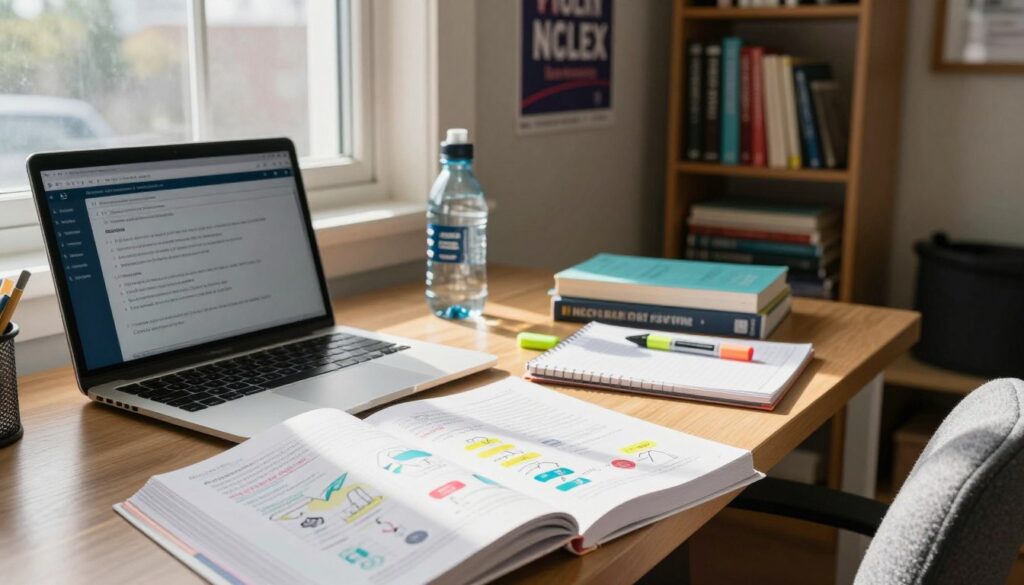
Looking for NCLEX study materials means finding books known for their accuracy and depth. The Saunders and Lippincott Q&A Reviews are great for our study sessions.
While studying nursing, we can also check out online courses for the USMLE. These courses use similar teaching methods to help us learn medical concepts fast.
Features to Look For
A good NCLEX study guide should offer more than questions. It should have clear, detailed rationales for each answer, right or wrong.
Look for books with these features:
- Clinical reasoning: Choose books that teach applying knowledge to real patients.
- Application-based questions: Make sure the questions require the same critical thinking as the exam.
- Nursing implications: Find summaries that explain why certain nursing actions are important.
By picking books that focus on these areas, we make the most of our time. We build the analytical skills needed to pass the exam confidently.
Explore Online Resources
Online platforms are the best way to learn nursing concepts when time is tight. They help us improve our clinical skills and get ready for the exam. By using top-notch NCLEX study resources every day, we can study anywhere.
Comprehensive Review Courses
Structured review courses guide us through a lot of information. They break down hard topics into easy-to-manage parts. This is great for a quick study period. You might want to check out online classes to help you prepare.
Consistency is key when using these platforms. To make the most of our time, focus on these features:
- Adaptive learning technology that finds our knowledge gaps.
- Short video lectures that cover important nursing topics.
- Downloadable summary sheets for quick review.
Practice Question Banks
Using strong question banks is the best way to apply what we know. These NCLEX study materials explain each answer in detail. This lets us learn from our mistakes right away. Look for platforms with NGN-style case studies to practice clinical judgment.
Tracking our progress keeps us motivated and focused. By looking at our performance, we can adjust our study plan. This ensures our last days of studying are as effective as possible.
Join Study Groups
When we face a two-week deadline, working with others is key to success. Sharing our knowledge with peers helps us grasp complex nursing concepts fast. Together, we build a support system that keeps us driven during this intense study time.

Benefits of Collaborative Learning
Collaborative learning brings unique benefits that solo study can’t match. Explaining a concept to a peer helps us organize our thoughts better. This makes us realize what we don’t know, which is incredibly effective for mastering tough topics.
- Increased Accountability: Group meetings keep us on track.
- Diverse Perspectives: We learn different ways to tackle clinical scenarios.
- Refined Clinical Judgment: Talking about patient care sharpens our critical thinking skills.
Finding the Right Group
To maximize our time, we need to pick our study partners carefully. Look for peers who are just as dedicated to the two-week goal and stay positive. It’s also good to find people who are good at balancing work and online learning to handle the tight schedule well.
After we form our group, we should focus on key topics. Prioritizing and delegating are often tested on the NCLEX. By teaching each other, we improve our ability to make quick, safe decisions.
Practice with Sample Questions
Getting ready for the NCLEX means treating every practice question as a chance to learn. We should not just memorize; we need to apply our nursing knowledge to real-life situations. By doing lots of questions, we get better at thinking critically and get ready for the test.
Importance of Question Variety
The exam now has many types of questions, including the new Next Generation NCLEX (NGN) items. We must try different question styles to be ready for the test. This way, we learn to think clearly in various clinical situations.
Just picking the right answer is not enough. We must thoroughly review every rationale to grasp the thinking behind it. This habit helps us learn from mistakes and improve our clinical judgment.
- Analyze the rationale: Understand why the correct answer is right and why the others are wrong.
- Identify patterns: Recognize recurring themes in how questions are structured.
- Diversify topics: Ensure we cover all client need categories to avoid knowledge gaps.
Timing Your Responses
Learning to manage time well is key before the test. By timing our answers during practice, we get used to the test’s pressure. This helps us pace ourselves and not rush through hard questions.
We should keep a steady pace without losing accuracy. If a question takes too long, we must make a quick choice and move on. Disciplined practice builds the mental strength to stay focused during the whole test.
Take Care of Your Health
To do our best, we must treat our health as a key part of our study plan. While we learn tough medical stuff, we can’t forget our own bodies. Setting clear study times helps avoid exhaustion and boosts our test day performance.
Nutrition Tips for Studying
What we eat affects our brain and energy during long study times. We should eat nutrient-dense foods for lasting energy, not quick sugar highs. Drinking enough water is also key, as dehydration can hurt our focus and memory.
Here are some daily habits to try:
- Eat complex carbs like oatmeal or whole grains for steady energy.
- Add healthy fats like walnuts or avocados for brain health.
- Keep water close to stay hydrated all day.
- Avoid heavy, processed foods that make us tired and foggy.
Looking for more structure? Check out online classes to help you get ready for the cna. They stress the need for a balanced lifestyle and good nutrition to stay calm and focused.
Importance of Sleep
Sleep helps our brains solidify what we’ve learned. We need a consistent sleep schedule, even when we feel like cramming. Sleeping less to study more actually hurts our ability to learn new things.
We aim for seven to nine hours of sleep each night. This keeps our minds sharp for the next day. Remember, a well-rested brain is our greatest asset when we take the exam.
Review & Revise Key Concepts
Mastering complex nursing ideas is key to acing the exam. We can’t just read our textbooks passively. We must actively learn to really get it. This way, we make the most of our NCLEX study guide as we near the end of our prep.
Focus on Weak Areas
We should spend our last days on topics that stump us. Subjects like pharmacology and infection control are vital. Spotting our weak spots early lets us turn them into strengths.
Instead of just glancing over familiar stuff, we’ll use active recall. We’ll test our memory with questions on drug types or isolation rules. This focused review helps us feel sure about our knowledge when we sit for the exam.
Flashcards and Summary Sheets
Condensing our notes into brief formats makes reviewing quicker and more effective. Summary sheets help us break down big info into easy-to-digest points. These tools are key parts of a top-notch NCLEX study guide.
Here are some tips for our last review:
- Create digital or physical flashcards for key meds and lab values.
- Summarize complex disease processes into simple flowcharts or diagrams.
- Review our weakest topics daily to keep the info fresh.
- Teach the concept to a peer to check our own understanding.
By regularly going over these materials, we build our confidence in nursing basics. This careful review is the last step in getting ready for what’s next.
Take Full-Length Practice Exams
Full-length practice tests are the best way to get ready for the real exam. They help us build the mental strength needed to pass. Using top-notch NCLEX study resources lets us see how well we know the material under real test conditions.
Importance of Simulating Test Conditions
To get the most out of our practice, we need to create a test-like environment. This means finding a quiet spot, turning off our phones, and sticking to the exam’s full length. Consistency is key to keep our focus for hours.
It’s also important to follow the official break schedule. For more tips on studying, check out online classes to help you prepare for the pharmacy tech certification. These tips can help with any high-stakes exam.
Analyzing Your Performance
After the exam, we dive into our results. We look for areas where we struggled the most. By checking our wrong answers, we can improve our studying with NCLEX study resources.
This cycle of testing and reviewing helps our study plan grow with us. We should keep track of our scores to see how far we’ve come. The table below shows how to categorize our performance to focus better.
| Evaluation Metric | Focus Area | Action Required |
|---|---|---|
| High Error Rate | Core Nursing Concepts | Review textbooks and lecture notes |
| Time Management | Question Pacing | Practice with timed drills |
| Low Confidence | Complex Clinical Scenarios | Use interactive NCLEX study resources |
| Consistent Success | Mastered Topics | Brief review to maintain knowledge |
Stay Calm and Confident
Mastering the mental game is as important as learning clinical facts. We’ve followed a strict NCLEX study plan. Now, we must trust our hard work.
When we think about studying for the NCLEX in 2 weeks, our mindset is key. We manage stress by focusing on our breathing and keeping our goals in mind.
Managing Test Day Nerves
We use proven strategies to stay calm during the exam. We imagine ourselves reading each question carefully and choosing the right answer. This builds our mental strength for the test.
Our dedication to these tips keeps us steady under pressure. Our NCLEX study schedule helps us stay organized, even when time is short.
Visualizing Success
We imagine ourselves leaving the testing center feeling accomplished. This positive thinking helps us use our NCLEX exam techniques well during the test.
We’ve worked hard for these strategies. We’re ready to show our skills and start our nursing careers.