
Did you know nearly 20% of the NCLEX-RN exam is about physiological adaptation and safety? A big part of this is pediatric care. Preparing for this area can feel overwhelming. But, we can make it simpler by focusing on key content.
By learning about developmental milestones and safety, we can feel less anxious on test day.
To do well, we need to use our study time wisely. A free pediatric nursing study guide helps us focus on common scenarios. This includes things like congenital heart defects and respiratory distress. Consistency is key in improving our clinical judgment through practice.
If you need more help, think about joining online classes to help you get ready for the NCLEX-RN. These classes give us the tools to quickly learn complex ideas. With the right strategy, we can tackle these questions with confidence and become licensed nurses.
Key Takeaways
- Focus on high-yield topics like developmental milestones and safety interventions.
- Use a structured study guide to identify and review common pediatric conditions.
- Prioritize understanding age-specific assessments to improve clinical judgment.
- Incorporate practice questions to reinforce knowledge of rapid deterioration signs.
- Leverage online prep courses to gain confidence and master testing strategies.
Understand the NCLEX-PN and NCLEX-RN Structure
If you’re wondering, “How do I study pediatrics for NCLEX fast?”, start by understanding your exam. The NCLEX-PN and NCLEX-RN both cover pediatric care. But they test your skills in different ways.
Pediatric nursing needs specialized knowledge. Nurses must adapt care to meet the needs of different ages. This ensures the best outcomes for patients.
Key Differences in Exam Types
The main difference is in how each exam assesses you. The PN exam tests your ability to apply what you know. The RN exam looks at your ability to analyze and coordinate care.
| Feature | NCLEX-PN Focus | NCLEX-RN Focus |
|---|---|---|
| Scope of Practice | Data collection and implementation | Assessment and complex planning |
| Pediatric Depth | Basic safety and common conditions | Pathophysiology and delegation |
| Clinical Judgment | Following the nursing process | Analyzing and prioritizing care |
Understanding Pediatric Content Areas
To study effectively, organize your review by age group. Infants, toddlers, school-age kids, and teens all react differently to illness and medicine.
Focus on safety protocols like correct medication dosing and age-appropriate communication. Understanding these early helps solidify your study plan.
Prioritize Pediatric Topics for Study
Success on the exam often depends on how well we prioritize high-yield pediatric content. By focusing our energy on the most frequently tested areas, we can achieve efficient pediatrics NCLEX prep without feeling overwhelmed by the sheer volume of information.
We do not need to memorize every minor detail to succeed. Instead, we should learn to distinguish between normal physiological findings and those that indicate a possible health crisis.
Common Pediatric Conditions
Many pediatrics NCLEX exam tips emphasize the importance of understanding acute respiratory and cardiac conditions. These topics appear frequently because they require nurses to act quickly and accurately in high-pressure situations.
We should prioritize studying conditions like asthma, bronchiolitis, and congenital heart defects. Recognizing the early signs of respiratory distress is a critical skill that will serve us well during the exam.

“The art of nursing is to provide care that is both scientifically sound and deeply compassionate, specially when treating our youngest patients.”
Growth and Development Milestones
Growth and development milestones are high-yield content that we must master. These stages provide a framework for assessing whether a child is meeting age-appropriate expectations.
We should focus on the major theories, such as Erikson’s stages of psychosocial development and Piaget’s cognitive stages. Understanding these concepts helps us identify when a child’s progress might be delayed or abnormal.
By keeping these milestones in mind, we can answer questions about safety, nutrition, and play with much greater confidence. This targeted approach is the foundation of efficient pediatrics NCLEX prep and will help us feel prepared on test day.
Remember that applying these pediatrics NCLEX exam tips consistently will make our study sessions more productive. We are building the knowledge base necessary to provide safe and effective care to pediatric patients.
Use Visual Aids and Resources
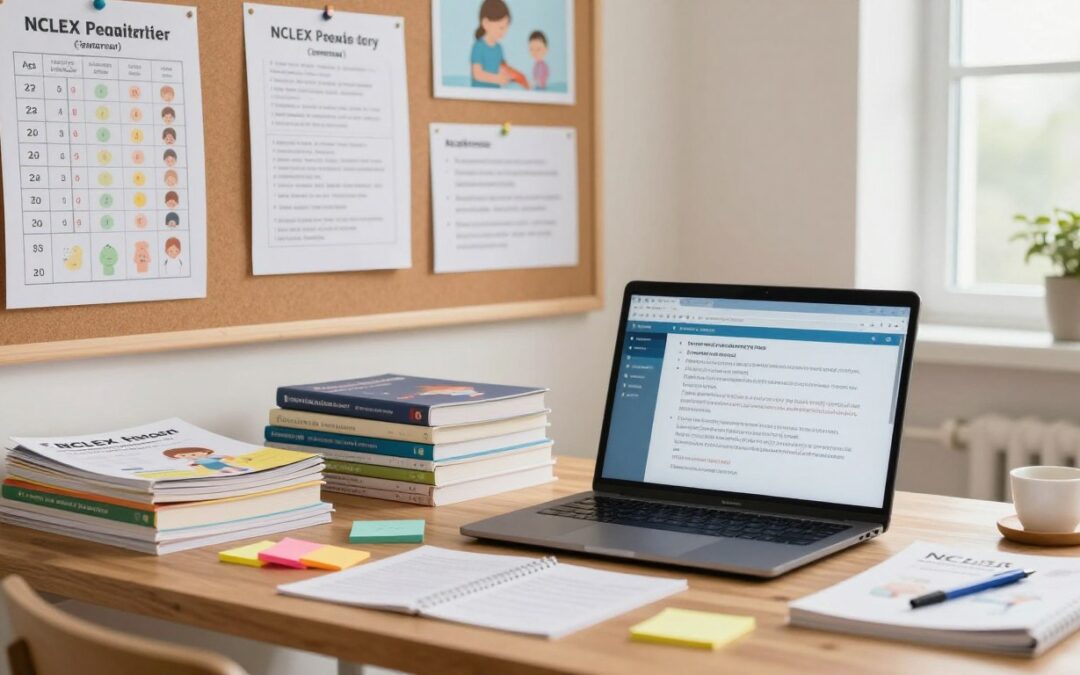
Learning pediatric nursing is more than just reading books. It needs a visual approach. Using pediatric nursing study strategies with images helps us understand how to care for different age groups. This way, we can connect what we learn to real patient care.
Pediatric Charts and Diagrams
Visual aids are key because pediatric nurses must adjust their communication based on a child’s age. Color-coded charts for immunizations or growth percentiles make learning easier. Seeing the differences between a toddler and an adolescent helps our fast track pediatrics NCLEX study work better.
Creating your own flowcharts for heart defects or respiratory distress is helpful. Seeing how a condition progresses helps us quickly spot important nursing tasks. This way, we learn by understanding, not just memorizing.
Recommended Textbooks and Online Resources
Choosing the right materials is important. Look for resources with online classes for real-life learning and case studies. These offer a more realistic view than textbooks can.
We’ve made a list of resources for a fast track pediatrics NCLEX study plan. These tools will help you stay focused and efficient in your studies.
| Resource Type | Primary Benefit | Best For |
|---|---|---|
| Visual Flashcards | Quick Recall | Developmental Milestones |
| Clinical Case Studies | Critical Thinking | Complex Pathophysiology |
| Pediatric Nursing Apps | On-the-go Review | Medication Calculations |
| Interactive Diagrams | Conceptual Clarity | Anatomical Differences |
Create a Study Schedule
Creating a study schedule helps us tackle pediatric content one step at a time. It’s important to quickly spot problems in pediatric care. By focusing on high-priority topics, we boost our confidence for the NCLEX.

Allocating Time for Each Topic
Our study time should match the needs of children. Breaking down complex topics into smaller parts helps avoid burnout. Using an organized study calendar keeps us on track.
“Success is the sum of small efforts, repeated day in and day out.”
Here’s a suggested plan for our study time:
- Respiratory and Cardiac: 30% of study time due to high-risk decompensation.
- Growth and Development: 25% of study time for milestones.
- Gastrointestinal and Renal: 25% of study time for fluid management.
- Pharmacology and Safety: 20% of study time for dosage calculations.
Incorporating Practice Questions
Active testing is key for retaining information. We can do a quick pediatrics NCLEX review by answering five to ten questions right after learning a new topic. This helps us spot gaps in our knowledge early.
Staying consistent is essential for mastering these topics. By making quick pediatrics NCLEX review a daily habit, we stay sharp. Remember, quick recognition of changes in a child’s condition is critical, and regular practice sharpens our intuition.
Engage in Active Learning Techniques
Active learning changes how we handle complex clinical info for exams. It moves us from just reading to fast track pediatrics NCLEX study and better retention. This method makes our brains work harder, leading to a deeper grasp of pediatric nursing.
Flashcards for Key Terms
Flashcards are a fantastic tool for learning developmental knowledge and key NCLEX tips. They help us master important terms, like immunization schedules and safety rules for different ages. By testing ourselves often, we spot knowledge gaps early, avoiding them on test day.
Organizing our flashcards by body system or developmental stage is key. This helps us link related ideas, making recall easier during exams. Using these effective pediatric NCLEX study methods helps us learn to apply what we know, not just memorize it.
Group Study Sessions
Group study sessions offer new views on tough pediatric cases. Explaining a complex topic to a friend strengthens our own grasp of it. It’s a great way to test our clinical thinking and see how others tackle similar issues.
Discussing case studies in groups prepares us for the dynamic exam. It sharpens our communication and critical thinking. By working together, we fast track pediatrics NCLEX study and gain the confidence to excel in nursing.
Focus on Practice Questions
Mastering pediatric nursing is more than just reading books. It requires regular practice with questions. This helps us find areas where we need to improve and boosts our clinical skills. It’s key for a quick pediatrics NCLEX review that really works.
Source Quality NCLEX Practice Questions
Choose platforms with high-quality, realistic exam questions. For example, Archer Review has a huge question bank. It lets us apply complex pediatric concepts to real patient care. This is a great way for rapid pediatrics NCLEX learning.
It’s important to review the reasons behind each question, even if we get it wrong. Knowing why an answer is correct helps us think critically. This way, we learn the material deeply, not just memorize it.
Time Yourself When Practicing
Timing ourselves is a big part of rapid pediatrics NCLEX learning. It helps us manage our time well, just like the real test. This way, we don’t get stuck on one question for too long.
Try setting a timer for each question set. This keeps us focused and calm. Regular timing is a key part of a successful quick pediatrics NCLEX review plan.
| Practice Method | Primary Benefit | Recommended Frequency |
|---|---|---|
| Timed Question Blocks | Improves pacing skills | Daily |
| Rationale Review | Deepens clinical logic | After every session |
| Scenario Simulation | Reduces exam anxiety | Weekly |
Utilize Pediatric NCLEX Review Courses
When we feel overwhelmed by the vast amount of pediatric information, turning to professional review courses can be a game-changer. Relying on disorganized NCLEX pediatrics cramming techniques often leads to burnout and gaps in our clinical knowledge. Instead, we can choose a path that provides a clear roadmap for our success.
Online and In-Person Options
We have several choices when selecting a review program that fits our personal lifestyle. Online courses offer unmatched flexibility, allowing us to study at our own pace from the comfort of our homes. These platforms often feature interactive modules that keep us engaged throughout the process.
In-person classes provide a different set of advantages, such as direct access to instructors and peer support. Being in a classroom environment can help us stay disciplined and focused on our goals. Both formats represent effective pediatric NCLEX study methods that help us organize our preparation time efficiently.
Benefits of Structured Learning
Structured learning provides us with a clear, logical progression through the material. Instead of jumping between random topics, we follow a curriculum designed to build our confidence step by step. This approach ensures we cover critical areas like pediatric growth, development, and family-centered care.
Quality review courses emphasize the core pillars of pediatric nursing, which include:
- Empathy and Communication: Learning how to interact effectively with both children and their families.
- Therapeutic Play: Understanding how to use play as a tool for assessment and treatment.
- Family Involvement: Recognizing the vital role that caregivers play in the healing process.
By investing in a professional course, we gain access to expert guidance that simplifies the most challenging topics. We avoid the pitfalls of ineffective NCLEX pediatrics cramming techniques by focusing on high-yield content. Ultimately, these programs serve as one of the most effective pediatric NCLEX study methods available to us today.
Review the Latest Pediatric Guidelines
It’s key to keep up with new medical standards for our exams. When we do rapid pediatrics NCLEX learning, our knowledge must be current. Questions often ask us to apply new care standards to real-life situations.
American Academy of Pediatrics Recommendations
The American Academy of Pediatrics (AAP) updates its guidelines often. These updates are the gold standard for pediatric nursing. Keeping up with these changes ensures we give safe and effective care.
Knowing the latest vaccination schedules is a must for our exams. We need to know the right ages for doses and when to avoid them. Regular review of these guidelines helps us answer questions correctly.
Updates on Pediatric Medications
Medication safety is a big part of our nursing training. Always check for patient allergies before giving new meds. Also, have epinephrine ready when giving vaccines, as it’s a key safety step for allergic reactions.
Using good NCLEX pediatrics cramming techniques means focusing on these safety steps. Learning the right ways to give meds helps us answer drug safety questions with confidence. Here’s a table with important safety tips to remember during study time.
| Safety Protocol | Primary Action | Clinical Importance |
|---|---|---|
| Allergy Screening | Verify before every dose | Prevents adverse reactions |
| Vaccine Safety | Keep epinephrine nearby | Manages anaphylaxis risk |
| Dosage Accuracy | Double-check weight-based math | Ensures therapeutic efficacy |
| Patient ID | Use two unique identifiers | Prevents medication errors |
Take Care of Your Well-Being
Passing the nursing boards is more than just memorizing facts. We must take care of our bodies to keep our minds sharp during the test.
Good NCLEX pediatrics cramming techniques don’t work if we’re tired. Getting enough sleep, staying hydrated, and eating well are key to our brain power.
Maintaining Physical Health
Rest is a key part of our study plan. Skipping sleep can make us forget things and feel more anxious.
Drinking water keeps our brains working well during long study times. Eating healthy meals helps us stay focused, not just caffeine or sugar.
Managing Exam Stress
Studying for the exam can be very stressful. Deep breathing or short walks can help when we feel overwhelmed.
Staying calm helps us use what we know. We stay confident by balancing study time with breaks. Taking care of our health means we’re ready for the exam.