

Ever thought if your clinical instincts are enough for the licensure exam? Or if more protection is needed for your future patients? We think patient well-being is the core of professional nursing in the U.S.
Learning these protocols is more than just passing a test. It’s about making a lifelong commitment to excellence. By focusing on these standards, we make sure every action in a clinical setting reduces harm and boosts recovery.
To do well, you need to understand the basics of high-quality care. You can check out NCLEX fundamentals ensuring patient safety and NCLEX focus areas. This helps align your study with these key requirements. Showing you know these guidelines well is a big step towards your career success.
Key Takeaways
- Patient protection is the primary responsibility of every nurse.
- Clinical judgment relies heavily on your grasp of risk reduction.
- Standardized protocols form the basis of all high-quality care.
- Mastering these concepts directly impacts your licensure exam results.
- Effective communication remains a top priority for preventing medical errors.
Understanding NCLEX and Its Role in Nursing
Before you start working in a clinical setting, you need to understand the NCLEX exam. It’s the last test you must pass to show you’re ready to give top-notch care. Knowing the NCLEX safety importance is key for anyone aiming to do well in their nursing career.
What is the NCLEX?
The National Council Licensure Examination, or NCLEX, is a test used by nursing boards in the U.S. It checks if you have the basic knowledge and skills for safe nursing. You can find online classes to help you prepare for the CNA and other nursing certifications.
“The core of nursing is not just the task, but the judgment behind it.”
Purpose of the NCLEX Examination
The main goal of the NCLEX is to make sure only qualified people get a nursing license. It tests your ability to make smart decisions in real-life situations. The exam focuses on critical thinking to see how you prioritize patient care in different settings.
The NCLEX safety importance comes from its ability to mimic the tough decisions nurses make every day. It moves you from just memorizing facts to making decisions based on evidence. This change is essential for keeping patient care at a high level.
Types of NCLEX Exams
There are two main types of NCLEX exams, each for a different level of nursing. Knowing which one you need is the first step in getting ready.
- NCLEX-RN: For those aiming to be Registered Nurses.
- NCLEX-PN: For those looking to become Practical or Vocational Nurses.
Both exams focus on the NCLEX safety importance by checking your risk awareness. Whether you’re an RN or a PN, your main job is to keep patients safe by making informed decisions.
The Importance of Safety in Nursing Practice
Safety is at the heart of nursing. Every action we take helps our patients get better. By following NCLEX safety guidelines, we make sure our care is consistent and effective.
Defining Safety in Healthcare
Patient safety means minimizing risks and preventing harm. It’s about making sure our care leads to the best outcomes. We focus on spotting hazards before they harm our patients.
This goes beyond just doing tasks. It’s about the whole environment we work in. Clean equipment and clear communication build trust with our patients.
Historical Context of Safety in Nursing
Healthcare has changed a lot, moving toward transparency and error prevention. Nursing used to just focus on completing tasks. Now, we focus on systematic safety measures.
Learning from past mistakes helps us improve. By understanding why NCLEX safety guidelines were made, we stay up to date and vigilant.
Why Safety is a Nursing Priority
Safety is our number one priority. It keeps our patients safe from avoidable problems. It also protects us and our colleagues from the effects of medical errors.
Consistency is key for a safe environment. Making safety a daily habit keeps our practice high-quality and ethical. Our commitment to safety defines our success as nurses.
How Safety is Assessed on the NCLEX
It’s important to know how the exam checks if you can keep patients safe. The board of nursing makes the test to see if you can follow NCLEX safety guidelines in real situations. The exam tests how you make decisions when there are risks.
Categories of Questions Related to Safety
The exam groups safety questions under big topics like Management of Care and Safety and Infection Control. You’ll get questions that check if you know NCLEX safety guidelines. These questions make sure you can keep a safe place for everyone.
Strategies for Tackling Safety Questions
When you get tough questions, think about how to lower risks. Show you can give tasks to the right people based on their job. Also, think about the legal and ethical sides of your actions to stay out of trouble.
Use a step-by-step method to find the most important safety needs. By following NCLEX safety precautions, you can stop problems before they get worse. Always choose the answer that keeps the patient safe first.
Real-World Scenarios and Case Studies
The exam often uses stories that are like real hospital problems. Doing experiential learning simulations helps you practice making big decisions in a safe way. These stories make you use all your knowledge to give the best care.
| Safety Focus Area | Primary Objective | Key Competency |
|---|---|---|
| Delegation | Task Assignment | Scope of Practice |
| Risk Reduction | Hazard Mitigation | Clinical Judgment |
| Legal/Ethical | Patient Advocacy | Professional Standards |
Top Safety Topics Tested on the NCLEX
Understanding clinical safety can seem daunting at first. But, it’s key to your success. By learning NCLEX exam safety protocols, you’re ready to give top-notch care anywhere.
Infection Control Procedures
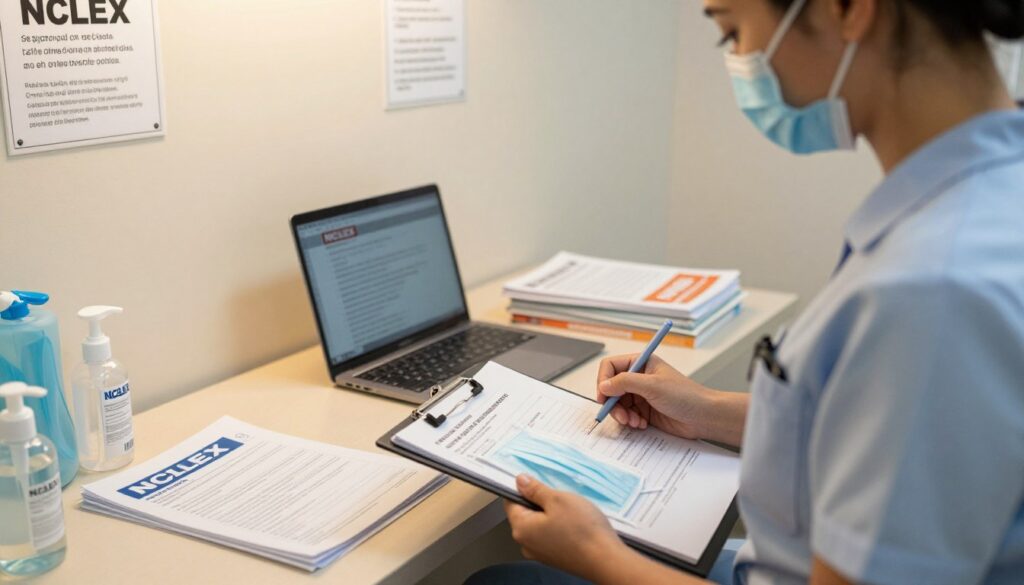
Infection control is vital in nursing. Did you know hand hygiene can cut illness spread by 40%? Always washing your hands is a simple yet powerful way to keep patients safe.
Knowing how to put on and take off personal protective equipment (PPE) is also critical. Remember, remove gloves first, then your gown, to avoid spreading germs. These NCLEX safety precautions are tested to make sure you can keep environments clean.
Medication Administration and Errors
Medication safety is a big deal. Focus on the “rights” of medication, like the patient, drug, and dosage. It’s not just about rules; it’s about caring for your patient.
Patient Fall Prevention Strategies
Falls are a big worry in healthcare. Check a patient’s mobility and use assistive devices if needed. Make sure call lights are easy to reach and beds are low to prevent falls.
Emergency Response Protocols
In emergencies, acting fast is key. Know the chain of command and specific protocols for emergencies. Stay calm and follow your facility’s guidelines to handle tough situations well.
| Safety Category | Primary Goal | Key Action |
|---|---|---|
| Infection Control | Reduce Transmission | Hand Hygiene |
| Medication Safety | Prevent Errors | Double-Check Rights |
| Fall Prevention | Patient Safety | Environment Audit |
| Emergency Response | Life Preservation | Rapid Assessment |
Test-Taking Strategies for Safety Questions
We believe a systematic approach is key to mastering nursing safety on the NCLEX. Breaking down complex scenarios into manageable parts helps you identify critical interventions easily. This method keeps you calm and focused during the exam.
Understanding Question Formats
The exam presents safety scenarios in different formats, like traditional multiple-choice and “Select All That Apply” (SATA). These formats test your ability to prioritize care, not just recall facts. Knowing these formats helps you understand what the question is really asking.
Many questions ask you to identify the “first” or “most important” action. Look for keywords like “immediate,” “priority,” or “first.” Recognizing these cues is key to success.
Analyzing Answer Choices
When evaluating options, use established clinical frameworks. The ABCs (Airway, Breathing, Circulation) and Maslow’s Hierarchy of Needs are essential for nursing safety on the NCLEX. These frameworks help you rank interventions based on patient stability.
Always consider which action, if omitted, would cause the most harm. Focus on the most immediate physiological needs. This ensures your answer is based on evidence-based practice.
| Framework | Primary Focus | Best Used For |
|---|---|---|
| ABCs | Life-threatening issues | Emergency scenarios |
| Maslow’s | Basic physiological needs | General patient care |
| Nursing Process | Assessment before action | Clinical decision making |
Eliminating Wrong Answers
Elimination is a powerful strategy when unsure. Start by removing options that are clearly unsafe or violate protocols. Often, two choices seem plausible, but one is safer.
Look for “distractor” answers that describe common but incorrect practices. By ruling out these options, you increase your chances of selecting the best intervention. Mastering these techniques will boost your confidence in nursing safety on the NCLEX.
Resources for Studying Safety Topics
Preparing for the exam can feel overwhelming. But the right resources make a big difference. Mastering NCLEX safety measures needs a structured plan and reliable info. With good study tools, you’ll feel more confident on test day.
Recommended Textbooks and Online Materials
Textbooks are key to your study plan. Look for guides that explain clinical protocols simply. Saunders and Lippincott’s are great for learning safety basics.
Online platforms also offer digital libraries. They include:
- Interactive diagrams for infection control.
- Detailed charts on medication administration.
- Up-to-date guidelines on patient fall prevention.
Online Review Courses for NCLEX
Online review courses offer a guided study path. UWorld and Kaplan focus on NCLEX safety measures. They use video lectures and expert explanations to clarify tough topics.
These platforms mimic the actual test environment. They help you focus on safety protocols and spot areas for improvement. Consistency is key to sharpening your clinical judgment.
Practice Tests and Sample Questions
Practice tests are the best way to prepare. Use question banks that let you filter by topic, like NCLEX safety measures. This targeted practice helps you get better at answering safety questions.
When taking tests, try to simulate the real exam. Find a quiet spot, set a timer, and avoid distractions. This helps you manage your time and reduces anxiety on the real exam.
Common Misconceptions About Safety on the NCLEX
Many nursing students feel anxious about their exam prep. This anxiety comes from rumors about hard topics. When we ask, how important is safety on the NCLEX?, we find many believe things that slow them down. It’s key to clear these myths to boost your confidence and pass the exam.
The Myth of Safety Questions Being Complicated
Many think safety questions are too hard. But, these questions are based on basic nursing principles you use every day. They’re not meant to confuse you but to check if you can keep patients safe.
Don’t overthink these questions. Just remember, the goal is to keep patients safe. Often, the safest choice is the simplest one.
Overemphasis on Other Topics
Some students focus too much on rare facts and diseases, ignoring safety. While knowing a lot is good, safety is more important. Without a safe environment, your knowledge is less useful.
Make sure to study safety well. It’s key in many areas, like:
- Infection control and sterile technique.
- Proper medication administration and verification.
- Fall prevention and environmental hazards.
- Clear communication during hand-offs.
Misunderstanding the Weight of Safety Questions
Some think safety questions are minor. But, safety is a primary focus of the exam. These questions are very important for showing you’re a competent nurse.
Knowing how important these questions are helps you study better. By focusing on safety, you’re not just trying to pass a test. You’re becoming a safe and competent nurse. This mindset helps you master the skills needed for nursing.
Integrating Safety into Your Nursing Philosophy
Making safety a part of your daily work is more than a rule; it’s who you are as a nurse. Seeing your job as a way to protect patients leads to better care. This change helps you grow from a student to a trusted healthcare worker.
Creating a Safety-First Mindset
Being proactive is key to success. By focusing on NCLEX safety measures, we can spot risks before they happen. This way, we stay alert, even when things get busy.

To develop this mindset, ask yourself important questions before acting. Here are some key principles to follow every day:
- Always check patient identity with two methods.
- Wash your hands well to stop infections.
- Double-check medication doses against orders.
- Watch for small changes in patient health.
Cultivating Teamwork in Safety Practices
Nursing is all about working together and sharing information. When we talk openly with our team, we protect our patients from mistakes. Good teamwork helps us catch errors early and support each other under pressure.
Strong relationships with other healthcare workers lead to better patient care. We encourage you to speak up about any safety concerns. A safe environment is built when everyone feels free to share their worries.
Continuous Education and Improvement
The healthcare world changes fast, and so must our knowledge. We see safety as an ongoing journey, not a fixed goal. By staying curious and learning, we keep our skills up to date.
Look for new learning chances often. This could be attending workshops or checking out the latest NCLEX safety measures. Commitment to learning makes a nurse truly stand out.
The Role of Critical Thinking in Safety
Learning to think critically is key for nurses who want to give the best care. We see critical thinking as the heart of our daily decisions. It’s about more than just memorizing facts; it’s about how we use information right away.
Developing Clinical Reasoning Skills
Clinical reasoning helps us spot risks before they turn into emergencies. We need to link a patient’s symptoms, medical history, and meds. This proactive approach lets us catch problems early.
Improving these skills means looking at patient situations from different sides. Wonder why a change in vital signs might be a safety issue. By always questioning our thoughts, we build a strong foundation for safe care.
Applying Evidence-Based Practices
Evidence-based practice guides us in the fast world of healthcare. We use the latest research to make sure our actions are proven. This focus on science cuts down on uncertainty and keeps patients safe.
By following the latest clinical guidelines, we lower the chance of mistakes. It’s not just about tradition; we must check if our methods meet the highest standards of care. Keeping up with new research helps us stay at the top of our game.
Making Informed Decisions
Every choice we make matters, on the exam and in real life. We must consider the risks and benefits of each action. This shows we put the patient’s safety first.
Use case studies and simulation tools to practice making decisions under pressure. These tools help us improve our judgment and confidence. Being able to make safe, informed decisions is what makes us good nurses.
Ways to Improve Your Knowledge of Safety Protocols
We think that getting involved is the best way to learn about clinical safety. Textbooks are a good start, but to really get it, you need to do more. By trying new things, you can make the theory real.
Attending Workshops and Seminars
Workshops and seminars let you learn from those who face safety issues every day. They cover new, evidence-based practices that might not be in your books yet. Staying updated is key to doing well.
At these events, you learn how hospitals keep patients safe. You can also ask questions and clear up exam topics. Here are some benefits:
- Expert views on patient care.
- Chances to meet other nursing students.
- Seeing the latest in healthcare safety.
Engaging in Simulation Training
Simulation training is a top way to learn safety protocols. It lets you practice making big decisions without risk. This builds your confidence for the test.
Simulation labs let you deal with emergencies in a safe way. By doing this over and over, you make your knowledge real. This is key for the NCLEX exam safety protocols that need fast, right answers.
Joining Professional Nursing Organizations
Joining a nursing group connects you with others who aim for excellence. These groups offer special access to journals, webinars, and mentors. Being part of a network keeps you up-to-date on safety rules.
We suggest finding student spots in groups like the American Nurses Association. These resources are full of info to help you become a safe, skilled nurse. Continuous learning is what makes a nurse great.
Preparing for the Safety Component of the NCLEX
Mastering nursing safety on the NCLEX starts with a good plan. Your success depends on organizing your time well before the exam. Breaking down complex topics makes studying easier and helps you remember important info.
Building a Study Schedule
Creating a study schedule is essential for covering safety topics before the exam. Set aside specific times each week for safety and clinical judgment. Being consistent is key when preparing for such a big test.
Reviewing Practice Exams
Regularly reviewing practice exams is a good idea. They show you which safety areas need more work. Analyzing your mistakes helps you understand the correct answers better.
Utilizing Study Groups
Joining study groups offers different views on tough topics. Talking about scenarios with peers can clear up confusion and boost your confidence. Remember, learning together often uncovers details you might miss alone.
Staying consistent is the secret to mastering safety and becoming a licensed nurse. Stay focused, keep your materials in order, and trust your preparation. You have everything you need to succeed in nursing safety on the NCLEX.
Final Thoughts on Safety and the NCLEX
Passing the NCLEX is not just about memorizing facts. It’s about caring deeply for every patient you’ll meet in your career. Understanding the NCLEX safety importance is key to a strong start in your nursing journey.
Commitment to Lifelong Learning
Healthcare changes fast with new discoveries and tech. Stay eager to learn about the latest in your field. This keeps you ready to protect your patients, even after you’ve passed your boards.
Safety as a Core Nursing Principle
The NCLEX shows the high standards of nursing, like at Mayo Clinic or Johns Hopkins. Every shift, you carry this duty. Keeping your patients safe is at the heart of your job.
Encouragement for Future Nurses
You have the dedication and skills to succeed in nursing. Trust your training and judgment. We believe in your ability to give top-notch care and look forward to your impact on nursing.