

Are you feeling overwhelmed by the nursing content you need to learn? We get it, figuring out how much time to study is a big worry for many.
Finding the right balance between studying and your personal life is key. Success is not about cramming. It’s about making a study plan that works for you.
In this guide, we’ll look at evidence-based strategies for your exam prep. By planning your study time well, you’ll be ready to pass with confidence.
Key Takeaways
- Prioritize quality over quantity when reviewing nursing concepts.
- Create a consistent schedule to reduce pre-exam anxiety.
- Utilize active recall techniques to improve long-term retention.
- Balance intense review sessions with necessary rest periods.
- Track your progress to adjust your timeline as needed.
Understanding the NCLEX Exam Structure
To master the nursing boards, we need to understand the exam’s structure. The National Council of State Boards of Nursing (NCSBN) organizes content into Client Needs. Knowing this helps us study effectively.
Looking for help? Check out online classes to prepare for the. It boosts your confidence. Preparation is not just about hard work; it is about working smart.
Key Topics Covered in the NCLEX
The Client Needs framework has four main categories. These categories reflect our future nursing duties. There are six subcategories that further detail the exam’s scope.
These categories test our skills in safe care environments and health promotion. We must also show we can handle psychosocial and physiological integrity. Mastering these core areas is key to passing.
Types of Questions on the Exam
The exam now includes modern question types. We need to get used to Next Generation NCLEX (NGN) case studies. These test our critical thinking skills in complex scenarios.
We’ll also see bow-tie questions that challenge our clinical judgment. These questions ask us to identify a client’s condition and choose the right nursing actions. Practicing these formats early helps us feel prepared for the test.
Importance of a Study Schedule
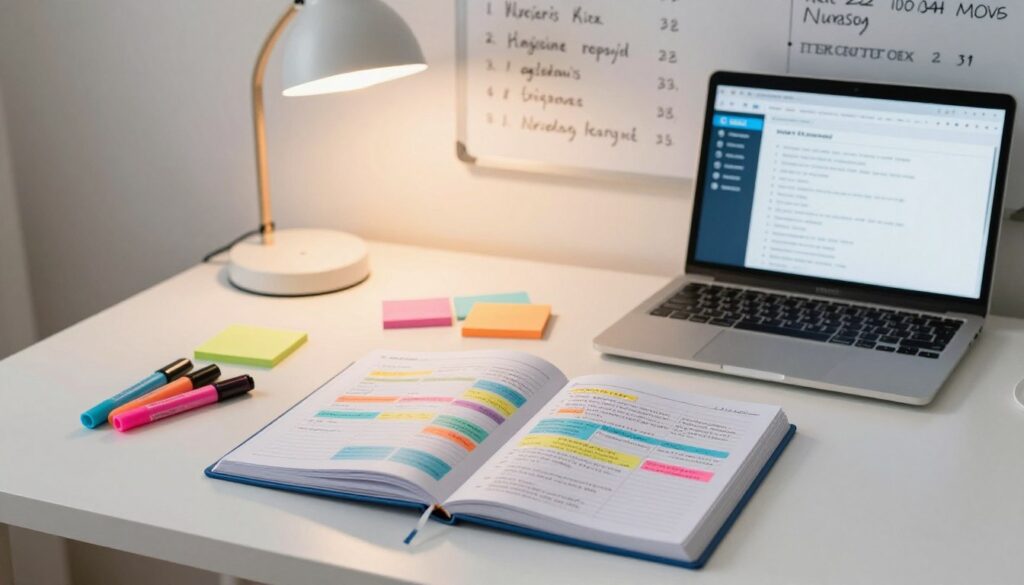
Creating a NCLEX study schedule makes studying less chaotic and more organized. It’s like having a map to guide us through all the nursing info we need to learn. This way, we can manage our time better and feel less stressed about the test.
Benefits of Consistent Study Hours
Sticking to a routine is better than studying in short, intense bursts. Consistency helps our brains understand complex nursing ideas better over time. This leads to better memory retention.
Instead of just reading notes, we should actively engage in our studies. Our study sessions become more effective when we use certain strategies:
- Active retrieval practice: Testing ourselves often to improve memory.
- Exam-style questions: Using knowledge in real-world nursing scenarios.
- Detailed rationales: Understanding the reasons behind each answer.
Avoiding Last-Minute Cramming
It’s tempting to study hard just before the exam, but it’s not the best approach. Last-minute studying rarely helps us understand complex nursing decisions. When we rush, we might just memorize facts without really understanding them.
Staying consistent in our studying helps us feel truly prepared for the NCLEX. A well-planned NCLEX study schedule keeps us from getting burned out. We should aim to build a strong foundation of knowledge that will help us long after the exam.
Recommended Study Hours Per Week
Many of us wonder about the right NCLEX preparation hours to feel ready for the test. Figuring out how many hours should I study weekly for NCLEX? is a personal journey. It depends on your background and timeline. Finding a study rhythm that fits your lifestyle is key to success.
General Guidelines for Aspiring Nurses
The NCLEX study hours per week you need vary based on your timeline. For a two-week intense prep, plan to study 4 to 6 hours daily. This method needs focus and a strict schedule to cover all material.
If you prefer a longer NCLEX study time frame, like a 12-week plan, you can study at a slower pace. Aim for 30 to 45 minutes daily. This way, you can fit studying into your nursing school or work schedule. For more structured guidance, check out a customized study plan.
Factors Affecting Study Time
Several factors affect your NCLEX study duration. Your current knowledge level is a big factor. Those who’ve recently finished school might need less review time than those who’ve taken the test before. Your personal commitments also play a role, as studying full-time is different from balancing a job.
Consistency is key in your prep. Daily practice at a moderate volume is better than cramming on weekends. A steady pace helps build long-term retention and lowers test-day stress.
| Study Plan Type | Daily Commitment | Total Duration |
|---|---|---|
| High-Intensity | 4–6 Hours | 2 Weeks |
| Balanced | 1–2 Hours | 6–8 Weeks |
| Integrated | 30–45 Minutes | 12+ Weeks |
The NCLEX recommended study hours are those that help you master the content without burnout. Listen to your needs and adjust your schedule as you go through your review materials.
Creating a Personalized Study Plan
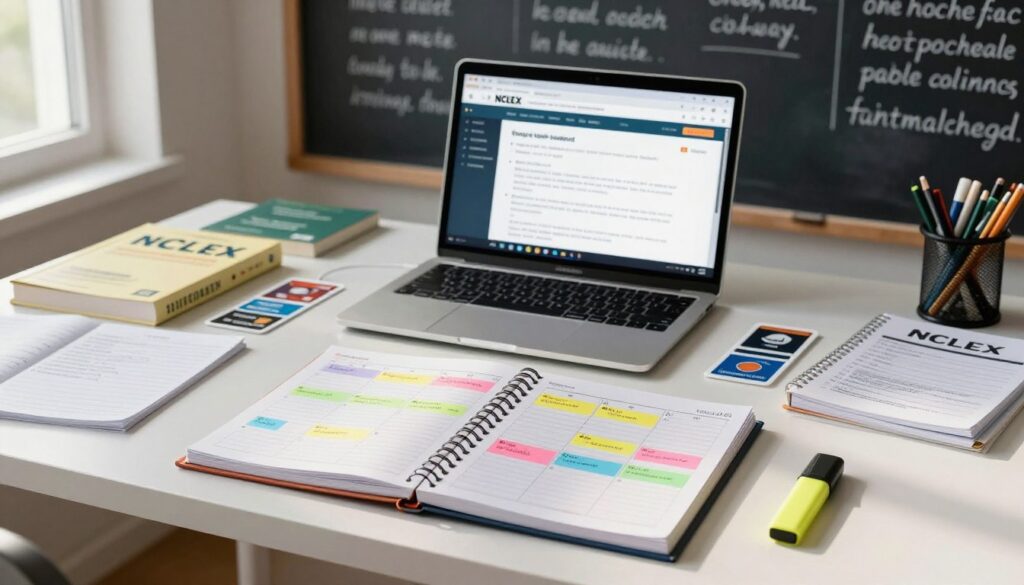
Making a study plan that fits you can turn big challenges into strengths. It makes sure every study hour is used well. We focus on what’s most important for our success.
Assessing Your Current Knowledge Level
First, we do a detailed self-assessment to find out where we need to improve. It’s key to start with our weakest subjects. These are often Pharmacology, Fluids and Electrolytes, or Management of Care.
These topics are tough because they’re important and many students struggle with them. By focusing on these areas first, we can make a strong NCLEX study schedule. This way, we tackle the hard stuff before moving to easier topics.
Setting Achievable Weekly Goals
After we know what to focus on, we set realistic goals. This keeps us moving forward and helps us stay on track. It’s important to have goals that are reachable so we don’t get overwhelmed.
We can make our NCLEX weekly study plan even better by using top-notch tools. For example, online courses for the USMLE offer great ways to practice clinical thinking. This helps us adjust our study plan as we get better, keeping it both flexible and effective.
Staying consistent is the secret to doing well. With a steady NCLEX weekly study plan, we can keep getting better. This way, we’ll feel ready and confident when it’s time to take the test.
Utilizing Study Resources Effectively
To master the material, we must rely on high-quality study aids that mirror the actual exam experience. Integrating these tools into your routine is one of the most effective NCLEX study tips available to nursing students today.
Recommended NCLEX Prep Books
While digital tools are popular, many of us find great value in traditional prep books. These resources provide a structured way to review core nursing concepts and clinical judgment.
- Look for books that offer comprehensive content reviews covering all client need categories.
- Prioritize texts that include detailed rationales for every practice question, as understanding the “why” is just as important as the “what.”
- Ensure the book includes updated information that aligns with the latest test plan changes.
Online Courses and Practice Exams
Modern preparation often involves interactive platforms that adapt to our specific learning needs. For those seeking a more immersive experience, exploring online classes designed for experiential learning can significantly boost your confidence.
Data shows that UWorld students achieve a 98% pass rate on both the NCLEX-RN and NCLEX-PN. This success is largely attributed to the use of a QBank that mimics the real exam interface.
When selecting your digital resources, keep these essential NCLEX study tips in mind:
- Choose platforms that offer adaptive testing to challenge your weak areas.
- Utilize spaced-repetition flashcards to ensure long-term retention of complex pharmacology and pathophysiology.
- Always prioritize platforms that provide detailed performance analytics to track your growth over time.
Balancing Study and Personal Life
Preparing for the NCLEX is a long journey, not a quick race. It needs a balanced way to succeed. We often focus too much on NCLEX recommended study hours. But, our mental and physical health is key to our success.
Trying too hard and getting exhausted doesn’t help. It’s better to find a balance.
Effective Time Management Techniques
To stay focused without getting too tired, we should break our study time into smaller parts. The Pomodoro method is great for this. It lets us study in short, focused bursts with short breaks in between.
This way, we stay sharp and avoid getting mentally tired. Here are some tips to make the most of your time:
- Divide your content: Focus on one topic at a time to avoid feeling overwhelmed.
- Use a timer: Study for 50 minutes, then take a 10-minute break.
- Plan your week: Schedule your study time on a calendar to stay on track without overdoing it.
Prioritizing Self-Care During Study
Our well-being is just as important as studying. Getting enough rest, staying hydrated, and taking breaks are as vital as studying itself.
Ignoring our physical needs hurts our memory and thinking skills. Instead, make these habits part of your study routine:
- Prioritize sleep: Aim for seven to nine hours of sleep to help remember what you’ve learned.
- Stay hydrated: Drink water to keep your energy up.
- Take a day off: Take at least one full day each week to relax and not study.
By setting these limits, we make our NCLEX recommended study hours more effective. Remember, a healthy mind is our best tool for this tough exam.
Tracking Your Progress
Measuring our study success is more than just counting hours. We need to see how we’re growing and where we stand. By watching our progress, we can make our NCLEX weekly study plan better. This keeps us focused and productive.
Using Study Logs and Apps
Using study logs or apps is a great idea. They help us see our progress and stay on track. By tracking our data, we understand how consistent and dedicated we are.
It’s important to spend 5–7 minutes per question. This time is for reviewing the rationales, which is key to learning. We focus on understanding the “why” behind each answer, not just rushing through.
Adjusting Your Plan as Needed
Sometimes, we need to adjust our study plan. If we’re struggling with certain topics, it’s time to change. By adjusting our NCLEX study time frame, we can focus more on those areas.
Being flexible is key to success. By regularly checking our progress, we can focus on what needs more work. This keeps us moving forward with confidence.
| Metric | Goal | Action |
|---|---|---|
| Question Accuracy | Above 65% | Review weak topics |
| Time Per Question | 5–7 Minutes | Analyze rationales |
| Weekly Consistency | 100% Completion | Update study log |
| Confidence Level | High | Practice more exams |
Consistency is the bridge between goals and accomplishment. Keeping an organized record of our efforts keeps us motivated. Remember, our NCLEX weekly study plan evolves with our knowledge.
Exam Day Preparation
As the exam date approaches, we must get our logistics and mindset ready. We’ve spent a lot of NCLEX preparation hours on clinical content. Now, we need to build our mental strength. We should practice in a way that feels like the real test.
Final Review Tips
Focus on your weak spots with a “miss list” of tough topics. Consistency is key. Take timed practice tests that match the real exam. This helps build the stamina needed for a 5-hour test with 85 to 150 questions.
Don’t cram new info in the last days. Instead, work on your test-taking skills and calm your nerves. Reviewing your weak areas boosts your confidence to handle tough questions.
Essential Items for Exam Day
Knowing the material is just part of the prep. We also need to manage the testing center logistics. Make sure you have all your ID documents ready the night before. Being organized helps keep your mind calm and focused.
Here are some must-haves for a smooth day:
- Valid, government-issued photo identification.
- Comfortable, layered clothing for changing room temperatures.
- A light, healthy snack and water for breaks.
- Clear directions to the testing center and parking.
By getting these details sorted, we avoid morning stress. These NCLEX study tips help us enter the test center with the focus and clarity needed to pass.
Conclusion: Finding Your Optimal Study Hours
Finding the right study hours for the NCLEX is a personal journey. We must listen to our own needs as we prepare for the nursing board exam.
Listening to Your Needs
Studies show that students aiming for a 75% QBank score pass the NCLEX 98% of the time. This proves that quality and consistency are key to success. Taking care of our mental health is essential to stay sharp during practice.
Adapting Strategies for Success
Being flexible with our study plans helps us find our rhythm. Adjusting our study hours prevents burnout. We wish you all the best as you become licensed nurses.