

Did you know nearly 15% of nursing graduates feel overwhelmed? They worry about what to expect on exam day. This anxiety is common for students getting ready for their professional licensure. You might wonder, How many questions are on the NCLEX?
The exam length changes based on how well you do. It adjusts to really test your clinical judgment.
Feeling overwhelmed is normal, but you’re not alone. By using top-notch online classes to help you prepare for the NCLEX-RN, you can build your confidence. Mastering the format is key to reaching your career goals. Let’s simplify the testing structure so you can focus on your nursing future.
Key Takeaways
- The exam uses Computerized Adaptive Testing to evaluate your skills.
- Test length varies for every candidate based on individual performance.
- Clinical judgment is the primary focus of the current testing model.
- Preparation is essential to reducing test-day anxiety and stress.
- Reliable study resources provide the practice needed for success.
Overview of the NCLEX Exam
Students often wonder about the exam process. Let’s dive into what this test means for your future. The National Council Licensure Examination, or NCLEX, is a key step for aspiring nurses in the U.S. It checks if graduates are ready for safe patient care.
What is the NCLEX?
The NCSBN creates the exam. Even though states control nursing rules, the test is the same everywhere. This makes sure all nurses, no matter where they studied, show they can care for patients well. Learn more about the NCLEX question count and how it works in our detailed guide.
Importance of the NCLEX for Nurses
Passing the NCLEX is a big deal for nurses. It shows you can make good decisions and use your nursing skills in real life. Without passing, you can’t legally work as a nurse.
The table below shows why this exam is so important for nursing:
| Feature | Description | Purpose |
|---|---|---|
| Standardization | Nationwide consistency | Ensures public safety |
| Evaluation | Clinical judgment | Tests entry-level readiness |
| Regulation | State board oversight | Maintains professional ethics |
| Outcome | Licensure eligibility | Grants legal practice rights |
The NCLEX question count and tough test format are to keep people safe. Passing shows you’re ready to be a professional healthcare worker.
Structure of the NCLEX Exam
The nursing exam’s structure has changed a lot. It now tests your clinical judgment and decision-making skills more. Understanding these changes is key to getting ready.
The exam uses real-world scenarios. This makes sure you can give safe and effective care.
Types of Questions on the NCLEX
You’ll face many different NCLEX test questions. These questions are designed to test your critical thinking. The exam goes beyond just memorizing facts.
It checks how you apply nursing knowledge in complex situations.
- Traditional Multiple-Choice: These items test your foundational knowledge and clinical application.
- Next Generation (NGN) Case Studies: These interactive sets present patient scenarios that require you to analyze data and prioritize interventions.
- Alternative Formats: You may see drag-and-drop, fill-in-the-blank, or ordered response items that test your technical proficiency.
Format of the NCLEX (Computer Adaptive Test)
The exam uses a Computer Adaptive Test (CAT) format. This format measures your competency accurately. As you answer NCLEX exam queries, the algorithm adjusts the difficulty level based on your previous performance.
If you answer a question correctly, the system provides a slightly harder one to confirm your mastery. If you struggle, the test presents an easier item to pinpoint your current knowledge level. This dynamic process ensures that the NCLEX test questions you receive are tailored to your ability. It provides a fair and precise assessment of your readiness to practice as a nurse.
Number of Questions on the NCLEX
The number of questions on the NCLEX is not fixed. This can make some candidates nervous. But, knowing how many questions are on the NCLEX? can help you feel more ready.
Minimum and Maximum Questions Explained
The exam adjusts based on your answers. You’ll see a minimum of 85 and a maximum of 150 questions. This adaptive system checks your level with each answer.
If you show you know your stuff, the exam might end early. But, if you’re close to passing, it will keep going. It’s more about your clinical judgment than the number of questions.
Content Distribution Across Questions
The exam covers key nursing knowledge in several areas. You’ll see a mix of topics that mirror real healthcare. The NCLEX assessment quantity ensures you’re tested on safe and effective care.
The test focuses on main categories to prepare you for practice:
- Safe and Effective Care Environment: It’s about managing care and safety.
- Health Promotion and Maintenance: It deals with growth, development, and prevention.
- Psychosocial Integrity: It looks at mental health and coping.
- Physiological Integrity: It tests your knowledge of basic care, comfort, and drugs.
Mastering these areas boosts your confidence. Stay focused on the scenario, not the number of questions.
Passing Standard of the NCLEX
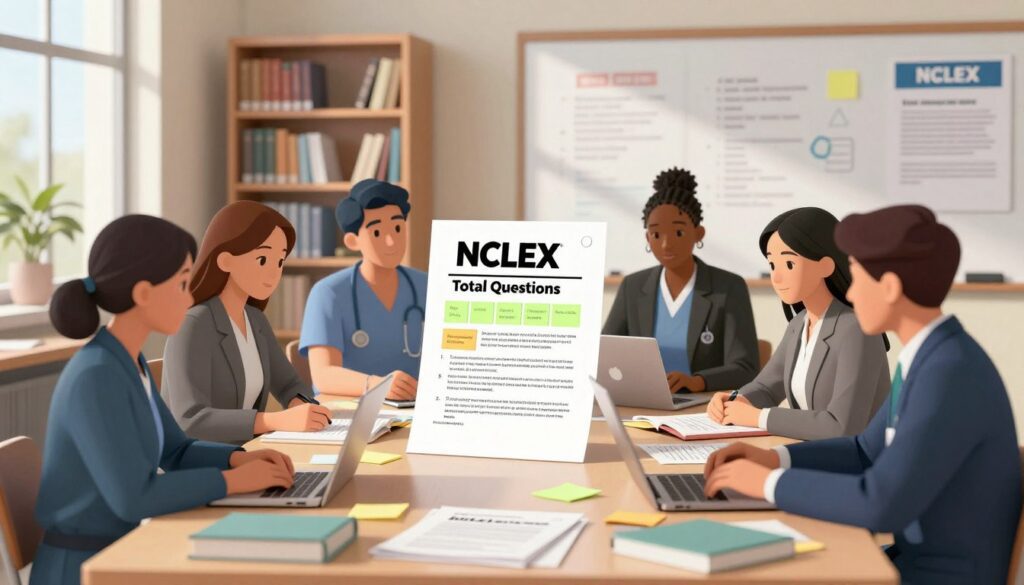
The path to becoming a nurse involves a detailed system that checks your clinical judgment. It’s not just about getting the right answers. Many students worry about the NCLEX inquiry total. But, it’s a test that checks if you can safely and effectively care for patients.
What Constitutes a Passing Score?
You don’t aim for a certain grade. Instead, you show you can answer questions at the entry-level standard. The exam uses Item Response Theory to check your ability after each answer. This method keeps the test fair for everyone.
You don’t have to get every question right to pass. The system checks if your skills are always above the passing level. When it’s 95% sure you meet the standard, the exam ends, no matter the NCLEX inquiry total.
Impact of Question Difficulty on Scoring
The questions’ difficulty affects your score. If you answer correctly, you get a harder question. If you get it wrong, you get an easier one. This helps test your actual ability level.
This process keeps checking your skills as you go. It makes sure you’re ready for real healthcare situations. Your success depends on keeping a high level of performance, even as questions get harder or easier.
Exam Duration and Timing
The pressure of a ticking clock can feel overwhelming during your nursing boards. The NCLEX quiz length varies based on your performance. Knowing the overall time limits helps you stay calm and focused.
How Long Do You Have to Complete the NCLEX?
You have a maximum of five hours to complete your exam. This includes time for introductory screens, optional breaks, and the test questions.
The exam is computer-adaptive, so the number of items changes based on your accuracy. You can learn more about the specifics of the NCLEX quiz length and what to expect regarding the total number of questions.
Tips for Time Management During the Exam
Effective pacing is essential for success. You don’t need to rush through every item to finish early. Instead, focus on providing high-quality clinical reasoning for each scenario.
We recommend the following strategies to manage your time effectively:
- Read each question carefully to identify the core nursing concept being tested.
- Avoid spending too much time on a single item if you feel stuck.
- Take advantage of the optional breaks if you feel your concentration starting to wane.
Remember, the goal is to demonstrate your competency through thoughtful analysis. By maintaining a steady rhythm, you ensure that you have enough time to tackle even the most complex case studies with confidence.
Strategies for NCLEX Preparation
Success on your nursing boards is not by chance. It comes from careful preparation. Move beyond just memorizing to really grasp the material’s core concepts. A consistent study schedule helps manage your time and lowers stress as the exam nears.
Study Tips to Tackle the Question Format
The exam has a special format that changes based on your answers. To excel, focus on understanding NCLEX test questions instead of just memorizing. Here are some tips to boost your critical thinking:
- Break down complex scenarios into smaller, manageable parts.
- Identify the core nursing intervention required in each prompt.
- Practice answering questions that focus on prioritization and delegation.
Consistency is key during this time. Set aside a specific time each day to review your notes and solve new problems. This keeps your knowledge sharp and fresh.
Practice Tests to Gauge Readiness
Full-length practice exams are vital for building endurance. They simulate the real test’s pressure and help you tackle various NCLEX test questions. Reviewing your wrong answers is just as critical as getting them right.
When reviewing your results, look for patterns in your mistakes. Are you struggling with certain clinical areas or question types? Identifying these gaps lets you tailor your study plan to improve your weak spots.
High-quality practice tools greatly increase your confidence. Feeling ready for the NCLEX test questions you’ll face makes you enter the test center calm and focused.
Understanding NCLEX Results
The wait after your test feels long, so let’s break down how your results are figured out. The NCLEX assessment quantity changes for each person, but the logic is the same. It’s not just about how many questions you answer. It’s about the statistical probability of your skills.
How Are Results Calculated?
The exam uses a complex algorithm to check your skills. As you answer questions, the computer adjusts the difficulty. This makes sure the NCLEX assessment quantity fits your performance.
To pass, you need to show you’re consistently above the passing standard. The system stops when it’s 95% sure you’re either above or below the needed level. This way, the decision is fair and accurate for all nursing candidates.
When and How Will You Receive Your Results?
Candidates usually want to know their status quickly. While official results come from your state board of nursing, there are early ways to see your performance.
- Official Notification: Your state board of nursing will send your official results via mail or email, usually within six weeks.
- Quick Results Service: Many candidates choose to use the Pearson VUE Quick Results service, which provides an unofficial result 48 hours after the exam.
- State Board Website: You can often check your license status on your state board’s website once the data is processed.
The NCLEX assessment quantity doesn’t affect how fast you get your results. Whether you answered the minimum or maximum questions, the time to process is the same. Be patient, as official confirmation is what really matters for your career.
Common Myths About the NCLEX
Let’s clear up the confusion about the NCLEX exam. Many students are worried by NCLEX exam queries in study groups and online forums. We can help you understand what’s true and what’s not, so you can feel calmer and more focused on test day.
Debunking Misconceptions
One big myth is that the number of questions you get determines if you pass or fail. Many think getting lots of questions means they did poorly. But, the exam’s length just shows how fast the system can check if you’re ready.
Here are a few more myths that can cause stress:
- Myth: You must get every single question right to pass.
- Myth: The exam is designed to make you fail.
- Myth: If the computer shuts off early, you definitely failed.
Realities vs. Myths of the Exam Experience
The Computer Adaptive Testing (CAT) system is fair and accurate. It changes the question difficulty based on your answers. If you get it right, the next question is harder. If you get it wrong, it’s easier to see your knowledge level.
This way, the test checks if you can give safe and effective nursing care. You don’t need to get every question right. You just need to show you’re consistently above the passing standard. Knowing this helps you see the system is trying to find your true level of skill, not trick you.
Instead of worrying about the number of questions, focus on your preparation. Trust in your education and the hard work you’ve done. By keeping these facts in mind, you can stay confident during your test.
What Happens If You Fail the NCLEX?
Getting a failing result on your nursing exam can be tough. But, it’s not the end of your nursing career. Many nurses have overcome this hurdle and gone on to have successful careers. Remember, your NCLEX inquiry total doesn’t limit your future in healthcare.
Retake Policies and Procedures
If you fail, you’ll get a Candidate Performance Report (CPR) from the board of nursing. This report is invaluable because it shows where you did poorly. It helps you know where to focus your studying.
Most states let you retake the exam after 45 days. You’ll need to re-register with Pearson VUE and pay fees again. Always check with your state board of nursing for specific re-testing rules.
Tips for Preparing for the Next Attempt
To get ready for your next try, make a study plan that targets your weak spots. Don’t just repeat what you did before. Try new things like adaptive question banks or review courses with detailed explanations.
Focus on understanding the why behind each decision, not just memorizing facts. Keep an eye on your NCLEX inquiry total to make sure you’re practicing enough. Stay positive and keep a regular study schedule to build your confidence.
Resources for NCLEX Success
Getting ready for your nursing boards is more than just studying hard. You need the right tools to understand the NCLEX examination specifics. Choosing top-notch study materials can greatly boost your confidence and results. Focus on resources that match the latest testing standards to make your studying more effective.
Recommended Study Guides and Books
Many students use detailed review books to build a solid base. These books break down tough clinical ideas into easy-to-understand chapters. This helps you remember information better. Look for books with detailed rationales for each practice question.
When picking your main study book, consider these well-liked options known for their accuracy:
- Saunders Complete Review for the NCLEX-RN: Seen as the top choice for content review.
- Lippincott Q&A Review: Great for those who focus on practice questions.
- HESI Complete Review: Best for students who like a structured, academic way of learning.
Online Resources and Courses
Digital platforms offer interactive ways to learn, which is key for mastering the NCLEX examination specifics. Many students find online question banks give the best feel of the real test. These tools adjust to your level, focusing on areas you need to improve.
Check out these digital tools to enhance your prep:
| Resource Name | Primary Benefit | Best For |
|---|---|---|
| UWorld | High-quality rationales | Deep understanding of concepts |
| Archer Review | Realistic CAT simulations | Getting ready for the exam |
| Kaplan Nursing | Decision tree strategies | Improving critical thinking |
Consistency is key when using these online tools. Set a daily goal for practice questions instead of studying all at once. This steady effort ensures you’re ready for the exam’s unique challenges.
Final Thoughts on NCLEX Preparation
Mastering the NCLEX examination specifics is about balancing study with a positive mindset. You’ve spent hours on clinical data, but your mental approach is key. We think your hard work has given you the essential clinical judgment needed to pass.
The Importance of Confidence and Mindset
Confidence is as important as your knowledge. Trusting your prep helps you tackle tough questions. Believing in your ability to care for patients will keep you calm.
See the exam as a milestone, not a barrier. A positive attitude lets you focus on the logic of each question. You have the skills to pass and start your nursing career with pride.
Support Systems for Test Takers
You don’t have to face this alone. A strong support system is key to managing stress. Connect with peers to share resources and encouragement.
Mentors and experienced nurses offer invaluable guidance in your final study weeks. Talking to them keeps stress low and reminds you of your community. Rely on your network, stay focused, and trust your journey.
Conclusion
Passing the National Council Licensure Examination is a big step in your career. We hope this guide helps you feel ready for your test day.
Knowing the exam changes based on your answers can help you relax. You now understand how the NCLEX quiz length adjusts. This knowledge is a key to your success.
Key Takeaways for Success
Work on improving your clinical judgment skills. These skills are essential for safe nursing and good patient care. You’ve prepared well with resources like UWorld or Kaplan.
Walk into the testing center with a positive attitude. You’ve earned this moment in your career. We believe you’ll do great and care for your patients well.
If you’re feeling stressed, talk to your friends or mentors. Having a support system is important for your mental health. We’re excited to see you become a licensed nurse in the United States.