

Did you know that nearly 15% of first-time test-takers fail their nursing boards on the first try? This fact might seem scary, but it’s a common challenge for many students starting in healthcare. The exam is a key step to becoming a professional nurse in the U.S., showing if you’re ready for the job.
While this test is a big challenge, knowing the rules about retakes can ease your worries. We aim to guide you through the licensure process after graduation. By understanding how often you can take the NCLEX, you’ll feel more confident in your studies. Good preparation is the best way to pass on your first try.
Key Takeaways
- The exam is a critical milestone for launching your professional nursing career in the U.S.
- Most jurisdictions allow up to eight testing opportunities within a single calendar year.
- Waiting periods between attempts are mandatory to allow for additional study and review.
- State boards often require remedial coursework if you do not pass after multiple tries.
- Preparation is your best tool to minimize stress and avoid the need for repeat testing.
Understanding the NCLEX Exam Structure
Getting to know the NCLEX is key to starting your nursing career. This test checks if you can make safe and effective decisions in clinical settings. No matter how many times you take the NCLEX frequency, the challenge stays the same.
What is the NCLEX?
The National Council Licensure Examination is a test used by nursing boards in the U.S. It uses Computerized Adaptive Testing (CAT). This method changes the question difficulty based on your answers. It makes sure the exam really tests your skills.
Types of NCLEX Exams
There are two main types of exams. The NCLEX-RN is for those aiming to be Registered Nurses. The NCLEX-PN is for Practical or Vocational Nurses. Both focus on patient safety, but the NCLEX-RN covers more complex topics.
| Feature | NCLEX-RN | NCLEX-PN |
|---|---|---|
| Target Role | Registered Nurse | Practical/Vocational Nurse |
| Focus | Complex Clinical Judgment | Foundational Nursing Care |
| Exam Length | 85–150 Questions | 85–150 Questions |
Scoring and Pass Rates
The scoring is strict and doesn’t change with your history. Many worry about NCLEX exam intervals, but the test’s difficulty is the same for everyone. You need to show you’re very skilled to pass, as it’s designed to keep patients safe.
Pass rates change each year, depending on how well you prepare and your education. We suggest focusing on steady studying, not just how many times you take it. Mastering the material will help you feel confident and ready for your test.
Eligibility Criteria for Taking the NCLEX
Starting your journey to become a licensed nurse requires meeting certain criteria. You must have all your documents ready to avoid delays. Following these steps will help you reach your professional goals smoothly.
Educational Requirements
You need to graduate from an accredited nursing program to take the exam. Your school will send your transcript to the state board to confirm your graduation. It’s important to keep your eligibility status up to date, as any changes could affect your testing ability.
Application Process
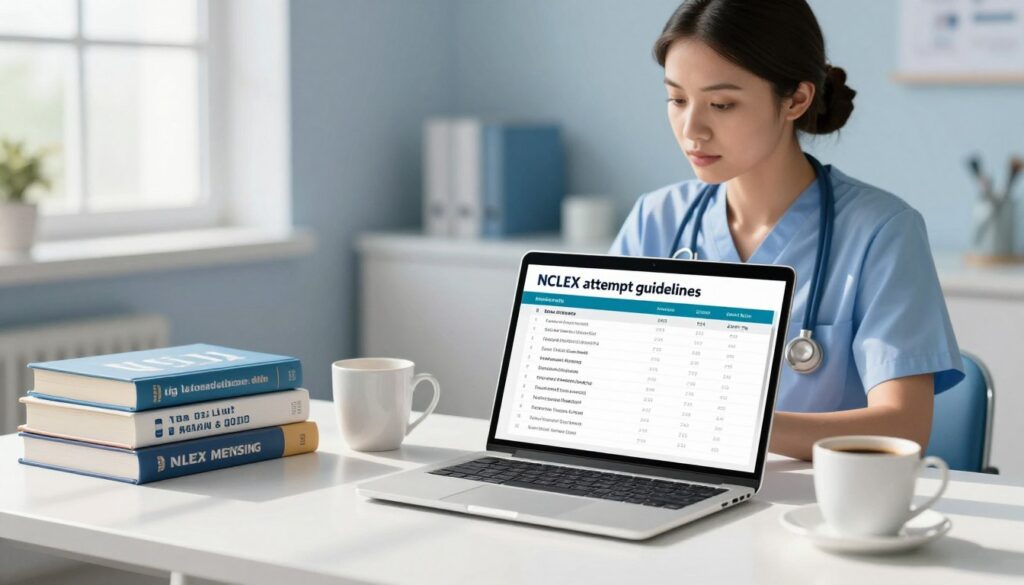
The application process has two main parts: registering with Pearson VUE and applying for licensure with your state board. You must follow the NCLEX attempt guidelines set by your state. Double-check your personal information to avoid any mistakes that could delay your test date.
Test Fees
Planning your finances is important, as application fees can add up if you need to retake the test. Knowing the NCLEX retake policy is key, as each retake requires a new registration fee. Being prepared for these costs helps you stay focused on your studies.
| Fee Category | Description | Estimated Impact |
|---|---|---|
| Registration Fee | Standard Pearson VUE cost | Required for every attempt |
| State Licensure Fee | Board of Nursing processing | Varies by state |
| Additional Costs | Study materials and prep | Variable investment |
Frequency of Taking the NCLEX
Knowing how often you can take the NCLEX is key to becoming a licensed nurse. We’re here to guide you through the rules. This way, you can plan your testing schedule with complete confidence.
State Regulations on Attempts
Most people can take the NCLEX up to eight times a year. But, NCLEX exam limitations differ by state. Each state’s board of nursing decides how many times you can retake the test.
In places like Alaska or Florida, the rules might be stricter. You might need to take a remedial course after failing a few times. It’s important to check your state’s rules before your next test.
Waiting Period Between Attempts
There’s also a waiting period between attempts. The National Council of State Boards of Nursing (NCSBN) requires a 45-day wait. This gives you time to study and improve.
To keep up with your NCLEX testing frequency, remember these tips:
- Check your ATT: Wait for your new Authorization to Test (ATT) before scheduling.
- Review your report: Use the Candidate Performance Report to find areas to improve.
- Consult your board: Make sure your state doesn’t need extra documents or fees before you can retake.
By knowing these rules, you can approach your next test with a clear and focused mindset. We think good preparation and understanding the system are the best ways to achieve your goal of licensure.
Preparing for the NCLEX
Success on the NCLEX is not just about knowing facts. It’s about applying that knowledge under pressure. Treat your prep as a professional commitment, not just a review. Focus on clinical judgment to understand core concepts for safe nursing.

Study Materials and Resources
Choosing the right study materials is personal. They should match your learning style. Use interactive video modules, textbooks, or apps. But, be consistent.
Make sure your resources reflect the NCSBN’s test plan. Mix media to keep your brain active. Visual aids are great for pharmacology, while audio summaries are good for nursing priorities. Quality over quantity is key.
Test-Taking Strategies
Develop a sharp eye for detail when studying. Always read the question stem carefully. Look for clinical cues that show the difference between routine and emergency.
Eliminate obviously wrong options first. This boosts your chances, even with unclear questions. Stay calm to let your knowledge shine without anxiety.
Practice Tests
Practice tests build your stamina for the exam. They simulate the Next Generation NCLEX, focusing on real-world decisions. Review your answers, even if you got them right.
Here’s a table of common study resources to help you plan:
| Resource Type | Primary Benefit | Best For |
|---|---|---|
| Question Banks | Active Recall | Identifying Knowledge Gaps |
| Video Lectures | Conceptual Clarity | Visual and Auditory Learners |
| Review Books | Deep Content Review | Building Foundational Knowledge |
| Flashcards | Quick Memorization | Pharmacology and Lab Values |
Consequences of Failing the NCLEX
Seeing a failing result on your screen is tough, but your dream of becoming a nurse is not lost. It is completely normal to feel disappointed when your hard work doesn’t immediately pay off. Remember, this one moment doesn’t define your future or your nursing career.
Emotional Impact
The emotional weight of not passing can be overwhelming, leading to frustration or self-doubt. Take time to process these feelings instead of rushing. Self-compassion is vital during this time, as many successful nurses have faced similar setbacks.
Financial Implications
Not passing also has practical financial implications. You’ll need to pay for the exam again and possibly additional coursework. Plan your budget carefully for your next attempt.
Retaking the Exam
When you’re ready to try again, learn about the NCLEX exam reattempt policy. This policy outlines waiting periods and requirements for your state. By following it, you can plan to improve your performance.
Persistence is the bridge between a temporary setback and your ultimate goal of becoming a licensed nurse.
Many find a second attempt helps them feel more confident and clear. Stay focused on your goal, use available resources, and trust in your preparation. You’ve made it this far, and your hard work will pay off.
Tips for Success on the NCLEX
Passing the NCLEX is more than just memorizing nursing facts. It’s about how you approach the exam. By improving your test-taking strategy, you can boost your confidence and do better on the big day.
Time Management During the Exam
Effective pacing is essential to make sure you have enough time for every question. Keep a steady pace, but don’t rush through hard clinical scenarios.
- Check the timer often to see how you’re doing.
- Don’t spend too long on a tough question.
- Use your best judgment and move on.
Understanding Question Formats
The exam has different question types to test your critical thinking. Knowing these formats can lower your anxiety and avoid surprises.
You’ll see Select All That Apply (SATA), fill-in-the-blank, and drag-and-drop questions. Practice these to feel more comfortable with the test.
Importance of Self-Care
Your health is key to staying focused. Make sure to take care of yourself before the exam.
Get enough sleep, eat well, and exercise regularly. These habits help keep your mind sharp for the test. Remember, staying calm is as important as your nursing knowledge.
Resources for NCLEX Preparation
We believe that your path to nursing licensure becomes much clearer when you use top-notch study resources. Success is rarely an accident; it’s the result of a well-structured plan that meets your specific needs. By looking at your Candidate Performance Report, you can see which areas need more focus during your study sessions.
Recommended Study Guides
Textbooks and review books are a cornerstone of effective preparation. Many find official guides from the National Council of State Boards of Nursing to be the most accurate. These guides include detailed rationales that help you understand the “why” behind every correct answer.
When picking a guide, look for updated content that matches the latest test plan. Consistency is key, so choose something you find easy to read and follow. Adding flashcards to your study routine can also help you remember complex medical terms and pharmacology.
Online Courses and Tutorials
Digital platforms offer a dynamic way to engage with nursing content through interactive videos and quizzes. These courses simulate the actual testing environment, which helps reduce anxiety on exam day. Many programs track your progress, helping you focus on areas where you struggle.
Tutorials are great for visual learners who benefit from seeing clinical procedures explained in real-time. By using these digital tools, you can keep a steady pace and ensure you cover all necessary domains before your exam. Taking advantage of these modern resources can significantly boost your confidence.
Community Support Groups
Studying for such a significant exam can feel isolating, but you don’t have to go through it alone. Joining community support groups lets you share experiences and study tips with fellow nursing candidates. These forums provide a safe space to ask questions and find encouragement when the material feels overwhelming.
Engaging with peers who are on the same journey can offer fresh perspectives on difficult concepts. You might discover new study techniques or mnemonic devices that have worked for others. Remember that your community is a powerful asset in your quest to become a licensed nurse.
| Resource Type | Primary Benefit | Best For |
|---|---|---|
| Study Guides | Deep content review | Foundational knowledge |
| Online Courses | Interactive practice | Simulating exam conditions |
| Support Groups | Emotional encouragement | Motivation and networking |
Understanding NCLEX Notification and Scheduling
The process of registering and scheduling your NCLEX exam can seem daunting. But don’t worry, we’re here to make it easier for you. Keeping your paperwork in order lets you focus on studying without getting bogged down by details. Knowing the NCLEX testing frequency helps you stay on track with your career goals.
How to Schedule Your Exam
After your nursing board approves your application, you’ll get an email with your Authorization to Test (ATT). You need to book your test through the Pearson VUE website quickly to pick your date and location. Keep an eye on your email for your ATT, as it has important details about your testing window.
Make sure to follow the latest Examination Candidate Bulletin. It has the most up-to-date information for your state. Double-check your personal info matches your ID to avoid any problems on exam day.
Notification of Results
Once you finish the exam, your results go to your nursing board for processing. Many people use Pearson VUE’s Quick Results to get an unofficial score within 48 hours. Remember, this isn’t your official license status.
Your official results will be sent to you by your state board of nursing. This can take up to six weeks. Be patient during this time as you move closer to your new career.
Reapplication Process for Failing Candidates
If you don’t pass on your first try, you’re not alone. You’ll get a Candidate Performance Report (CPR) showing where you need to improve. Looking at this report is key to the NCLEX retake policy.
To try again, you need to reapply with your nursing board and pay the fees. You also have to register again with Pearson VUE for a new ATT. Following the NCLEX exam reattempt policy keeps you in line with state rules as you prepare for your next test.
Common Myths About the NCLEX
Many nursing students feel overwhelmed by rumors about the test. We aim to clear up these misconceptions. This way, you can focus on your studies without worry.
Debunking Misconceptions
One common myth is that the exam gets harder if you fail. But, the truth is different. The National Council of State Boards of Nursing uses a set model to check your skills. Knowing this can help you relax while studying.
Real Experiences from Nurses
Many nurses have found success by ignoring online rumors. They say official resources from the NCSBN are the best guide. Their stories show that good preparation can overcome any obstacle.
Importance of Accurate Information
Your career goals should be based on facts, not rumors. Always check testing policies with your state board of nursing. By knowing the truth about the NCLEX, you’ll feel more confident on your journey to becoming a nurse.