

Ever wondered how top nursing students remember so much without getting tired? They use smart tricks to make hard medical facts easy to remember.
Getting ready for your board exams can feel too much. But, with essential mnemonic strategies for NCLEX prep, you can make tough stuff simple. This way, it stays in your memory longer.
These memory tools are powerful for your big exam. If you need more help, check out online classes to help you get ready for the NCLEX-RN.
We aim to be your friendly guide from nursing school to being a licensed nurse. Let’s see how these methods can make studying easier and help you do well on tests.
Key Takeaways
- Mnemonics are great for remembering hard clinical info.
- Memory aids make studying less stressful by breaking down big info into simple bits.
- Practicing these methods makes recalling info faster during exams.
- Using different learning tools helps you move from nursing school to real-world practice.
- Doing well on your boards needs both knowing a lot and being able to recall it quickly.
Understanding the Importance of Mnemonic Devices
When we face the pressure of the NCLEX, having a reliable memory strategy is key. The volume of clinical data can feel overwhelming. But, specific memory tools can help us break down complex information into smaller pieces.
What is a Mnemonic Device?
A mnemonic device is a memory aid designed to help us store and recall information. These tools act as mental shortcuts that help us remember when we need to. They make learning more efficient by creating associations.
Many students wonder, “What are the best mnemonic devices for NCLEX?” The answer is to find patterns that fit our learning style. These devices are not a replacement for deep understanding but are essential anchors for our memory.
Benefits of Using Mnemonics for NCLEX
The main benefit of NCLEX mnemonic devices is how they simplify high-pressure testing. During exams, stress can block our access to knowledge. These tools provide a quick way to bypass stress and recall the right information.
By using these structures, we save time during the test. We can quickly sort symptoms, treatments, or drug classes without doubt. This confidence is key to staying focused during the exam.
How Mnemonics Enhance Memory Retention
We improve memory retention by linking new, complex information to familiar phrases or images. This association makes it easier to access data later. When we connect a hard concept to a simple word, we strengthen our neural pathways.
Using these techniques helps us organize treatments into logical sequences. As we practice, our ability to recall nursing facts improves. Incorporating these tools into our study routine prepares us for the nursing profession’s challenges.
Common Types of Mnemonic Devices
Exploring different memory aids is a great way to improve your retention of clinical information. By understanding these various structures, you can pick the one that fits your learning style best. Using NCLEX mnemonic devices helps you break down complex data into easy-to-manage pieces.
Acronyms and Acrostics
Acronyms and acrostics are favorites among nursing students. An acronym forms a new word from the first letter of each word in a list. Acrostics create a sentence from the first letter of each word.
These methods are great for memorizing lists or sequences quickly. They turn dry facts into catchy phrases, making them easier to remember.

Visualization Techniques
Visualization creates a mental image to represent a concept or process. Associating a difficult topic with a vivid picture strengthens the neural connection. This method is best for visual learners.
Try out these structures to see what works best for you. Whether it’s a story or a scene, visualization makes your clinical knowledge stick better than rote memorization.
Rhymes and Songs
Rhymes and songs make learning sequences like the alphabet or physiological processes easier. The rhythm of a rhyme makes it easier to recall information during tests. Many students find that turning a list into a tune helps them remember steps perfectly.
By using these NCLEX mnemonic devices daily, studying becomes less of a chore. Try making your own rhymes to boost your confidence and recall during prep.
Top Mnemonic Devices for Nursing Topics
Let’s dive into some of the best memory tools for nursing school. Using top mnemonic devices for NCLEX can greatly improve your learning. These tools help break down complex information into easy-to-remember chunks.
Vital Signs: B.P.R.R.
Checking vital signs is key for nurses. We use B.P.R.R. to remember Blood pressure, Pulse, Respiration, and Rate. This makes sure we don’t miss important checks during rounds.
Cranial Nerves: On Old Olympus’ Towering Top, A Finn And German Viewed Some Hops
Learning the twelve cranial nerves can be tough. But with “On Old Olympus’ Towering Top, A Finn And German Viewed Some Hops,” it’s easy. This phrase is a top choice for NCLEX success, making a list memorable.
Pharmacology: “Some Nurses Try Pot, Others Prefer Referrals”
Pharmacology has lots of drugs to remember. Phrases like “Some Nurses Try Pot, Others Prefer Referrals” help us quickly recall drug effects. We also use similar tricks for diseases, like the 5 A’s of Alzheimer’s: Amnesia, Anomia, Apraxia, Agnosia, and Aphasia.
| Topic | Mnemonic | Key Focus |
|---|---|---|
| Vital Signs | B.P.R.R. | Assessment Order |
| Cranial Nerves | On Old Olympus… | Anatomical Sequence |
| Alzheimer’s | 5 A’s | Symptom Recognition |
| Pharmacology | Some Nurses Try… | Priority Actions |
Using these top mnemonic devices for NCLEX daily will boost your confidence. Make sure to practice them regularly to keep the information fresh.
Mnemonics for Nursing Assessments
Doing patient assessments can be tough, but top mnemonic devices for NCLEX make it easier. They help you stay focused and catch every important detail.
Head-to-Toe Assessment: “I See You”
Starting with a head-to-toe check is key to good care. Use the phrase “I See You.” to keep your checks in order.
This trick helps you check each body part one by one. It boosts your clinical confidence and helps you spot small changes in patients.
Nursing Process: “ADPIE”
The nursing process is vital for making decisions. The ADPIE acronym makes it easier to handle tough patient cases.
- Assessment: Start by gathering data.
- Diagnosis: Find out what the patient needs.
- Plan: Set goals and outcomes.
- Interventions: Take action to care for the patient.
- Evaluation: Check if your plan worked.
Learning this sequence is a top way to prepare for the NCLEX. It makes you think clearly about nursing care steps.
Pain Assessment: “OPQRST”
Pain management is a big deal on the boards. Use OPQRST to quickly get all the pain details you need.
This mnemonic helps you remember to ask about Onset, Provocation, Quality, Radiation, Severity, and Time. It ensures you get all the info for accurate and compassionate care. Using these top mnemonic devices for NCLEX will help you do well under pressure.
Memorizing Dosage Calculations
We can change how you tackle tough dosage problems with simple, effective NCLEX mnemonic techniques. Many students get nervous about math-heavy questions. But breaking them down into smaller steps can make a big difference. By mastering these patterns, you’ll feel more confident and solve problems quickly and accurately.
Remembering Conversion Factors
Knowing how to switch between units is key for accurate medication use. We mostly use the metric system, which is based on powers of ten. This makes it easier to work with decimals instead of doing long division or multiplication.
When practicing these conversions, focus on the relationship between the base unit and its prefixes. Using effective NCLEX mnemonic techniques helps you see these shifts clearly. This mental setup helps avoid mistakes when you’re under pressure during exams.
Key Equivalents: “King Henry Died Unexpectedly Drinking Chocolate Milk”
To keep your metric prefixes straight, we use the phrase: “King Henry Died Unexpectedly Drinking Chocolate Milk.” This sentence shows the order of metric measurements. Each word matches a prefix you’ll often see in clinical settings.
- King: Kilo
- Henry: Hecto
- Died: Deca
- Unexpectedly: Unit (meters, liters, grams)
- Drinking: Deci
- Chocolate: Centi
- Milk: Milli
Common Metric Conversions
Using these effective NCLEX mnemonic techniques helps you quickly switch units. The table below shows the most common conversions you need for nursing and exams.
| Unit Type | Conversion | Relationship |
|---|---|---|
| Kilogram to Gram | 1 kg = 1,000 g | 1,000x larger |
| Gram to Milligram | 1 g = 1,000 mg | 1,000x larger |
| Milligram to Microgram | 1 mg = 1,000 mcg | 1,000x larger |
| Liter to Milliliter | 1 L = 1,000 mL | 1,000x larger |
Effective Use of Mnemonics in Studying
Learning effective NCLEX mnemonic techniques changes how you handle complex medical info. These tools are powerful but only work if you use them daily. Treat your memory aids as key parts of your learning, not just quick fixes.
Incorporating Mnemonics into Your Study Routine
Being consistent is key to any good study plan. Start using your memory devices early to make them second nature. Practice them with your nursing books to build a strong mental base for tough topics.
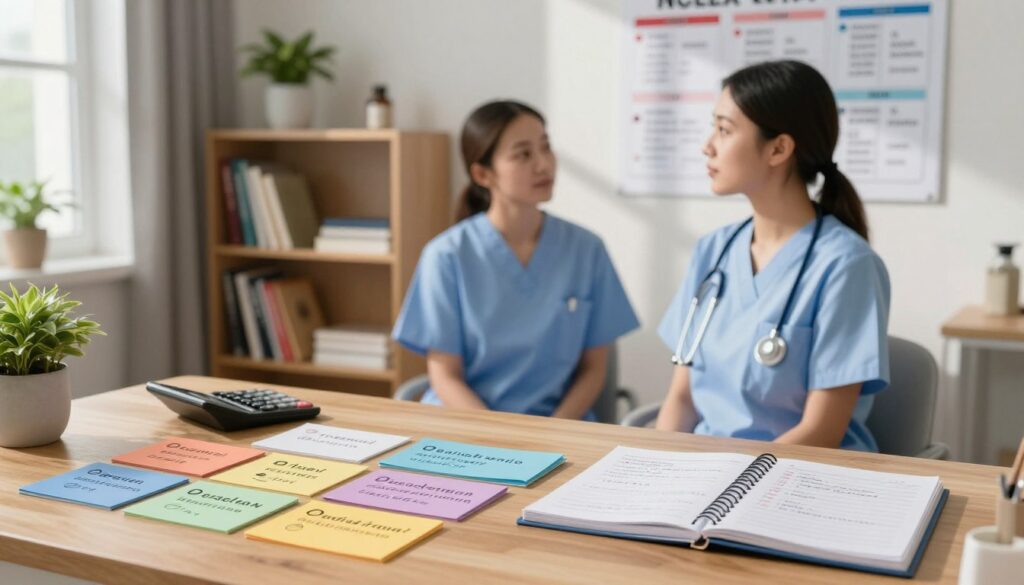
Write your mnemonics on flashcards or sticky notes around your study area. This visual aid keeps important info in your mind. Consistency is the key to keeping these concepts during long study times.
Timing and Repetition for Maximum Impact
Spaced repetition helps move info from short-term to long-term memory. Instead of cramming, review your mnemonics at longer intervals. This method ensures quick access to vital data during exams.
Review your memory aids every morning before new material. This keeps your brain ready for complex problems. Using effective NCLEX mnemonic techniques in a structured way helps avoid forgetting under stress.
Customizing Mnemonics for Personal Understanding
The best students tailor memory tools to fit their learning style. If a standard acronym doesn’t work for you, change it to something meaningful. When you connect personally with the material, your brain stores it better.
Personalizing your memory aids boosts your confidence during exams. You’ll find it easier to recall them when time is tight. Remember, effective NCLEX mnemonic techniques are those that make sense to you personally.
| Study Method | Primary Benefit | Best For |
|---|---|---|
| Spaced Repetition | Long-term retention | Pharmacology |
| Personalized Mnemonics | Faster recall | Complex processes |
| Active Recall | Testing readiness | Clinical scenarios |
Group Mnemonic Activities for NCLEX Prep
We think that studying with friends is a great way to learn tough stuff together. Using NCLEX study tips with mnemonics in group sessions makes studying fun and engaging. It turns a solo, stressful task into a lively team effort.
Study Groups and Team Learning
Studying in a group helps you learn by teaching others. When you explain something to a friend, you strengthen your own knowledge. This teamwork also brings out new ideas and memory tricks you might not have thought of alone.
Create Mnemonics Together
Brainstorming is key for remembering things. Get your study buddies together to make up acronyms or rhymes for hard topics. By combining your creativity, you can come up with unique memory aids that everyone can remember.
Share and Compare Mnemonics
After making your own mnemonics, share them with your classmates. Seeing different versions helps find the most effective ones. Using these NCLEX study tips with mnemonics helps everyone in your group do well on the test. Supporting each other builds a strong base for your nursing careers.
Online Resources for Mnemonics
Looking for ways to boost your NCLEX study tips with mnemonics? The internet is full of tools to help. These tools make complex info easy to handle. They turn your study time into something productive.
Educational Websites and Apps
Many nursing sites have quizzes and flashcards that use mnemonics. Mobile apps are great because you can study anywhere. They keep your memory sharp. You can also find online courses for the USMLE that use similar study methods.
YouTube Channels for Visual Learning
Video content is key for visual learners. Nursing YouTube channels use fun videos and songs. These dynamic visual aids help you remember info better than books.
Social Media Groups and Communities
Joining online groups on Facebook or Reddit is great. You get to share and learn from others. It’s a great way to improve your NCLEX study tips with mnemonics with feedback from peers.
| Resource Type | Primary Benefit | Best For |
|---|---|---|
| Mobile Apps | Portability | Quick daily reviews |
| YouTube Channels | Visual Retention | Complex processes |
| Study Forums | Peer Support | Sharing unique mnemonics |
| Nursing Blogs | Detailed Guides | Deep conceptual understanding |
Real-Life Applications of Mnemonics
Learning to use mnemonic tools for NCLEX is more than just passing exams. It’s a skill that helps you in real-life nursing situations. These tools turn complex medical information into actionable steps. This saves time in urgent moments.
Case Studies and Examples from Nursing Practice
The FAST acronym is key for spotting stroke symptoms. It stands for Facial drooping, Arm weakness, Speech difficulty, and Time to call. Nurses use it to start emergency care fast. This simple trick ensures no important detail is overlooked when time is of the essence.
“The mnemonics I learned during my prep didn’t just help me pass the exam; they became my internal checklist during my first year as a nurse. They provide a sense of calm when the clinical environment feels overwhelming.”
Feedback from Successful NCLEX Examinees
Nurses often say that mnemonic tools help them long after exams. They use these tools to check their work during busy shifts. This builds confidence and helps avoid mistakes in stressful situations.
The table below shows how memory aids move from study to practice:
| Mnemonic | Clinical Application | Primary Benefit |
|---|---|---|
| FAST | Stroke Assessment | Rapid Identification |
| ADPIE | Nursing Process | Structured Care |
| OPQRST | Pain Evaluation | Comprehensive Data |
The Role of Mnemonics in Everyday Nursing
In nursing, being efficient means being safe. Mnemonics help you organize your thoughts quickly, even when caring for many patients. By mastering NCLEX with mnemonic tools, you build mental shortcuts. These keep your nursing skills sharp and reliable.
These tools are more than just for exams. They help you develop the clinical intuition needed for safe, effective care throughout your career.
Overcoming Challenges with Mnemonic Devices
Mastering NCLEX with mnemonic tools is a goal that needs strategy and troubleshooting. These memory aids are very effective but can be confusing if not solid. We aim to help you overcome these challenges with the right techniques.
Tips for Creating Your Own Mnemonics
The best memory aids are those you create yourself. They should relate to your learning style. Make them short and punchy to remember them during exams.
- Use vivid, emotional imagery to make the concept more memorable.
- Connect new information to things you already know well, like your favorite hobbies or daily routines.
- Keep your acronyms simple so you do not have to spend extra energy decoding them during the exam.
Avoiding Common Mistakes
One big mistake is making a mnemonic too complex. If it’s harder to remember than the information, simplify it. This will help you learn faster.
Another error is using a mnemonic that is technically inaccurate. Always check your memory aids against your textbooks. Accuracy is non-negotiable for patient safety and exam success.
Motivational Strategies to Stick with Mnemonics
Feeling overwhelmed is normal when studying a lot. Break your study sessions into smaller chunks. This makes it easier to manage.
Celebrate your small wins, like recalling a tough pharmacology list. Remember, mastering NCLEX with mnemonic tools is a marathon. Stay patient, keep your goals in mind, and trust the process.
Conclusion: Mastering NCLEX with Mnemonics
Passing the NCLEX is more than just reading books. Using the best memory aids for studying changes how you handle complex information. These tools make hard ideas easier to remember.
You’ve learned many ways to organize your thoughts for the big day. Using key mnemonic strategies for NCLEX prep helps you remember important details when it matters most. These methods show your hard work and dedication to nursing.
Reviewing Your Mental Toolkit
Remember the acronyms and visualization techniques that worked best for you. These patterns help you stay focused during long study times. Now, you have a strong set of memory tools to tackle tough exam questions.
Building Confidence for Exam Day
Go into your test with a clear mind and steady hands. Your hard work has built a solid base for your nursing career. Trust the systems you’ve made to guide your clinical decisions.
The Lasting Impact of Your Study Habits
These methods will help you long after the exam. They make you more efficient in real hospital settings. We believe your commitment to excellence will lead to a successful nursing career.