

Did you know nearly one in five first-time nursing graduates fail their licensure exam? This fact puts a lot of pressure on students. We know you want to Pass NCLEX exam with confidence and ease.
To pass, we need to make complex medical info easy to handle. Memory aids are great tools for organizing lots of clinical data. They help you significantly reduce test anxiety and remember things better when it matters most.
Many students ask, What are the best NCLEX mnemonics? These clever tricks help us remember important pharmacology, lab values, and nursing priorities. Using these proven methods in your study routine will help you focus better and do well on test day.
Key Takeaways
- Memory aids simplify complex medical concepts for easier retention.
- Using these tools helps students manage high-pressure testing environments.
- Strategic recall techniques effectively lower overall test anxiety.
- Bite-sized information chunks improve long-term knowledge storage.
- Consistent practice with these methods builds essential clinical confidence.
Introduction to NCLEX Mnemonics
Successful nursing students often use clever memory aids. These tools help simplify complex information. They turn study sessions into productive learning times.
Why Mnemonics Matter for Nursing Students
Nursing school requires a lot of memorization. Nursing mnemonic techniques help organize this information. They make it easier to recall during exams.
Looking for extra help? Check out online classes for the NCLEX-RN. They can improve your study approach.
How Mnemonics Enhance Memory Retention
Mnemonics make it easier to remember new information. For example, the nursing process is remembered with the acronym ADPIE. This ensures you follow patient care steps.
| Letter | Concept | Clinical Application |
|---|---|---|
| A | Assessment | Gathering patient data |
| D | Diagnosis | Identifying health issues |
| P | Planning | Setting care goals |
| I | Implementation | Executing the care plan |
| E | Evaluation | Reviewing patient outcomes |
Using these techniques helps you remember complex information easily. Make them a part of your daily routine. Regular practice boosts your confidence for exam day.
Musculoskeletal System Mnemonics
Let’s dive into how to make complex musculoskeletal ideas easier with memory tools. When you’re getting ready for your boards, nursing exam shortcuts can be a lifesaver. They help you learn anatomy and injury management during clinical rotations.
For example, remember the acronym RICE for soft tissue injuries. It stands for Rest, Ice, Compression, and Elevation. It’s key for treating sprains and strains. You can find more anatomy and physiology nursing mnemonics tips to boost your knowledge.
Remembering Cranial Nerves
Learning the twelve cranial nerves can be tough. Use the mnemonic “Oh, Oh, Oh, To Touch And Feel Very Good Velvet, Ah, Heaven.” Each word starts with the first letter of the nerves.
This trick helps you remember the nerves from Olfactory to Hypoglossal quickly. Regular practice will make you more confident in neurological exams. These nursing exam shortcuts will stay with you long after class.
Joint Types and Movements
Knowing how joints work is key for physical exams. We group movements to help you see how the body moves. The table below shows common joint types and their main movements to aid your studying.
| Joint Type | Primary Movement | Example |
|---|---|---|
| Hinge | Flexion/Extension | Elbow |
| Ball and Socket | Rotation/Circumduction | Hip |
| Pivot | Rotation | Neck (C1-C2) |
| Gliding | Sliding | Wrist bones |
These nursing mnemonic techniques make complex anatomy easier. Create your own versions to make it more personal. The key to success in nursing school is consistent practice.
Cardiovascular System Mnemonics
The heart is complex, but the right memory tools can help you succeed. The cardiovascular system is key for the NCLEX. Using nursing exam shortcuts helps you remember important facts quickly.
Remembering Heart Sounds: S1 and S2
Knowing heart sounds is essential for nurses. Simple memorization techniques for NCLEX can help. S1, or the “lub” sound, happens when the mitral and tricuspid valves close.
S2, or the “dub” sound, occurs when the aortic and pulmonic valves close. Remember, S1 is the start of systole and S2 is the start of diastole. For more tips, see these cardiovascular care nursing mnemonics and tips.
Commonly Used Cardiac Medications
Speed and accuracy are critical in cardiac emergencies. The MONA acronym is a helpful nursing exam shortcut:
- Morphine: Reduces pain and anxiety.
- Oxygen: Improves tissue perfusion.
- Nitrates: Dilates coronary arteries and improves blood flow.
- Aspirin: Prevents further platelet aggregation.
Using these memorization techniques for NCLEX will prepare you for exams. Consistency in studying is key for retaining information. Practice these patterns to make your exams easier.
Respiratory System Mnemonics
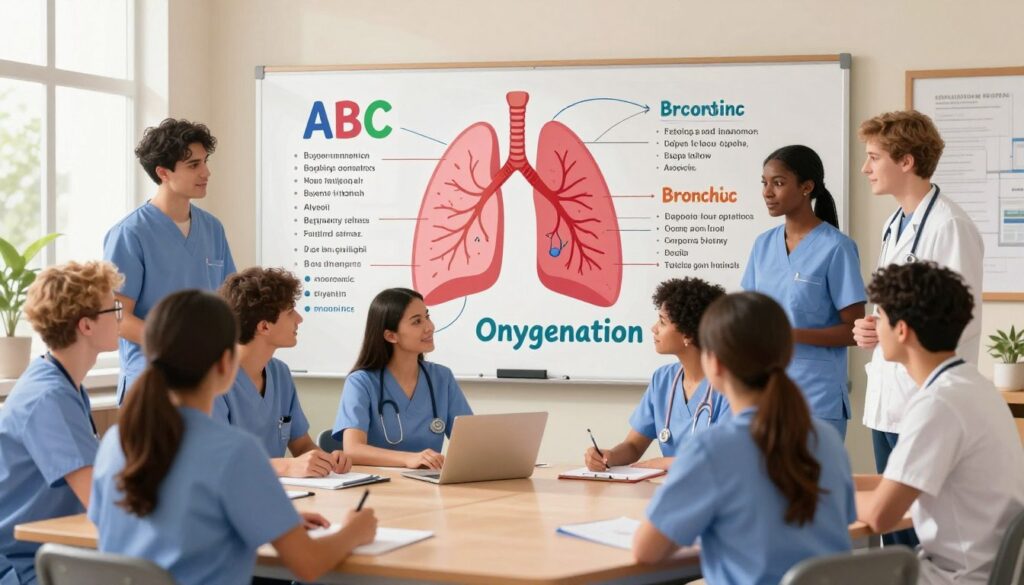
Studying the lungs can be easier with smart memorization techniques for NCLEX. Respiratory distress is a critical situation that needs quick action. Simple memory aids help you remember important steps to save a patient’s life.
Signs of Respiratory Distress
It’s vital to spot early signs of respiratory failure to ace NCLEX test questions. Look for signs like nasal flaring, using extra muscles, and wheezing. These show the body is struggling to breathe.
To remember causes of pulmonary edema, use the mnemonic MADD DOG. It helps you remember factors that cause fluid in the lungs:
- Medications
- Arrhythmias
- Diet
- Drugs
- Disease
- Overload
- Genetics
Anatomy of the Respiratory Tract
Knowing the airway’s structure is as important as spotting distress. The respiratory tract has upper and lower parts, each with its role. Visualizing the path from nose to alveoli helps you understand gas exchange.
Make a mental map of the tract to improve memorization techniques for NCLEX. Start at the pharynx and go down to the bronchi. Consistency is key in learning these landmarks, as they are the base for complex respiratory issues.
Gastrointestinal System Mnemonics
Understanding the digestive tract is easier with clever tricks. Nursing mnemonic devices make complex info simple. They help you remember important details for the NCLEX test.
Understanding Liver Function Tests
The liver is vital, and knowing its health markers is key. We use ALT to remember Alanine Aminotransferase, a liver damage indicator. High levels mean liver cells are stressed.
For patient care, remember BATTED for daily tasks: Bathing, Ambulation, Toileting, Transfers, Eating, and Dressing. These tasks help assess a patient’s care ability after a GI procedure. Keeping these in mind ensures you support patients fully.
Remembering Digestion Process
The digestion sequence can be tough to remember. Visualize the path from start to finish. Remember CAUTION for warning signs, like changes in bowel or bladder habits, which could mean cancer.
These nursing mnemonic devices help you quickly sort symptoms and test results. This skill is key to confidently ace the NCLEX test. Practice regularly, and these patterns will become second nature.
Endocrine System Mnemonics
Endocrine disorders can seem daunting, but the right tools help a lot. Learning these concepts is key for nursing students. Nursing mnemonic devices make complex hormonal pathways easy to understand.
Diabetes Management Tips
Studying adrenal gland disorders can be tricky. Remember, Addison’s disease means you need to ADD hormones. Cushing’s syndrome is about having too many hormones, or a CUSHION of them. These NCLEX memory aids help you tell the two apart under pressure.
“The beautiful thing about learning is that no one can take it away from you.”
Managing diabetes means knowing about insulin and glucose. Always remember the “3 Ps” of hyperglycemia: Polyuria, Polydipsia, and Polyphagia. Knowing these symptoms helps you quickly see what patients need.
Hormones and Their Functions
Knowing the main functions of hormones is key. We’ve organized common hormones to help your studying. Use this table to better understand how these messengers affect the body.
| Hormone | Primary Function | Clinical Impact |
|---|---|---|
| Insulin | Lowers blood glucose | Diabetes management |
| Cortisol | Stress response | Metabolic regulation |
| Thyroxine | Regulates metabolism | Energy levels |
| ADH | Water retention | Fluid balance |
Practicing with these nursing mnemonic devices boosts your confidence. Make sure to review these NCLEX memory aids often. With these strategies, you’re on your way to mastering the endocrine system.
Reproductive System Mnemonics
Maternal and newborn care can be overwhelming. But, the right tools make a big difference. NCLEX memory aids help you remember important information quickly. This is key during stressful tests.
Ever wondered, what are the best NCLEX mnemonics? For reproductive systems, focus on labor stages and common infections. These topics are often tested, so knowing them well is vital.
Stages of Labor
Remember the four stages of labor with D-P-P-R. This stands for Dilation, Pushing, Placenta, and Recovery. Each stage needs specific care for the mother and baby.
In the immediate postpartum period, the APGAR score is key. It’s used at 1 and 5 minutes after birth. This score helps you see if the newborn needs urgent care.
Understanding STIs and Treatments
Knowing STIs and their treatments is critical. Group them by symptoms or treatment types. NCLEX memory aids help avoid confusion between similar conditions.
For pharmacology, remember antibiotics often end in “-cillin” or “-cycline.” Always check for allergies before treating infections. Here’s a quick guide to reproductive health concerns.
| Condition | Primary Symptom | Common Treatment |
|---|---|---|
| Chlamydia | Often asymptomatic | Azithromycin |
| Gonorrhea | Purulent discharge | Ceftriaxone |
| Syphilis | Painless chancre | Penicillin G |
| Trichomoniasis | Frothy discharge | Metronidazole |
Neurological System Mnemonics
If you’re searching for what are the best NCLEX mnemonics?, start with the neurological system. It’s vital to track complex patient changes. Memory aids can boost your confidence in clinical rotations and exams.
Signs of Stroke: FAST
Knowing how to spot a stroke fast is key for nurses. The FAST acronym is a lifesaver for recognizing stroke symptoms. It’s simple and easy to remember when you need it most.
Here’s how to use the FAST mnemonic:
- F – Facial drooping: Look for one side of the face sagging or numb.
- A – Arm weakness: Ask the patient to lift both arms to see if one falls.
- S – Speech difficulty: Listen for slurred speech or confusion.
- T – Time to call: Time is brain, so call emergency services right away if you see these signs.

Understanding Neurological Assessments
Doing a detailed neurological assessment needs a methodical approach. We use tools to check consciousness and motor skills. These NCLEX study tips help you stay organized at the bedside.
Always start by checking the patient’s baseline. Consistency is key for spotting small changes in pupil response or limb strength. These tools help you focus on patients with acute neurological issues, leading to safer care.
Pharmacology Mnemonics
Learning hundreds of medications can seem daunting. We’ve made it easier for you. Pharmacology is tough for nursing students because of all the drug names and reactions. Nursing mnemonic techniques help break down complex info into smaller parts.
Drug Classifications and Examples
Grouping meds by class is a top NCLEX study tip. Knowing a drug’s suffix or main action helps you understand its function. For example, the LEAN mnemonic makes remembering emergency drugs easy:
- Lidocaine
- Epinephrine
- Atropine sulfate
- Narcan
This acronym helps you recall critical drugs fast. Keeping lists in your notes builds a solid clinical practice base.
Common Side Effects to Remember
It’s also key to remember common side effects. Students often find it hard, but linking drug classes to affected body systems helps. Focus on the most common side effects seen on exams.
“The art of medicine consists of amusing the patient while nature cures the disease.”
Look for patterns in how meds affect vital signs or digestion. Using these nursing mnemonic techniques will prepare you for medication questions. Regular practice is essential for mastering these NCLEX study tips and boosting your confidence.
Infection Control Mnemonics
Effective nursing mnemonic techniques make complex safety rules easy to remember. These tools are key for students aiming to pass the NCLEX exam with confidence.
Modes of Transmission
Airborne precautions use the SPIDERMAN mnemonic. It helps identify diseases needing strict isolation to stop spread.
The letters in SPIDERMAN stand for SARS, Pertussis, Influenza, Diphtheria, Epiglottitis, Rubella, Mumps, Adenovirus, and Neisseria meningitidis. Having this list ready helps you know what precautions to take during clinical rotations.
Key Steps in Hand Hygiene
Hand hygiene is critical to fight infections. The WASH method is key to clean hands before and after touching patients.
Remember WASH as: Wet your hands, Apply soap, Scrub for twenty seconds, and Hand-dry well. Doing this consistently is essential to pass the NCLEX exam and keep patients safe.
Safety and Emergency Mnemonics
In a hospital, quick thinking can save lives. When a patient’s health worsens fast, you need reliable mental tools. These help you stay calm and focused during emergencies.
Recognizing Abnormal Vital Signs
Spotting trouble early is key in nursing. We use “VITAL” to remember important signs: Ventilation, Intensity, Temperature, Awareness, and Level of pain. This helps you catch problems before they get worse.
When facing NCLEX exam questions, remember that odd vital signs are a warning. Look for patterns, not just single numbers. A drop in blood pressure with a higher heart rate means shock, needing quick action.
Emergency Response Protocols
The ABCDE rule is a must for emergency care. It helps you tackle the most urgent issues first. This keeps the patient stable until the medical team arrives.
“Success in nursing is not just about knowing the facts; it is about the ability to apply those facts under pressure to protect your patient.”
Using these shortcuts helps you think clearly in emergencies. Below is a table showing the ABCDE protocol steps. It helps you focus on the most important actions first.
| Letter | Focus Area | Clinical Action |
|---|---|---|
| A | Airway | Clear obstruction and stabilize |
| B | Breathing | Assess rate and oxygen saturation |
| C | Circulation | Check pulses and capillary refill |
| D | Disability | Evaluate neurological status |
| E | Exposure | Examine for hidden injuries |
Learning these protocols is vital for NCLEX exam success. Practice them often so they’re automatic in real situations. Stay focused, stay calm, and always put the patient’s safety first.
Conclusion: Using Mnemonics Effectively
Memory aids are great for improving your recall in stressful tests. Regular practice makes these shortcuts reliable. You can find online classes to help you get ready for the CBX. This adds structure to your study routine.
Building Personalized Memory Devices
Create unique connections that mean something to you. Try visualizing or recording important points to listen to on your commute. These personal shortcuts help link complex medical ideas to quick actions.
Refining Your Skills with Targeted Practice
Make these memory strategies a part of your daily life. Use flashcards and checklists to track your progress. Applying these tips to practice questions boosts your mental strength for the NCLEX exam. Stay committed to your goals and trust your preparation.