

Ever thought about making your path to becoming a registered nurse easier? Focusing on key areas can make studying less daunting. By learning the basics first, we gain confidence to handle tougher topics later.
Good NCLEX study tips help us deal with the huge amount of info needed for the exam. We can focus on NCLEX topics that show up a lot. If you need help, online classes can guide you. Let’s go through this together to make sure we’re ready for the test.
Key Takeaways
- Focus on high-yield concepts to maximize study efficiency.
- Use structured review plans to reduce exam-related stress.
- Build confidence by mastering foundational nursing principles early.
- Leverage professional resources to guide your learning process.
- Maintain a consistent schedule to improve long-term retention.
Understanding the NCLEX Examination Structure
Getting to know the exam layout is key to starting our NCLEX preparation. Understanding how the test works helps us study smarter, not harder.
This knowledge also reduces our anxiety on test day. It lets us focus on learning the material well. Knowing what the test expects from us makes us more ready.
Overview of Exam Components
The NCLEX is a computer-adaptive test. This means the questions get harder or easier based on our answers. We could face anywhere from 75 to 265 questions.
We have 6 hours to complete the exam, including breaks. Learning to manage our time well is very important for passing.
Types of Questions You’ll Encounter
Many students worry about the questions being too hard. But, by practicing different types, we can find the easiest NCLEX questions. We’ll see more than just multiple-choice questions.
There are fill-in-the-blank, ordered response, and hot-spot questions too. Getting used to these diverse formats prepares us for anything.
As we dive into NCLEX topics, practicing these question types boosts our confidence. Staying calm and focused is the best way to tackle the exam.
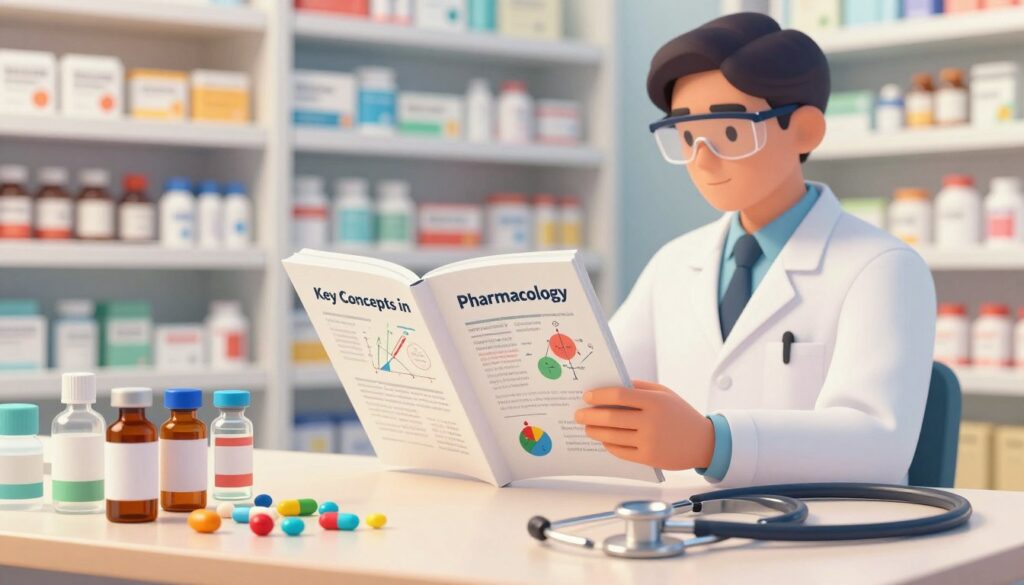
Key Concepts in Pharmacology
Many students find pharmacology tough, but it’s key to our success. By focusing on the most important info, we can make these topics easier. This way, we can improve our NCLEX passing rate.
It’s better to understand how drugs work in our bodies than just memorize them. Categorizing drugs by their effects makes studying easier. This method helps us keep important info for a long time.
Common Medications to Know
Some drugs show up a lot on exams, so they’re key to study. For example, Digoxin (Lanoxin) has a narrow range. We need to remember its safe level is 0.8-2.0 ng/ml.
Checking these levels is vital for patient safety. If levels are out of range, we know there’s a risk of toxicity. Knowing these ranges helps us answer safety questions confidently.
Drug Classifications and Their Uses
Grouping drugs by class helps us quickly see their main uses. For instance, knowing how beta-blockers or ACE inhibitors work helps us predict side effects and nursing actions. This systematic approach beats just memorizing.
Learning the suffix of a drug class lets us guess its purpose, even if we’ve never seen the name before. This skill boosts our NCLEX passing rate. By mastering these classifications, pharmacology becomes easier to study.
Basic Nursing Care and Comfort
Comfort and hygiene are key in nursing. They help us improve our NCLEX passing rate. These skills keep patients safe, clean, and comfortable while they recover.
Learning these essential clinical tasks boosts our confidence in handling NCLEX exam topics. These skills are the foundation of quality patient care, whether you’re a student or a professional.
Hygiene Practices
Hygiene is not just about being clean. It’s also about preventing infections and respecting patient dignity. We must focus on keeping skin intact, like when caring for burns or wounds. The Rule of Nines helps us quickly assess burn areas for proper care.
For adults, the head is 9%, arms are 18%, back is 18%, legs are 36%, and genitalia is 1%. Remembering these percentages helps us manage patient comfort and prevent issues during hygiene routines.
Patient Mobility Techniques
Safe patient handling is essential to avoid injuries. Always check if a patient can help before moving them. For more support, consider online classes for the CNA exam, which cover these skills in detail.
Using proper body mechanics, like keeping your back straight, is critical for your career health. The table below shows common mobility levels we see in clinical rotations.
| Mobility Level | Patient Capability | Nursing Action |
|---|---|---|
| Independent | Full range of motion | Supervise for safety |
| Minimal Assist | Can bear weight | Provide steadying support |
| Moderate Assist | Limited strength | Use gait belt or walker |
| Total Assist | Non-weight bearing | Use mechanical lift |
Mastering these techniques keeps patients mobile and comfortable. Regular practice will boost our NCLEX passing rate as we tackle complex NCLEX exam topics.
Health Promotion and Maintenance
Health promotion empowers our patients to manage their long-term wellness. These NCLEX exam topics are key because they focus on preventing illness, not just treating it. By understanding these topics, we help our patients stay healthy for life.

Nutrition Fundamentals
Nutrition is the base for recovery and preventing disease. Knowing how to calculate intake is vital for monitoring patient health. For example, knowing that 1 cup equals 8 oz is essential for tracking fluid balance.
Good nutrition education helps us answer NCLEX practice questions about diet changes for chronic conditions. We should teach patients to eat balanced meals that meet their health needs. Giving clear advice helps patients stick to their health goals at home.
“Let food be thy medicine and medicine be thy food.”
Preventive Health Measures
Preventive care is the best way to fight chronic disease. We follow evidence-based guidelines for screenings and vaccinations. These steps are key to catching risks early.
Our job is to teach patients about the value of regular check-ups and lifestyle changes. By using these NCLEX exam topics in our work, we see better patient results. Teaching patients regularly is our strongest tool for lasting success.
We often face NCLEX practice questions that test our skill in choosing preventive screenings. By staying up-to-date, we make sure our patients get the best care. Proactive nursing is the way to a healthier future for all we serve.
Safety and Infection Control
Keeping patients safe is our top priority every day. In hospitals, keeping the area clean and safe is key to good care. By focusing on these areas, we can do better on NCLEX practice questions and face real challenges.
Standard Precautions
Standard precautions are our main defense against germs. We treat every patient as if they could be sick, no matter what. This means washing hands often, wearing the right gear, and using needles safely.
On NCLEX test strategies, we learn that washing hands is the best way to stop germs. We should always do this first, before doing more complex things. Keeping things clean is not just a rule; it’s a must for keeping patients safe.
Handling Hazardous Materials
Working with dangerous stuff needs careful following of rules and safety guides. We must know how to throw away biohazardous waste, sharp objects, and chemicals safely. Proper labeling and storage are key to a safe place.
If something spills, we must act fast to keep others safe. Using the right gear when cleaning up is a big part of many NCLEX practice questions. By practicing these steps, we can get better at them.
| Protocol Type | Primary Goal | Key Action |
|---|---|---|
| Standard Precautions | Infection Prevention | Hand Hygiene |
| Hazardous Waste | Exposure Control | Proper Labeling |
| Sharps Safety | Injury Prevention | Rigid Containers |
Psychosocial Integrity
Psychosocial integrity is key to patient-centered care and is often tested. Nurses must see how a patient’s mental state affects their physical health. We need to focus on the patient’s mental health as much as their physical needs.
Coping Mechanisms
Illness or hospitalization can be very stressful for patients. We must figure out if a patient is using healthy or unhealthy coping methods. Helping a patient means supporting their positive coping and letting them share their fears.
When we’re asked about coping, we should look for answers that support the patient’s emotional well-being. For more help, check out online classes for the CHCP exam. These resources can improve your skills in dealing with complex situations.
Therapeutic Communication
Good communication is essential for trust and understanding patient needs. It helps us get important information while making the patient feel valued. Keeping professional boundaries is key to creating a healing environment.
To do well in this area, focus on these key techniques:
- Active Listening: Listen fully without interrupting.
- Open-Ended Questions: Ask questions that let the patient share their thoughts freely.
- Empathy: Show understanding to build trust.
- Silence: Use pauses to let the patient process their feelings.
Using these NCLEX test strategies will help you choose the best response. Always aim to create a supportive environment that empowers the patient. Regular practice will make you more confident and caring.
Physiological Integrity
Physiological integrity is at the heart of our nursing work. It’s the main part of our NCLEX review materials. It helps us care for patients safely. Learning these ideas helps us make smart choices during the NCLEX exam.
Vital Signs Interpretation
Knowing how to read vital signs is key for nurses. We need to know what’s normal to spot problems fast. For example, a healthy heart beats 80 to 100 times a minute. Breathing should be 12 to 20 times a minute.
Remembering these numbers helps us focus on patient care when it matters most. We use them to see if patients are stable. Here’s a table with normal adult vital signs to help you study.
| Vital Sign | Normal Range | Clinical Significance |
|---|---|---|
| Heart Rate | 80-100 bpm | Cardiac output indicator |
| Respiratory Rate | 12-20 rpm | Gas exchange status |
| Blood Pressure | 120/80 mmHg | Vascular resistance |
| Temperature | 98.6°F (37°C) | Metabolic activity |
Basic Pathophysiology Concepts
It’s vital to understand how diseases work. This helps us make better judgments in our nursing work. Knowing this lets us see what patients might need before it’s too late.
By breaking down disease processes, we can tackle the NCLEX exam with confidence. Our NCLEX review materials teach us why symptoms happen. This helps us solve problems in real-life nursing situations. Regular practice with these ideas prepares us for any nursing challenge.
Maternity and Pediatric Nursing
Learning about maternal and pediatric care is a big step for nursing students. It mixes clinical skills with empathy. This focus helps us prepare well for the NCLEX exam.
Developmental Milestones
Knowing how kids grow is key for the NCLEX-RN. Growth patterns are set, but each child grows at their own pace. Spotting delays early helps us act fast.
We look at growth in physical, cognitive, and psychosocial areas. Keeping up with these changes helps us give care that fits the child’s age. Regular checks are our best way to ensure kids grow well.
Common Maternal Conditions
Watching over both mom and baby is a big job. We must remember that a normal fetal heart rate is 120 to 160 beats per minute. If it’s off, we need to check it right away.
It’s also important to know about the umbilical cord. It has two arteries and one vein for exchanging nutrients and oxygen. Knowing this helps us answer tough exam questions.
| Category | Key Metric | Clinical Significance |
|---|---|---|
| Fetal Heart Rate | 120-160 bpm | Indicates fetal well-being |
| Umbilical Cord | 2 Arteries, 1 Vein | Essential for circulation |
| Infant Growth | Weight doubles by 6 months | Marker of healthy development |
| Maternal Safety | Standard Precautions | Prevents infection transmission |
Prioritization and Delegation
Learning to prioritize is a game-changer for nursing students getting ready for the NCLEX-RN. In a busy clinical setting, how we organize care is key to success and patient safety. Improving these skills shows we can make decisions on our own.
Nursing Priorities Framework
We use structured frameworks to figure out which patients need help first. The ABCs—Airway, Breathing, and Circulation—are our top priority. We tackle these critical issues before moving on to less urgent tasks like pain management or teaching.
Maslow’s Hierarchy of Needs also guides us. It tells us to focus on basic needs like oxygen and food first. This approach helps us stay organized and confident during the NCLEX-RN exam.
Delegating Tasks Effectively
Assigning tasks to others is as important as assessing patients. We need to know who can do what to ensure safe care. The Five Rights of Delegation help us make the right choices.
When we delegate, we’re responsible for the outcome. It’s important to communicate well and check that tasks are done right. Here’s how we can share responsibilities with the nursing team.
| Task Type | Registered Nurse (RN) | LPN/LVN | UAP/CNA |
|---|---|---|---|
| Assessment | Complete/Initial | Focused/Ongoing | Not Allowed |
| Medication | IV/Complex/Oral | Oral/Subcutaneous | None |
| Patient Care | Complex/Unstable | Stable/Routine | Basic Hygiene |
| Teaching | Initial/Discharge | Reinforcement | Not Allowed |
Tips for Mastering NCLEX Topics
Getting ready for the Next Generation NCLEX needs a mix of clinical skills and smart planning. We can make our prep easier by focusing on key areas. These areas lay a solid base for passing the exam.
Knowing which NCLEX topics are easiest to master helps us use our time wisely. Online experiential learning through simulations is great for practicing tough decisions safely. These tools help us connect theory from books to real patient care.
Essential Study Resources
Nursing.com is a top pick for visual learning. Their video lessons make hard pharmacology topics easy to understand. Using these resources regularly keeps us on track with our study plan.
Practice Tests and Question Banks
Good NCLEX study tips include regular practice with top-notch question banks. We should choose platforms with Case Studies, Bow-tie, and Matrix grid formats. This makes the exam feel more real, boosting our confidence and endurance.