

Did you know nearly one in five nursing candidates faced binary grading? This method didn’t show their true clinical skills. It missed the complex decision-making needed in today’s hospitals. To fix this, a new, smarter way to test was created.
So, what is partial credit scoring on the NCLEX? It’s a big change in how we show we’re ready to be nurses. Instead of just passing or failing, it rewards us for getting parts of complex questions right.
This new system makes the exam more like real-world nursing. It shows how well we can judge in clinical situations. Knowing this helps us study better and feel more confident. We can learn the logic behind nursing actions without worrying about one wrong answer.
Key Takeaways
- The new system moves away from binary, all-or-nothing grading.
- Candidates receive points for selecting correct options in multi-choice items.
- This change better mirrors the complex decision-making required in clinical settings.
- It provides a more accurate reflection of a nurse’s entry-level competency.
- Understanding this format reduces test anxiety and improves preparation strategies.
Understanding the NCLEX Exam Structure
To truly master the exam, we must first look at the sophisticated framework that powers it. The NCLEX scoring system uses Computerized Adaptive Testing (CAT). This system adjusts the difficulty of each question based on our previous answers. It ensures a personalized assessment of our nursing knowledge.
Overview of the NCLEX-RN and NCLEX-PN
The National Council of State Boards of Nursing (NCSBN) designs both the NCLEX-RN and NCLEX-PN. They evaluate our readiness for entry-level practice. The RN exam focuses on complex clinical judgment. The PN exam focuses on practical nursing care and support.
| Exam Type | Primary Focus | Target Role |
|---|---|---|
| NCLEX-RN | Clinical Judgment | Registered Nurse |
| NCLEX-PN | Practical Care | Licensed Practical Nurse |
| Assessment | Adaptive Testing | Entry-Level Safety |
Types of Questions Included
We encounter a variety of question formats designed to test our critical thinking skills. The NCLEX exam scoring process includes multiple-choice, drag-and-drop, fill-in-the-blank, and ordered response questions. These formats challenge us to apply our knowledge in scenarios that mirror actual clinical environments.
The Importance of Scoring in Nursing Licensure
The NCLEX passing score is not just a number; it represents a vital benchmark for public safety. The NCSBN sets these standards to ensure that every candidate who earns a license is prepared to provide safe, effective care. By maintaining rigorous evaluation methods, the profession protects the public and upholds the integrity of nursing practice. We must view this process as a commitment to excellence in our future careers.
Introduction to Partial Credit Scoring
Understanding your test results is key to getting your nursing license. You might wonder: What is partial credit scoring on the NCLEX? It’s a new way to check if you know your stuff.
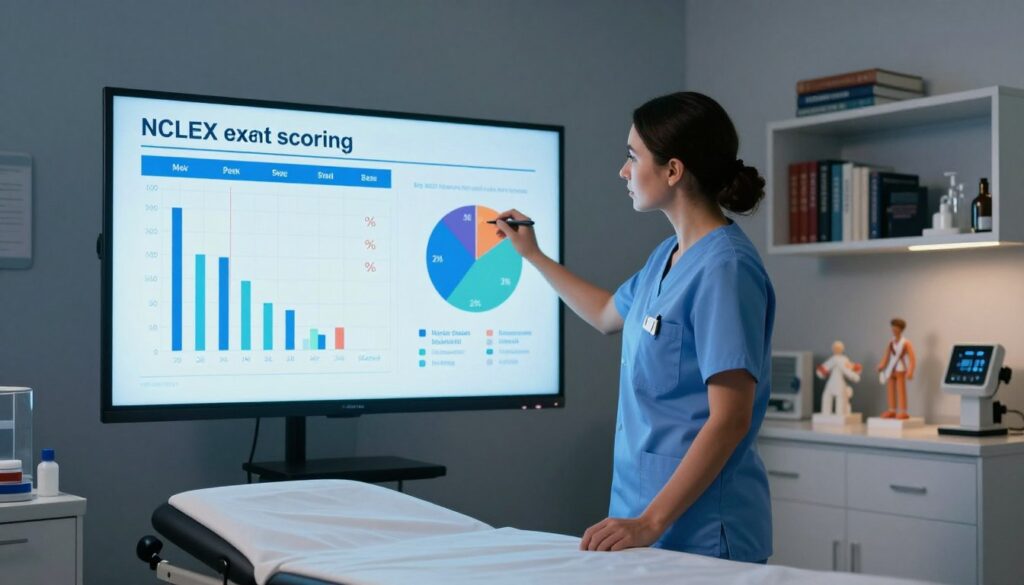
Definition of Partial Credit Scoring
Partial credit scoring, or polytomous scoring, lets you get points for almost right answers. It’s not just pass or fail anymore. You get points for showing you know some of the right stuff.
How It Differs from Traditional Scoring
Before, exams were all-or-nothing. NCLEX partial credit scoring now rewards you for knowing a bit of the topic. Here’s how it’s different.
| Feature | Traditional Scoring | Polytomous Scoring |
|---|---|---|
| Response Type | Single Correct Answer | Multiple Correct Options |
| Point Allocation | Binary (0 or 1) | Incremental (0, 1, or more) |
| Assessment Depth | Basic Knowledge | Clinical Judgment |
| NCLEX score breakdown | Less Detailed | Highly Detailed |
Why It Matters for Candidates
This change is big because it shows what nursing is really like. In nursing, there’s rarely just one right answer. You have to think about many things to make good choices.
This scoring method makes sure your NCLEX passing score really shows you’re ready to care for patients safely. It’s a fair way to test your skills, not just yes or no answers.
The Benefits of Partial Credit Scoring
We see the shift to more detailed evaluation methods as a big plus for nursing students. Moving away from strict, pass-or-fail grading is more fair. With NCLEX partial credit scoring, we can really see your clinical skills.
Improved Assessment of Knowledge
This new way of testing gives a clearer picture of what nurses know and can do. It values your correct judgments, not just if you got everything right. This way, your demonstrated competence is shown well.
Increased Chances of Passing the Exam
Many candidates have great clinical skills but find complex questions tough. NCLEX partial credit scoring lets you pass even if you’re not perfect. It rewards your smart choices, even if you don’t get everything right.
Reduced Test Anxiety for Candidates
Testing can be very stressful, but this scoring helps ease that. You don’t worry that one small mistake will ruin your score. Seeing your hard work and knowledge valued keeps your confidence up.
How Partial Credit Scoring Works
Let’s dive into the details of the NCLEX score breakdown to better prepare. As we move to the Next Generation NCLEX, understanding NCLEX partial credit scoring is key.
The exam now uses advanced methods to check our clinical judgment. It goes beyond simple yes or no answers. This way, it really tests how well we prioritize patient care.
Scoring Rubric Explained
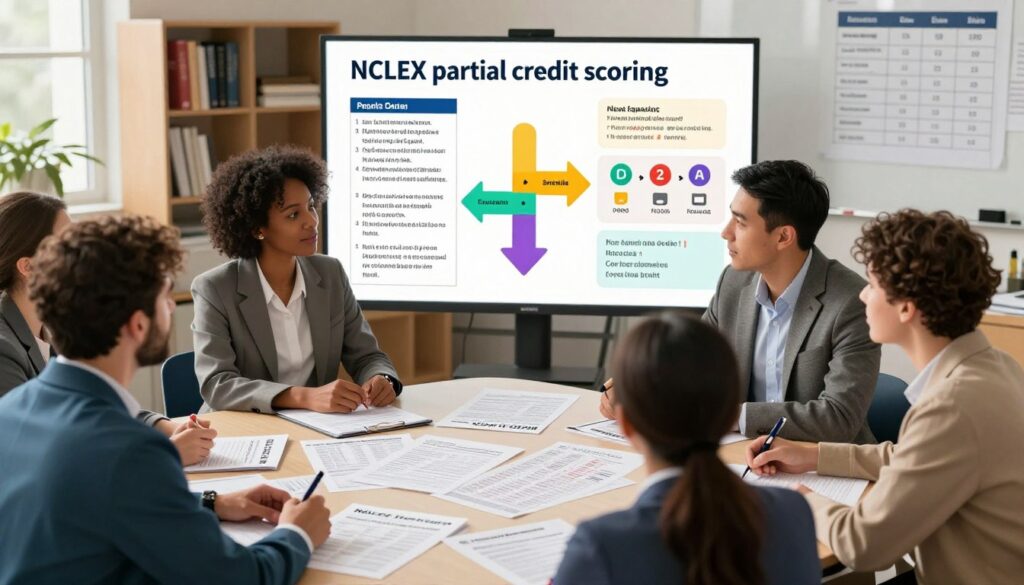
The NCLEX exam scoring uses three main ways to score us. These rules reward us for right answers and acknowledge partial knowledge.
- 0/1 Scoring: We get a point for a right answer and zero for a wrong one.
- +/- Scoring: We get points for right answers but lose points for wrong ones. This stops us from just guessing.
- Rationale-Based Scoring: This checks if we can link a clinical finding to a cause or action.
Example Questions Demonstrating Scoring
To see how these rules work, let’s look at examples. The table below shows how different question types affect our score.
| Question Type | Scoring Method | Point Allocation |
|---|---|---|
| Multiple Choice | 0/1 Scoring | 1 point for correct |
| Select All That Apply | +/- Scoring | Points for correct/deductions for wrong |
| Clinical Judgment Case | Rationale-Based | Points per correct link |
Impact of Answering Multiple Choice Questions
The NCLEX grading system aims to be fair and complete. When we face multiple-choice questions, we often use the 0/1 method.
But, with more complex formats, we need to be strategic with our time. We should pick the most accurate clinical choice carefully. By understanding these rules, we can tackle the exam with confidence and accuracy.
The Role of Item Response Theory
Item Response Theory is the key to precise nursing assessments today. It makes sure the NCLEX test scoring is both accurate and fair for everyone. This science helps measure our clinical skills well.
Basics of Item Response Theory
At its core, this system uses Computerized Adaptive Testing, or CAT. It gives us questions where we have a 50% chance of getting them right. This helps the system find out our exact skill level.
Connection to Partial Credit Scoring
Partial credit scoring is closely tied to this theory. The exam changes based on our answers, needing a detailed way to score us. This method gives a granular assessment of our knowledge, not just a pass or fail.
By scoring different parts of a question, the system gets a full view of our skills. This way, our NCLEX test scoring truly shows how ready we are for the job. It makes sure our skills are fairly judged.
Benefits of a Psychometric Approach
A psychometric approach makes testing fair and tailored to each person. It also cuts down on the effect of random guesses on our scores. Consistency and fairness are its main goals.
This science-based approach makes us confident in our licensure process. It focuses on our unique abilities, making the NCLEX test scoring a top standard in nursing. We can be sure our results show our true professional skills.
Implications for Nursing Education
Nursing programs are changing how they test students. They now see that clinical judgment is more important than just memorizing facts. This shift helps schools prepare students better for the real world of nursing.
How Schools Adapt to Partial Credit Scoring
Schools are updating their teaching to make students comfortable with complex questions. They add more real-life scenarios to classes. This helps students think critically and handle tough exams better.
Preparing Students for the NCLEX
The NCLEX passing score is set at 0.00 logits for RNs and –0.18 logits for PNs until March 31, 2026. Schools use these scores to plan their teaching and practice tests. This helps students feel more confident in their studies.
It’s also good to look into getting college credit online. This can help deepen your nursing knowledge. A strong base lets you focus on making smart clinical decisions, not just passing tests.
Strategies for Success on the Exam
Success on the NCLEX needs both knowledge and smart test-taking. Here are some tips to help you reach the NCLEX passing score.
| Strategy | Focus Area | Expected Outcome |
|---|---|---|
| Case Studies | Clinical Judgment | Improved decision-making |
| Mock Exams | Time Management | Reduced test anxiety |
| Peer Review | Knowledge Gaps | Better retention |
| Data Analysis | Passing Standards | Targeted improvement |
Preparing for the NCLEX: Study Tips
Getting a high NCLEX passing score starts with good preparation. We need to match our study methods to the exam’s format. Using the right materials boosts our confidence for the big day.
Recommended Study Resources
Choosing the right tools is key. Saunders review books and UWorld’s digital platforms are great. They help us understand the exam’s style.
These tools make us familiar with the exam format. This familiarity helps us stay focused during the test.
Practice Questions and Mock Exams
Mock exams are vital for tracking our progress. Look for platforms that give detailed feedback. This helps us pinpoint our strengths and weaknesses.
Regular practice makes us comfortable with the NCLEX passing score needs. It reduces anxiety and boosts critical thinking skills. Consistency is the key to success.
Time Management Strategies
Good time management is essential. It lets us evaluate each question carefully. Practice pacing yourself to avoid rushing through tough questions.
Here are some strategies for managing study time and improving performance:
| Strategy | Benefit | Implementation |
|---|---|---|
| Active Recall | Improves retention | Use flashcards daily |
| Timed Quizzes | Builds endurance | Set a 60-minute limit |
| Reviewing Rationale | Deepens understanding | Analyze every wrong answer |
| Simulated Testing | Reduces exam anxiety | Take full-length mock exams |
By following these tips, we set ourselves up for success. Remember, consistent effort leads to a good NCLEX passing score. With dedication and smart prep, we can conquer this challenge.
Common Misconceptions About Partial Credit
When you’re getting ready for your future, it’s key to know what’s real and what’s not. The exam’s pressure can make you anxious, leading to rumors. By focusing on the truth about NCLEX test scoring, we can build confidence instead of stress.
Clarifying Misunderstandings
One big myth is the “Pearson VUE hack.” Many think trying to re-register right after finishing shows if they passed or failed. But, this method doesn’t reliably show your score.
We advise against using these unofficial tips. They can make you feel worse and don’t give you real insight into your NCLEX test scoring results. Only the nursing regulatory body can give you official results.
Addressing Myths About Scoring
Another myth is that you can guess your score while taking the test. Some think the number of questions you get shows if you passed or failed. This is not true.
The exam is computer-adaptive, so everyone has a different experience. Trying to guess your score based on question count or difficulty is not helpful. Instead, trust the fair evaluation process designed to measure your skills.
The Reality of Exam Outcomes
The only way to get your official results is through your state board of nursing’s proper channels. Relying on rumors can take your focus away from your hard work. Knowing the truth about NCLEX test scoring helps us stay calm while waiting.
| Common Myth | The Reality | Impact on Candidate |
|---|---|---|
| Pearson VUE hack | No predictive value | Increases anxiety |
| Question count | Adaptive, not a grade | Causes confusion |
| Secret scoring | Official board release | Delays peace of mind |
Real-Life Experiences from Candidates
We can learn a lot from those who have passed the updated exam. Their stories give us a peek into the exam process. By looking at their experiences, we can improve our own study plans and handle the NCLEX score breakdown better.
Personal Stories of Success
Many who passed say changing their mindset was key. They moved from just memorizing to focusing on patient safety. This shift helped them tackle complex questions with confidence.
Challenges Faced and Overcome
Test-takers often struggle with the new question types. They worry about making a mistake, fearing it could affect their score. But, those who stayed calm and used their clinical skills found the system rewarded their critical thinking skills.
Lessons Learned from the Exam Experience
Nurses who passed the exam stress the importance of understanding the NCLEX score breakdown. They found that each correct answer adds to their score. This knowledge helps reduce anxiety and improves how they approach each question.
| Strategy | Benefit | Outcome |
|---|---|---|
| Clinical Judgment Focus | Improved Accuracy | Higher Confidence |
| Analyzing NCLEX score breakdown | Reduced Anxiety | Better Pacing |
| Practice with Multi-part Items | Increased Familiarity | Successful Passing |
Future of Partial Credit Scoring on the NCLEX
The nursing world is set for big changes in how we check if nurses are ready to work. The NCLEX scoring system needs to keep up with these changes. It’s important for us to stay updated on these changes to grow in our careers.
Potential Changes in Exam Format
The National Council of State Boards of Nursing (NCSBN) is always looking to improve. They check the NCLEX grading system every three years. This ensures the test stays relevant to real-world nursing.
We can expect new ways to test nursing skills in the future. These changes will focus on how well candidates think, not just what they remember.
Predictions by Nursing Educators
Nursing experts think we’ll see more complex tests. They believe the NCLEX scoring system will value thinking over memorization. This change aims to make the test fairer for everyone.
Ongoing Research in Nursing Assessment
Researchers are always working to make the test better. They study how different questions affect the NCLEX grading system. This research helps us understand how to improve nursing evaluations.
| Assessment Feature | Current Approach | Future Direction |
|---|---|---|
| Data Review Cycle | Every 3 Years | Continuous Monitoring |
| Question Complexity | Standardized Scenarios | Dynamic Clinical Simulations |
| Scoring Precision | Partial Credit Model | Advanced Psychometric Weighting |
| Candidate Feedback | Pass/Fail Results | Detailed Competency Mapping |
We need to be ready for these changes. By embracing these updates, we can keep delivering top-notch care and professional standards.
Conclusion: Embracing Change in Nursing Licensure
The world of nursing is always changing to keep up with healthcare needs. By embracing these changes, we grow as nurses. Learning about the NCLEX exam scoring helps us feel more confident and clear about our certification.
Importance of Adaptability and Growth
Adapting to new testing methods shows our dedication to learning all our lives. The NCLEX grading system now values clinical judgment more than just memorizing facts. This change is a step forward, making sure nurses are ready to think critically for patient safety.
Encouraging a Positive Attitude Toward Testing
Staying calm helps us do our best during important exams. The NCLEX exam scoring now looks at our nursing knowledge in a more complete way. By focusing on our clinical thinking, we see the exam as a chance to show we’re ready for nursing.
Final Thoughts on Nursing Career Advancement
Getting our license is a big step in our nursing careers. The new NCLEX grading system helps us become a more skilled and ready workforce. We’re excited for the future of nursing, knowing these standards help us give our patients the best care.