
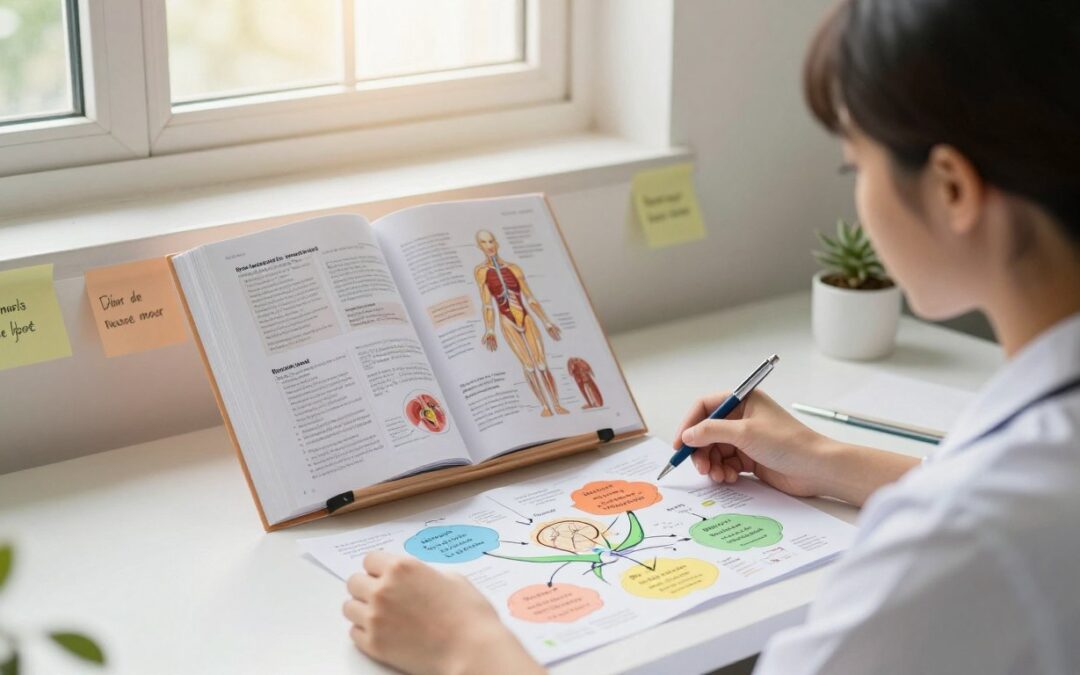
Ever thought your study habits might be stopping you from passing your nursing boards? Many students spend hours trying to remember endless lists. But, they feel lost when faced with tough clinical scenarios. True success in your NCLEX exam preparation comes from understanding human physiology, not just memorizing.
Let’s look at congestive heart failure. Memorizing symptoms like edema and tachycardia might not help if the question is tricky. But, if you understand the pathophysiology of fluid overload, you can always spot these signs.
By focusing on why patients have certain conditions, you build a durable knowledge base. This knowledge helps you beyond the test. It boosts your confidence and prepares you to care for your future patients safely and effectively.
Key Takeaways
- Prioritize conceptual learning over rote memorization to improve long-term retention.
- Mastering pathophysiology allows you to deduce symptoms instead of guessing.
- Logical reasoning is the most effective tool for solving complex clinical questions.
- Focusing on the “why” helps you apply knowledge to diverse patient scenarios.
- Building a strong foundation leads to better patient outcomes and professional confidence.
The Importance of Understanding in Nursing
The best nurses focus on understanding, not just memorizing. Flashcards alone won’t cut it for true success. Good NCLEX study strategies help you see how body systems and patient needs work together.
The Limitations of Memorization
Memorizing facts isn’t enough because it lacks context for tough decisions. When a patient’s situation changes, memorized info can’t keep up. Clinical environments are rarely predictable, making memorization feel overwhelming.
“Education is not the learning of facts, but the training of the mind to think.”
By moving beyond memorization, you gain a broader view of patient care. This shift is key for those seeking online classes to help you prepare for the NCLEX-RN. Knowing why you’re doing something is more valuable than just knowing how.
Building Critical Thinking Skills
Real nursing skill comes from understanding how different facts fit together. Strong critical thinking lets you analyze symptoms, not just list them. These NCLEX study strategies help you see how medications, history, and vital signs connect.
Practice by thinking about how a patient’s change might affect their treatment. This mental exercise boosts your ability to prioritize care. It turns studying into active, dynamic problem-solving.
Real-World Application of Knowledge
The goal is to apply what you learn to real patients. You need to turn textbook knowledge into bedside actions. Using NCLEX study strategies with case studies helps bridge the gap between school and hospital.
When faced with a tough scenario, try to see it from the patient’s point of view. This ensures you’re not just passing a test, but preparing for a lifelong career in healthcare. Your ability to put information together will define your nursing success.
Key Concepts to Focus On for NCLEX
Wondering how to pass NCLEX without memorizing every detail? Nursing is more about clinical judgment than just remembering facts. By focusing on key areas, you can make your studying more efficient and less stressful.
Some data points are worth memorizing for quick answers. Knowing common lab values and major drug classes helps a lot. Finding the right balance between memorization and understanding is key to success.
Pharmacology Principles
Instead of memorizing every drug side effect, learn about drug classes and their mechanisms. Knowing how a drug class works helps predict its effects. This approach is essential for passing NCLEX without memorizing everything.
Group medications by their purpose. For example, knowing all ACE inhibitors end in “-pril” helps you understand their safety profiles. This conceptual framework saves time and boosts your accuracy.
Nursing Theories and Models
Nursing theories are the foundation for patient care, but they can seem abstract. Focus on applying these models to real-world scenarios. Think about how theories like Orem’s Self-Care Deficit affect your daily patient care.
Viewing these theories as practical tools makes them easier to remember. Ask yourself how a model guides your decisions during a shift. This perspective helps you understand the material better than just memorizing it.
Patient Safety Guidelines
Patient safety is critical on the NCLEX. Focus on core safety protocols like fall prevention and infection control. These guidelines are essential and appear often on the exam.
Understanding these safety pillars prepares you for any situation. Use the table below to see which concepts need deep understanding and which can be quickly memorized.
| Concept Category | Focus Strategy | Primary Goal |
|---|---|---|
| Pharmacology | Drug Classes | Predicting outcomes |
| Lab Values | Key Ranges | Rapid identification |
| Safety Protocols | Standard Precautions | Preventing harm |
| Nursing Theory | Clinical Application | Patient-centered care |
By focusing on these key areas, you can pass NCLEX without memorizing everything. Understanding the why behind nursing actions boosts your confidence on test day.
Critical Thinking and NCLEX Success
Success on the boards is rarely about what you remember. It’s more about how you think. High-performing students use decision trees and safety protocols instead of just recalling facts. By mastering critical thinking for NCLEX, you can tackle tough questions with confidence.
Strategies for Developing Critical Thinking
To do better, adopt specific NCLEX test strategies that focus on clinical judgment. First, spot the core safety issue in each question. This helps you ignore distractions and focus on the best nursing actions.
Practice “if-then” reasoning during study time. Think about why a certain action is key for a patient’s safety. This builds a solid logical base for tackling unknown clinical situations.
Case Studies as Learning Tools
Using case studies is a great way to practice under real-world pressure. They help you apply your knowledge in a dynamic setting. This is key for improving your clinical reasoning.
By going through these scenarios, you learn to analyze patient data and make safe, evidence-based choices quickly.
The following table shows the difference between relying on memory versus critical thinking during exam prep:
| Approach | Focus Area | Outcome |
|---|---|---|
| Rote Memorization | Isolated facts | Limited flexibility |
| Critical Thinking | Clinical judgment | High NCLEX success |
| Safety Protocols | Patient outcomes | Reduced errors |
Understanding the NCLEX Test Blueprint
Students who do well treat the test blueprint as their main guide. The pass rate for NCLEX-RN candidates has changed, but knowing the exam well is key. By understanding the blueprint, you can feel less stressed and focus better on each question.

Test Plan Overview
The NCSBN creates the exam to check if you’re ready for nursing. The test plan is more than just topics; it’s a detailed guide. Knowing this helps you focus your studying on the most important areas.
Types of Questions to Anticipate
You’ll face different types of questions, not just the usual multiple-choice. There are fill-in-the-blank, ordered response, and multiple-response questions. Learning how to handle these with NCLEX test-taking tips will help you stay calm during the exam.
Consistency is key when practicing these question types. Spend time learning the logic behind each one. This way, you’re prepared for anything the exam throws at you.
Categories of Questions
The exam groups questions by client needs, like Safe and Effective Care Environment. These categories make sure the test covers all nursing duties. Using NCLEX test-taking tips in these areas helps you understand the main idea of each question.
By focusing on these categories, you can organize your knowledge better. When you know what a question is really asking, you can be more confident in your answers. This method is what sets successful candidates apart.
Evidence-Based Practice: A Foundation for Nursing
Evidence-based practice is the bedrock for every clinical decision in healthcare. It relies on solid research and data to ensure our actions improve patient care. Understanding the NCLEX conceptual understanding helps us see why certain protocols are used and how they keep patients safe.
Importance of Research in Nursing
Research guides our growth and keeps our care accurate. Staying current with studies helps us understand the why behind nursing. This is key for your NCLEX conceptual understanding, as it lets us focus on the most effective care.
Nursing changes with new discoveries. Valuing research means we aim for the best care. This keeps our practice safe and relevant in a changing medical world.
Integrating Evidence into Clinical Decision Making
The nursing process is more than a checklist; it’s a scientific method for solving complex problems. Using evidence in our daily work means we back our actions with data, not guesses. This skill shows we’re true professionals.
In exams, you’ll face choices that need evidence-based answers. A strong NCLEX conceptual understanding helps pick the best option. Grounding your knowledge in research boosts your confidence in making quick, smart decisions.
Time Management Strategies for Nursing Students
Managing clinical shifts and study sessions can be tough. Finding a balance between hospital work and studying is key for success. A structured routine helps keep your focus while protecting your mental health.
Balancing Study with Clinical Experience
Clinical rotations are valuable but demanding. Study in four-hour blocks, then take a break. This lets your brain process information better, avoiding burnout.
For more help, consider online classes for the cna or nursing basics. These can improve your study skills. Consistency beats cramming any day.
Prioritizing Topics for NCLEX
Not all study materials are equal. Focus on NCLEX conceptual understanding to apply knowledge in real scenarios. This way, you’re prepared for the exam’s complex questions.
Make a list of key subjects from the test blueprint. Use your best study hours on these topics. A strong NCLEX conceptual understanding boosts your nursing career confidence.
The Role of Clinical Judgment in Nursing
Clinical judgment is key to linking theory and safe patient care. It’s about making informed decisions under pressure. Mastering this skill boosts your critical thinking for NCLEX success.
Components of Clinical Judgment
Knowing your professional scope is a core part of clinical judgment. You must decide if a procedure is right for you to do. This keeps patients safe.
Another key part is prioritizing care based on how sick a patient is. You need to quickly tell if a patient is stable or not. This requires understanding disease processes deeply.
Enhancing Clinical Reasoning Skills
Use case studies to improve your critical thinking for NCLEX. They help you see how to prevent problems. This is what makes a great nurse.
Practice by thinking about “what if” scenarios during rotations. Ask yourself how changes in a patient’s condition might affect your care. These exercises strengthen your reasoning muscles for the exam.
| Judgment Level | Focus Area | Outcome |
|---|---|---|
| Novice | Following rules | Task completion |
| Advanced Beginner | Recognizing patterns | Basic safety |
| Competent | Prioritizing needs | Effective care |
| Proficient | Holistic view | Optimal outcomes |
In the end, critical thinking for NCLEX is about linking what you see and do. Stay curious and always ask “why” behind every action.
Effective Study Techniques for NCLEX Preparation
To pass the NCLEX, we need to move from just reading to actively engaging with the material. Many graduates say to increase study time from two to four hours a day to six to eight hours as your test date gets closer. This change usually happens over four to six weeks to make sure you’re ready.
Starting these NCLEX study strategies early helps build the endurance needed for the test.

Active Learning Approaches
Active learning means more than just highlighting or reading. Use NCLEX practice questions right after learning a concept. This method helps your brain remember and think critically.
Try explaining complex nursing concepts out loud as if teaching a peer. If you can explain it simply, you really get it. This method is better than just memorizing.
Study Groups vs. Solo Study
Whether to study alone or with a group depends on how you learn best. Solo study lets you focus on your weak spots without distractions. It’s great for a tight schedule when you have a lot to cover.
Study groups, on the other hand, offer a chance to discuss NCLEX practice questions and clinical scenarios. Hearing others’ views can reveal your own knowledge gaps. Find a mix that suits you, like solo study for deep review and group study for practice.
The best NCLEX study strategies are those you can keep up with. Whether you like quiet study or group work, stay focused on your goals. Consistency is the key to mastering the material and feeling confident on test day.
Resources for NCLEX Preparation
Finding the best study resources can be overwhelming. There are so many options, it’s easy to get lost. We aim to guide you to tools that match the exam standards and your learning style.
Recommended Study Materials
Using top programs like Kaplan, UWorld, and Simple Nursing is key. They break down complex nursing topics into easy-to-understand pieces. This ensures your study time is focused on exam-like content.
“Success is the sum of small efforts, repeated day in and day out.”
Investing in quality study guides boosts your confidence. They also offer essential NCLEX test-taking tips for tricky questions. The quality of your resources directly affects your understanding.
Online Platforms and Practice Tests
Digital tools are a big advantage for nursing students today. Many find online classes to help prepare for the cbx exams very helpful. These platforms offer interactive environments that mimic the real test experience.
Practice tests are a key part of your prep. They let you apply your knowledge in a controlled setting. This helps you refine your NCLEX test-taking tips before the exam.
See every practice exam as a chance to learn. Analyze your results, work on weak areas, and keep moving forward. With the right resources, you’re on your way to reaching your professional goals.
Mental Health and Self-Care for Nursing Students
Nursing school can be tough, but taking care of your mental health is key to your success. Becoming a registered nurse is a long journey. By focusing on your emotional well-being, you stay focused, calm, and strong during your NCLEX exam preparation.
Managing Stress During NCLEX Preparation
Studies show that 25% of nursing students feel depressed. So, mental health support is vital. It’s easy to get caught up in studying, but ignoring your mental state can lead to burnout. We believe your mental health is a critical part of your NCLEX exam preparation plan.
Techniques to Maintain Well-Being
Keeping well requires habits beyond school. Regular exercise is a natural stress reliever and boosts your brain power. Also, taking short breaks during study sessions helps avoid mental exhaustion and keeps your mind sharp.
If anxiety feels too much, don’t hesitate to get help. Talking to a counselor or mentor can give you the tools to handle tough times. Remember, looking after yourself is not a weakness; it shows you’re mature and ready for your career.
| Coping Strategy | Impact on Study | Recommended Frequency |
|---|---|---|
| Physical Exercise | Reduces cortisol levels | 3-4 times per week |
| Scheduled Breaks | Prevents cognitive burnout | Every 50 minutes |
| Professional Counseling | Provides emotional clarity | As needed |
| Mindfulness Practice | Improves focus and calm | Daily (10 minutes) |
Engaging with the Nursing Community
You don’t have to face your nursing career alone. Connecting with others who have the same goals makes you feel part of a community. This feeling is essential as you start your nursing journey. Sharing your experiences can make the challenges of nursing school feel more manageable.
Networking with Other Nursing Students
Online platforms have changed how we connect with others. Groups like the Nurses Helping Nursing Students Facebook community are great for advice and help. Talking with others who are going through the same thing can be very helpful.
These online spaces do more than just help with school. They also offer emotional support. Knowing you’re not alone can be very reassuring. We suggest you get involved, ask questions, and share your own knowledge to build strong professional connections.
Utilizing Mentorship for Guidance
Mentors can bridge the gap between your studies and your future career. They can share NCLEX test strategies that go beyond what you learn in class. Their advice comes from their own experiences, helping you feel more confident.
Finding a mentor doesn’t have to be hard. You might meet one through a senior student, a clinical instructor, or a nurse during your rotations. Their guidance can help you improve your study habits and stay focused.
| Support Resource | Primary Benefit | Best For |
|---|---|---|
| Peer Study Groups | Collaborative learning | Reviewing complex concepts |
| Online Forums | Broad community advice | Quick questions and support |
| Professional Mentors | Expert career guidance | Refining NCLEX test strategies |
Reviewing and Reflecting on Practice Questions
Your path to nursing greatness is built on learning from mistakes. We see every mistake as a chance to grow and improve your skills.
Analyzing Incorrect Answers
Looking into why you got something wrong can reveal where you need to improve. Ask yourself, “What should I understand instead of memorize for NCLEX?” when checking your answers. This turns mistakes into valuable learning moments.
Learning from Practice Tests
Using NCLEX practice questions regularly helps you get used to the real exam’s pressure. By tracking your scores, you learn how to pass the NCLEX without just memorizing. You’ll become skilled at applying nursing basics to tough patient cases.
Thinking about your progress helps build your mental toughness for success. We’re confident that your commitment to understanding the “why” behind answers will pave the way for a rewarding healthcare career. Keep pushing towards your goals and refining your strategy to face future challenges head-on.