

Did you know nearly 15% of nursing candidates feel overwhelmed before the exam’s halfway point? This often comes from trying to remember too much. Mastering your testing materials helps reduce this stress and keeps you focused.
Practicing on a small board, like the one at the testing center, can help calm your nerves. It also helps you organize your thoughts better. By effectively utilizing your limited space, you can turn a blank board into a tool for critical thinking. For more support, check out online classes to help you prepare for the NCLEX-RN.
In this guide, we show you what to write on your board to feel ready for the exam. Learning to writing on whiteboard during NCLEX helps you organize complex data. We’ll show you the best ways to use your space for the most impact.
Key Takeaways
- Use your board to offload mental stress and prevent cognitive overload.
- Practice your scratchpad strategy during mock exams to build muscle memory.
- Prioritize jotting down lab values or formulas that you struggle to memorize.
- Keep your notes organized to avoid confusion when reviewing difficult questions.
- Treat your board as a visual extension of your clinical reasoning process.
Understanding the Purpose of the Whiteboard
Think of your whiteboard as a personal assistant during the exam. It’s a space to show your thought process. This keeps your mind clear when you face tough questions. By using these NCLEX whiteboard tips, you can turn a simple tool into a powerful asset.
Importance of Whiteboard Usage
Practicing on a small board, like the one you’ll get, is key to success. This habit helps calm your nerves and makes your NCLEX test-taking strategies more effective. Writing down your logic reduces brain load, making it easier to find the right answer.
Remember to follow the official NCSBN Examination Candidate Rules about testing materials. Using your board for clinical scenarios keeps you focused. For more practice, check out online classes to help you prepare for the CNA exam.
Initial Setup and Layout
Starting with a clean setup is key for your NCLEX exam strategies. Before starting, organize your space. A well-organized layout helps you find information quickly without feeling overwhelmed.
Here are some whiteboard essentials for NCLEX to keep your session clear:
- Divide your board into sections for formulas, lab values, and quick notes.
- Keep your writing legible so you can read it under pressure.
- Clear your board as you move through questions to avoid confusion.
By treating your board as a reliable partner, you create a consistent environment. A well-organized layout helps you stay focused throughout the exam.
Key Information to Include
Planning your scratchpad is key to passing your nursing boards. A pre-planned layout for your notes keeps you calm and focused. Identify high-yield data that’s hard to memorize under stress to offload it right away.
Deciding what should I write on my whiteboard during NCLEX? is personal. But focusing on core concepts is essential. Practice these notes before starting your first question to save time and improve accuracy.
Crucial Formulas and Equations
Many find math questions the most stressful. Write down your most-used formulas at the start of the exam. This prevents mental blocks during complex calculations.
- IV flow rate formulas (gtt/min).
- Dosage calculation equations (Desired/Have).
- Conversion factors for weight and volume.
Lab Values and Normal Ranges
Memorizing every lab value is overwhelming. Focus on the most frequently tested ranges in clinical scenarios. Keep these on your board to quickly compare patient results.
The best NCLEX whiteboard content includes electrolytes like potassium, sodium, and calcium. Also, include basic hematology markers such as hemoglobin and white blood cell counts. Having these visible helps make safer clinical judgments.
Common Medications and Their Uses
Pharmacology is vast, but group drugs by suffixes or classes. Writing down these categories helps identify a medication’s purpose, even if you’ve never seen the brand name before.
Consider making a table or list for common drug classes like ACE inhibitors, beta-blockers, or anticoagulants. Knowing what should I write on my whiteboard during NCLEX? about pharmacology boosts confidence in complex safety questions. This is the best NCLEX whiteboard content strategy for staying on track.
Organizing Information Effectively
Effective organization is the secret weapon for many successful nurses during exams. We often see test-takers scribbling aimlessly, leading to mental fatigue and lost time. By using specific whiteboard ideas for NCLEX, you can keep your thoughts clear and your focus sharp.
If you need extra help, consider online classes to prepare for the CHCP. This can help refine your study habits. Proper preparation ensures you enter the testing center with a clear strategy for your scratchpad.
Color-Coding Techniques
Using color is a quick way to group related concepts. Different markers help your brain find information faster during stressful moments.
- Use one color for critical lab values to make them stand out.
- Assign a different shade to medication classes to avoid confusion.
- Keep a neutral color for general reminders or time-tracking notes.
Sectioning the Whiteboard
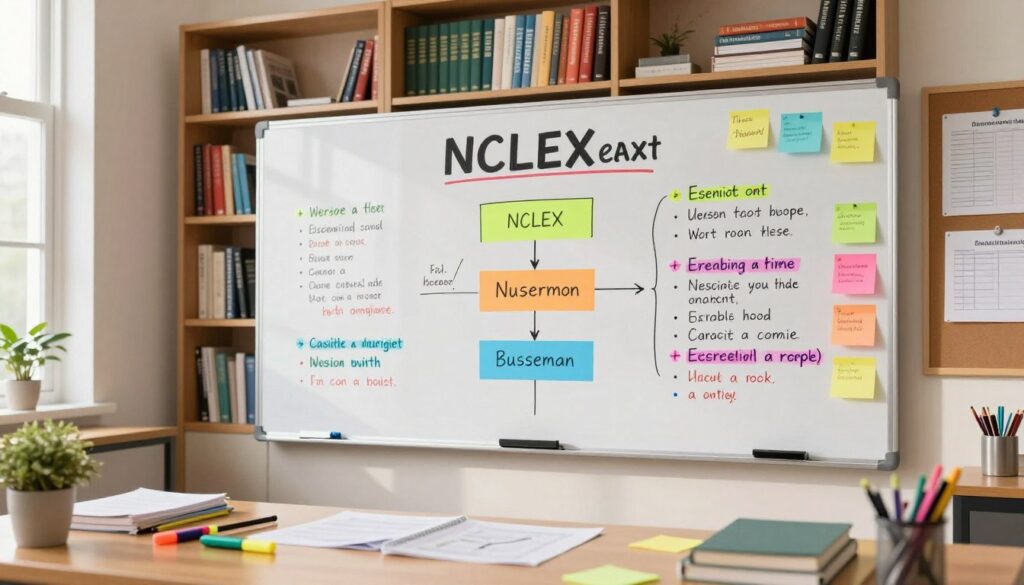
Divide your board into distinct zones before starting. This prevents your notes from becoming a cluttered mess.
Try splitting your space into quadrants. Use one area for formulas, another for nursing process steps, and a third for patient safety reminders. These whiteboard essentials for NCLEX help you maintain a logical flow.
Prioritizing Key Topics
Not every piece of information is equally important. Focus on high-yield topics that are hard to memorize under stress.
By prioritizing these core concepts, you ensure your most important data is always visible. Remember, the goal is to group ideas together instead of writing down every detail. This streamlined approach keeps your workspace clean and your mind ready for the next challenge.
Strategies for Note-Taking
Our top strategy is to quickly jot down key nursing facts at the start of the exam. By writing on whiteboard during NCLEX, you make personalized study notes. These notes serve as a backup, helping you stay calm and focused on tough questions.

Abbreviations and Symbols
Learning shorthand is essential for quick note-taking. Make a list of common medical abbreviations and symbols. Consistency is key, so pick symbols you use often in practice.
For instance, using arrows for “increase” or “decrease” saves time and space. You can also use shapes to group nursing interventions. These tweaks make your NCLEX study notes easier to scan during the exam.
Quick Reference Guides
After mastering shorthand, create quick guides for complex topics. Group related concepts together for easy access. Organizing your thoughts this way helps you quickly find important data like lab values.
View your whiteboard as a map through the exam. Keep important formulas and reminders in one spot. This strategic layout helps you focus on patient scenarios, not just memorization.
Essential Nursing Concepts
Let’s dive into how to organize key nursing knowledge to improve your test scores. Creating a visual framework is the best NCLEX whiteboard content for exam prep. It turns complex theories into practical steps for real-world scenarios.
Patient Safety and Risk Factors
Patient safety is at the heart of nursing. We suggest making a quick chart to list risk factors, like fall prevention or infection control. Visualizing these safety steps makes it easier to choose the right action in a high-pressure situation.
Also, map out patient anxiety levels. Sketch the stages—mild, moderate, severe, and panic. This best NCLEX whiteboard content helps you tell normal stress from a serious emergency.
Nursing Process Steps
The nursing process is key for solving tough problems. Write out ADPIE—Assessment, Diagnosis, Planning, Implementation, and Evaluation—at the top of your board. It keeps you on track with the logical care flow.
When faced with a hard question, go back to these steps. Using this structured method ensures consistent decision-making. Your board helps you stay patient-focused during the test.
Time Management Tips
When you sit down for your test, managing every minute is key. You need to keep a steady pace to finish strong. Using NCLEX whiteboard tips helps you stay focused and calm.
Managing work and online learning is a skill that helps in exams. By organizing well, you can control the clock with confidence.
Tracking Time During the Exam
Use your whiteboard to track your progress. Divide your exam time by the number of questions. This way, you can see how you’re doing without looking at the clock.
“Time is the most valuable thing a man can spend.”
Marking milestones on your board helps you stay on track. These NCLEX whiteboard tips let you adjust your pace if needed.
Pacing Techniques
Effective pacing is vital for complex questions. Don’t spend too much time on one question. Write down key words on your board to process information quickly.
Consistency is key in the exam. Keep a steady pace to have enough time for each scenario. These NCLEX whiteboard tips help you stay calm and finish clearly.
Common Pharmacology Topics
Struggling with drug classes? These whiteboard ideas for NCLEX will transform your study routine. Pharmacology is tough, but visual organization can make it easier.
Categories of Medications
Grouping medications by class is a smart move. Instead of memorizing each one, use color-coding on your whiteboard. This way, you can tell antihypertensives from antibiotics easily.
Color-coding helps you spot patterns in drug names. For example, “-pril” is for ACE inhibitors, and “-lol” is for beta-blockers. Keeping these groups separate helps avoid mix-ups during the exam.
Side Effects and Monitoring
It’s not just about knowing the drugs. You also need to know what to watch for in patients. Create charts on your board for essential monitoring requirements and common side effects.
This method turns your board into a quick reference guide. It helps you tackle complex scenarios faster and more accurately.
| Drug Class | Common Suffix | Primary Monitoring |
|---|---|---|
| ACE Inhibitors | -pril | Potassium levels & Cough |
| Beta-Blockers | -lol | Heart rate & Blood pressure |
| Statins | -statin | Liver enzymes & Muscle pain |
| Benzodiazepines | -pam | Respiratory rate & Sedation |
Using these whiteboard ideas for NCLEX will boost your confidence. Remember, clean and organized notes are the key to success.
Practice Questions and Scenarios
Using your whiteboard to break down practice questions is a top NCLEX exam strategy. It lets you organize information instead of trying to remember everything. This makes it easier to stay calm and focused, even when questions are tough.
Writing Sample Questions
When you face a hard question, write down the main points on your board. Focus on the key symptoms and the patient group in the question. This helps you rule out wrong answers that don’t match the situation.
This method makes the question’s logic clearer. Visualizing the data helps avoid common traps. It turns a complex question into a simple list of facts to analyze.
How to Use Scenarios for Reference
Complex patient scenarios need you to combine many details. For example, when dealing with Major Depressive Disorder (MDD), list symptoms, risk factors, and key nursing diagnoses like ‘risk for suicide.’ Having this organized on your board is a reliable reference for the whole question.
Breaking down these scenarios makes complex ideas easier to handle. This is a key NCLEX exam strategy for ensuring patient safety. Seeing everything laid out helps you choose the right nursing action.
Stress Management Techniques
We think managing stress is key to doing well on the NCLEX test. Knowing a lot is important, but staying calm is even more so. Use your whiteboard to keep your focus sharp during the test.
Visualization and Mindfulness
Visualization keeps you focused on your goals, even when the test seems tough. Write down positive thoughts or a mental map of success on your whiteboard. If anxiety hits, look at these notes to calm down.
Imagine teaching the material to someone. Even whispering out loud helps you understand questions better. This makes your whiteboard a collaborative partner, making the test feel less scary.
Breathing Exercises
Long exams can make you tense, which clouds your thinking. Use your whiteboard to remind you to breathe. Write “Breathe” or “Slow Down” when you need a break.
Using these NCLEX test-taking strategies has many benefits:
- Regulates your heart rate during high-pressure questions.
- Helps you reset your focus after a difficult scenario.
- Prevents mental fatigue by encouraging short, intentional pauses.
Your board is more than just for formulas; it’s for managing your mind. Stay aware of your body to keep your mind sharp. Trust your prep and use these tools to stay confident until the end.
Final Review Checklist
Your journey is almost complete, and a final review will help solidify your hard work. Take a moment to organize your thoughts before the test. This will ensure you feel ready. By refining your NCLEX preparation notes, you can walk into the testing center with total confidence.
What to Double-Check Before the Exam
Most nursing professors provide an exam blueprint that outlines the core competencies. Make your own study guide based on this blueprint. This way, you ensure you cover every required topic.
Review your NCLEX preparation notes to confirm you’ve mastered the most challenging concepts. Check that your formulas, lab values, and medication categories are clearly written and easy to recall. This structured approach ensures no critical information is left behind during your final study sessions.
Last-Minute Reminders
As the big day approaches, remember that your mental well-being is just as important as your academic knowledge. Ensure you have your identification and testing documents ready the night before to avoid unnecessary stress.
Keep your NCLEX preparation notes handy for a quick review, but avoid cramming new information at the last second. Trust in the preparation you have already completed and focus on staying calm. You have worked hard to reach this point, and you are ready to succeed.
Celebrating Your Preparation
Getting a nursing license takes a lot of hard work and determination. Finding good study habits can be tough at first.
Tools like Quizlet and active recall are key. They make hard information easy to remember with NCLEX study notes.
Reflecting on Your Journey
Look back at how far you’ve come. Every hour of studying brings you closer to your nursing dreams.
You’ve built a solid base with hard work and smart planning. This shows you’re ready for nursing’s challenges.
Staying Positive and Motivated
Stay focused as your exam date gets closer. Trust your study systems to help you stay organized and on time.
Your dedication to doing well shows in your work. Bring this confidence to your exam and your nursing career.