


Did you know that nearly 70% of all clinical decisions depend on diagnostic testing? This shows why mastering these metrics is key in nursing. We know memorizing data can be tough, but it’s essential for your success.
While specific ranges can differ between hospitals, knowing the basics is vital for patient safety. Our aim is to make this complex info easy to understand. This way, you’ll feel confident and prepared for your licensure test. We focus on the most important parameters to make studying easier.
Curious about What are normal lab values for NCLEX? or need a quick review? We’ve got you covered. We break down key lab values for NCLEX exam success into easy-to-manage pieces. Let us help you through the numbers that are most important for your career.
Key Takeaways
- Diagnostic data drives the majority of clinical decision-making in healthcare settings.
- Focusing on core ranges helps you navigate variations between different medical institutions.
- Simplifying complex data reduces test anxiety and improves your overall performance.
- Prioritizing frequently tested parameters ensures efficient use of your study time.
- Mastering these metrics builds the clinical judgment required for your nursing career.
Understanding Laboratory Values in Nursing
Laboratory testing is key in modern medicine. It gives us the data to confirm diagnoses and track illnesses. Remember, normal lab values NCLEX are just guidelines. Each healthcare facility has its own ranges.
Importance of Lab Values in Patient Care
To care for patients safely and effectively, we must know the testing process well. This knowledge helps us get accurate data and understand it for our patients:
- Pretest preparation: Teach the patient and make sure they follow the right steps, like fasting.
- Intratest specimen collection: Keep everything clean and label samples correctly.
- Post-test observation: Watch for any bad reactions or problems after the test.
Knowing common lab values for NCLEX helps us meet our patients’ needs. This knowledge lets us act fast when results are not what we expect.
How Lab Values Impact Nursing Decisions
Understanding NCLEX normal ranges is more than just knowing numbers. It’s about making smart choices. Knowing why a test is ordered helps us explain it to patients. This reduces their stress and builds trust.
Our skill in analyzing these results affects the care we give. Whether we’re changing a care plan or telling a doctor about a key finding, our decisions are based on solid knowledge. Always check the reference ranges your facility uses. These common lab values for NCLEX can vary due to different equipment and methods.
Using NCLEX normal ranges well helps us fight for our patients. Spotting abnormal trends early lets us act before things get worse. This ensures better health for everyone we care for.
Hematology Lab Values You Should Know
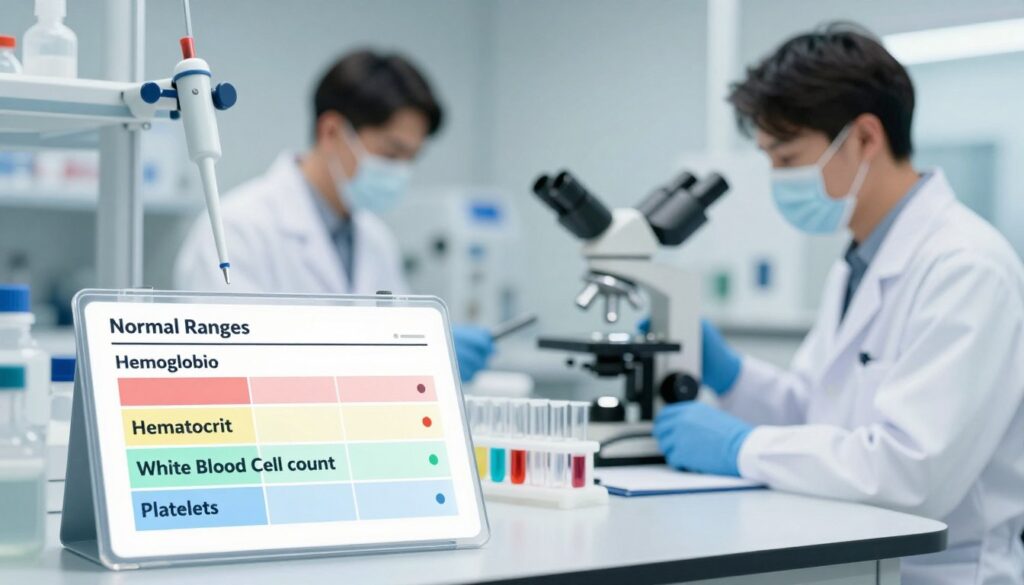
Looking at a patient’s blood work gives you a peek into their health. Hematology studies are key tests to find infections, anemia, and blood disorders. Learning these NCLEX lab values is essential for safe patient care.
Complete Blood Count (CBC) Overview
A complete blood count, or CBC, is a basic test that tells a lot about a patient’s health. It checks five important parts to see how the body works. These parts are:
- Red Blood Cells (RBCs)
- White Blood Cells (WBCs)
- Hemoglobin (Hgb)
- Hematocrit (Hct)
- Platelets
Normal Hemoglobin Levels
Hemoglobin is the protein in red blood cells that carries oxygen. Low levels mean anemia, while high levels might show dehydration or chronic hypoxia. Keeping these levels right is key for oxygen to reach tissues.
White Blood Cell Count (WBC) Ranges
White blood cells fight infections. A high WBC count means the body is fighting off an infection. A low count could mean a weak immune system, needing quick nursing help.
Platelet Levels and Their Significance
Platelets help blood clot and stop bleeding. Knowing these lab values for the NCLEX exam helps spot patients at risk for bleeding or clotting problems. Always watch these levels closely, like when patients are on blood thinners or having surgery.
| Component | Normal Range | Clinical Significance |
|---|---|---|
| Hemoglobin | 12–18 g/dL | Oxygen transport |
| WBC Count | 5,000–10,000/mm³ | Immune response |
| Platelets | 150,000–400,000/mm³ | Clotting ability |
By learning these NCLEX normal ranges, you’ll feel more sure when looking at NCLEX lab results. Remember, lab values for the NCLEX exam are more than numbers. They show how your patient is doing with treatment. Keep practicing these NCLEX lab values to be ready for the exam.
Chemistry Lab Values: Key Indicators of Health
Learning about common lab values for NCLEX is key. These tests show us a patient’s metabolic state. They help us spot problems early. By knowing normal lab values NCLEX standards, we make sure our care is precise and focused on the patient.
Basic Metabolic Panel (BMP) Explained
A Basic Metabolic Panel, or BMP, is a common blood test. It checks several blood substances. It’s a vital tool for checking kidney function, blood sugar, and electrolyte balance. We use these results to manage chronic conditions and see how medicines affect the body.
Glucose Levels and Their Implications
Glucose is our main energy source. Keeping it in a healthy range is key. When we check glucose levels, we look for signs of high or low blood sugar. This can mean diabetes. Early detection helps us act fast and avoid serious problems for our patients.
Electrolytes: Sodium and Potassium Normal Values
Electrolytes are minerals that help with fluid balance and nerve function. Sodium controls blood pressure and volume. Potassium is important for heart and muscle function. We must watch these values closely, as small changes can cause big symptoms.
| Test Parameter | Normal Range | Clinical Significance |
|---|---|---|
| Glucose (Fasting) | 70–99 mg/dL | Metabolic energy status |
| Sodium | 135–145 mEq/L | Fluid balance regulation |
| Potassium | 3.5–5.0 mEq/L | Cardiac and muscle function |
| Creatinine | 0.6–1.2 mg/dL | Kidney filtration health |
Knowing these NCLEX normal ranges is essential for nurses. By regularly checking these values, we gain the confidence to provide safe and effective care anywhere.
Special Considerations for Liver Function Tests
When we check liver health, we use special enzymes as our main tools. These markers help us spot liver damage or disease by seeing how well the liver works. Knowing these normal lab values NCLEX is key for safe and effective care.

Liver cells release enzymes into the blood when they get hurt. By watching these levels, we can see how liver conditions are getting better or worse. This helps us make smart clinical choices. Remembering these NCLEX lab reference values helps us understand patient symptoms better.
Alanine Aminotransferase (ALT) Normal Range
The ALT enzyme is mostly in the liver and shows liver health well. The normal range for ALT is 4 to 36 U/L. If ALT levels go up, it means liver cells are hurt or inflamed, and we need to act fast.
Aspartate Aminotransferase (AST) Levels
AST is in the liver, heart, and muscles. We check AST with ALT to find where damage is. Big increases in AST and ALT usually mean liver injury or long-term disease.
Alkaline Phosphatase (ALP) Values
ALP is in the liver, bile ducts, and bones. We use ALP to find bile duct blockages or bone problems. Knowing these NCLEX lab reference values helps us tell different health issues apart.
Kidney Function Lab Values
We use blood and urine markers to check kidney function. Knowing these lab values for NCLEX exam is key for nurses. These markers help us spot kidney problems early and prevent them from getting worse.
Creatinine and Blood Urea Nitrogen (BUN) Levels
The kidneys filter our blood, and BUN and creatinine show how well they do this. Blood Urea Nitrogen (BUN) should be between 6 to 20 mg/dL. If it’s higher, it means the kidneys are not removing waste well.
Creatinine is another important indicator. It shows how well the kidneys filter blood, unlike BUN which can change with hydration or diet. High levels of both suggest kidney problems.
Urinalysis: Key Findings to Interpret
Urinalysis gives us a quick look at kidney health and infections. We check for protein, glucose, or blood in the urine. These NCLEX lab reference values tell us if there’s an infection or kidney damage.
Remember, a clean-catch urine sample is essential for accurate results. Nitrites or leukocyte esterase mean a bacterial infection. By understanding these, we can choose the best treatment for our patients.
Coagulation Profiles: What to Know
When we examine NCLEX lab results, coagulation studies are key. These tests are vital for patients on blood thinners or at risk for clotting issues. Knowing these NCLEX lab reference values helps us spot risks of bleeding or clotting.
Prothrombin Time (PT) and INR Ranges
The Prothrombin Time (PT) shows how long it takes for blood to clot. For those not on blood thinners, it’s usually 11 to 13.5 seconds. We use the International Normalized Ratio (INR) to standardize these results, mainly for warfarin users.
A normal INR is 1.1 or below for a healthy person. If a patient’s levels are off, we must quickly adjust their treatment. Keeping these numbers in the right range is crucial to avoid complications.
Activated Partial Thromboplastin Time (aPTT)
While PT/INR checks warfarin, aPTT is for heparin users. This test ensures the heparin dosage is right without causing too much bleeding. We compare these results to the baseline to keep patients safe.
| Test Name | Normal Range | Primary Use |
|---|---|---|
| Prothrombin Time (PT) | 11–13.5 Seconds | Warfarin Monitoring |
| INR | 1.1 or below | Standardized Clotting Time |
| aPTT | 25–35 Seconds | Heparin Monitoring |
Knowing these NCLEX lab reference values helps us give better care at the bedside. Always be quick to notice changes in these levels and talk to the healthcare team. Being alert to these changes keeps us skilled and confident in our work.
Thyroid Function Tests and Their Ranges
When we look at NCLEX lab parameters, thyroid function tests are key. They show if the thyroid is working right. This is important for health, energy, and weight. Knowing these common lab values for NCLEX helps us give better care.
Thyroid Stimulating Hormone (TSH) Levels
The TSH test is the first step to check the thyroid. It’s made by the pituitary gland. It tells the thyroid to make its hormones. Normal TSH levels are usually between 0.4 and 4.0 mIU/L for healthy adults.
If TSH levels are not in this range, it means there’s a problem. High TSH means the thyroid is not making enough hormones. Low TSH means it’s making too much. We watch these levels to catch problems early.
T3 and T4 Normal Values
T3 and T4 are the hormones made by the thyroid. They show how well the body’s metabolism is working. Knowing when these levels are off is important for nursing care.
| Test | Normal Range | Clinical Significance |
|---|---|---|
| TSH | 0.4 – 4.0 mIU/L | Primary screening marker |
| Total T4 | 5.0 – 12.0 mcg/dL | Reflects thyroid output |
| Total T3 | 80 – 220 ng/dL | Active metabolic hormone |
People with too much thyroid hormone have high T3 and T4 and low TSH. Those with too little have low T4 and high TSH. Knowing these standard reference ranges helps us understand test results during our rotations.
Cultures and Sensitivities in Infection Management
Identifying the cause of infections is key to good nursing care and smart use of antibiotics. When we think a patient has a systemic infection, we need exact test results to pick the best treatment. Learning these NCLEX lab parameters helps us give our patients the safest care.
Importance of Blood Cultures
Blood cultures are essential for finding the cause of unexplained fevers. We must use strict sterile technique to avoid contamination. This prevents false positives that could lead to wrong treatments.
Knowing the exact pathogen helps us choose the best medicine. This is a big part of NCLEX lab results interpretation. Quick reporting of these results helps us adjust care plans fast.
Urine Culture Normal Findings
A clean-catch midstream urine sample is key for spotting urinary tract infections. In a healthy person, a normal urine culture should show no growth or very few bacteria. Teaching patients how to collect the sample right is important.
When looking at NCLEX lab results, remember that many bacteria often mean contamination, not infection. Always check these results with the patient’s symptoms and other NCLEX lab parameters. Our job in collecting samples affects the quality of the data for making decisions.
Preparing for the NCLEX: Essential Tips
Success on your nursing boards depends on how well you apply clinical data to patient scenarios. Spend at least 8 to 10 weeks studying before your exam. This ensures you cover every topic thoroughly.
Building a consistent routine helps you retain complex information without feeling overwhelmed. Mastering NCLEX lab values becomes easier when you understand the clinical reasoning behind each result.
Effective Study Techniques
Move beyond simple memorization by analyzing how specific results change in different disease states. This approach turns your understanding of NCLEX lab parameters into a practical tool for your future nursing career.
Use flashcards or digital apps like UWorld or Kaplan to test your knowledge in a simulated environment. These resources provide high-quality practice questions. They help build your confidence and improve your speed.
Staying Consistent and Focused
Managing your energy levels is just as important as reviewing your notes. Take short, frequent breaks to prevent burnout during your final weeks of preparation.
Focus on your progress, not the volume of material left to cover. You have the skills to excel. Steady practice will lead you to the results you want on test day.