
Ever wondered how top nurses make quick decisions when a patient’s life is at risk? In urgent clinical settings, knowing where to start can be tough. We think mastering a systematic approach is key to acing your NCLEX exam prep.
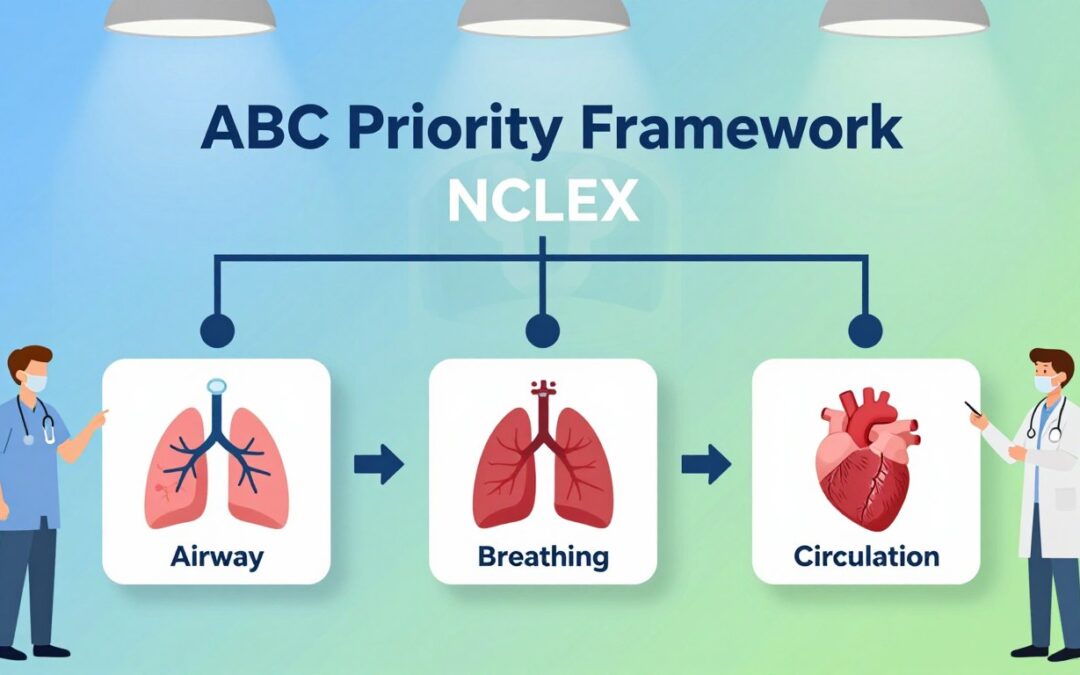
This guide looks at the ABC priority framework, a key tool for sorting patient needs. It focuses on Airway, Breathing, and Circulation to spot critical issues early. This way, you can act fast when every second counts.
Grasping this logic boosts your confidence in tackling complex clinical questions. We’ll dissect each part of this model to aid your growth and test success. Let’s explore how this strategy changes your nursing approach.
Key Takeaways
- The system prioritizes Airway, Breathing, and Circulation to save lives.
- It serves as a foundational tool for effective clinical decision-making.
- Students use this method to manage high-acuity patient scenarios.
- Mastering these steps improves your performance on standardized nursing tests.
- This approach helps you stay calm and focused during emergencies.
Understanding the ABC Framework in Nursing
The ABC priority framework is our guide in complex patient care. It helps us quickly spot life-threatening issues. This method is key to clinical decision-making in our careers.
What Does ABC Stand For?
The framework focuses on three key areas. We use these letters to prioritize our patients’ needs:
- Airway: Making sure air can easily reach the lungs.
- Breathing: Checking if the patient is breathing well.
- Circulation: Looking at the heart’s ability to pump blood.
Importance of the ABC Framework in Nursing
Knowing this system is key for NCLEX prioritization. It helps us stay focused in emergencies. By learning these steps, we improve our clinical judgment.
This framework is more than just for exams. It’s a daily tool for nursing prioritization. It helps us manage tasks for multiple patients. This way, we focus on the most urgent needs.
The Role of Prioritization in Patient Care
Nursing priority setting means evaluating problems based on urgency. We decide which tasks need immediate action and which can wait. This skill makes us better nurses.
Good nursing priority setting goes beyond symptoms. We consider the risk of quick decline versus current stability. By practicing NCLEX prioritization and nursing prioritization, we become more confident in our care.
Airway Management: The First Priority
Every nurse knows that the airway is the top priority in ABCs of patient care. We must make sure the patient can breathe easily before we do anything else. Without a clear airway, all other treatments won’t work well.
Signs of Airway Obstruction
Spotting an airway block early can save lives. Look for voice changes or stridor sounds. These signs mean the airway is narrowing.
“See-saw” breathing is another warning sign. It means the patient is struggling to breathe. Knowing these signs is key in ABCs of patient care.
“The airway is the gateway to life; if it is closed, the rest of the body cannot receive the oxygen it desperately needs to function.”
Techniques for Opening the Airway
When we find an obstruction, we must act fast. The head-tilt/chin-lift maneuver works well for most patients. But for those with neck injuries, we use the jaw-thrust maneuver to avoid harm.
| Assessment Sign | Clinical Meaning | Recommended Action |
|---|---|---|
| Stridor | Upper airway narrowing | Prepare for advanced airway |
| See-saw breathing | Severe respiratory effort | Manual repositioning |
| Silent chest | Complete obstruction | Immediate intervention |
When to Seek Advanced Interventions
Basic methods might not work for everyone. If a patient can’t breathe well, we need to act fast. We might use an oropharyngeal or nasopharyngeal airway to keep the airway open.
In serious cases, we prepare for advanced airway management. This could mean endotracheal intubation. Always be ready to call for help when needed. Quick action is key to saving lives.
Breathing: Assessing Respiratory Function
Checking how well a patient breathes is a key part of ABCs of patient care after we make sure their airway is clear. We need to see if they are getting enough oxygen to keep their organs working right.
Key Indicators of Proper Breathing
We look for certain signs to see if a patient is breathing well. A normal adult breathes between 12 and 20 times per minute. If they breathe more or less than this, it’s a sign they might be in trouble.
We also check how hard they are trying to breathe. Signs that need quick action include:
- Accessory muscle use: Seeing muscles in the neck or chest working hard.
- Cyanosis: Seeing a blue color on the skin, lips, or nails.
- Irregular patterns: Breathing that is shallow, gasping, or not even.
Interventions for Respiratory Distress
If we see signs of trouble, we must act fast. These steps are part of the ABCs of patient care and help keep things from getting worse. We might give extra oxygen through a mask or nasal tube.
In serious cases, we might need to help the patient breathe by hand. Spotting these needs early is key to helping them get better. We watch how the patient does with these steps to make sure they’re getting enough oxygen.
Common Conditions Affecting Breathing
Many health issues can make it hard for a patient to breathe. Knowing about these helps us plan the care we’ll need during our check-up.
| Condition | Primary Impact | Nursing Focus |
|---|---|---|
| Asthma | Airway constriction | Bronchodilators |
| COPD | Reduced gas exchange | Oxygen titration |
| Pneumonia | Fluid in lungs | Positioning/Suction |
By being careful and quick, we make sure every patient gets the help they need to breathe well. Practicing these skills makes us better at giving top-notch care in any setting.
Circulation: Ensuring Effective Blood Flow
After we’ve checked the airway and breathing, we focus on the heart. Keeping blood flowing well is key in the ABCs of patient care. Every nurse must know this to keep patients stable.

Assessing Pulse and Blood Pressure
We start by checking the patient’s pulse and blood pressure. A strong pulse means the heart is working well. But a weak pulse could mean trouble.
Looking at the skin also tells us a lot. Pale, cool, or clammy skin means blood might not be reaching the hands and feet. Capillary refill time is also important. In a healthy adult, color should return to the nail bed in about two seconds.
Recognizing Signs of Shock
Spotting shock early is critical to prevent it from getting worse. We watch the patient’s alertness closely. If they seem confused or sleepy, it’s a sign they might not have enough oxygen.
A sudden drop in blood pressure and a fast heart rate are big warning signs. By noticing these signs, we can act fast to help the patient.
Interventions for Circulatory Issues
When we find circulatory problems, we act quickly. We might elevate the patient’s legs or give fluids to help their blood volume.
The table below shows how we check if a patient’s blood flow is okay during an emergency:
| Indicator | Healthy Finding | Concerning Finding |
|---|---|---|
| Capillary Refill | Under 2 seconds | Over 3 seconds |
| Skin Temperature | Warm to touch | Cool or clammy |
| Mental Status | Alert and oriented | Confused or lethargic |
| Pulse Quality | Strong and regular | Weak or thready |
By using these methods, we make sure the ABCs of patient care are always our top priority. Keeping a close eye on blood flow helps us give our patients the best care.
Beyond ABC: Introducing the D and E of Prioritization
The ABCs are just the start. To keep patients safe, we need to look at more than just the basics. We must consider disability and the environment too. This helps us use clinical judgment to understand a patient fully.
The Importance of Disability Assessment
After we’ve checked the airway, breathing, and circulation, we look at the brain. This step, called Disability, tells us about brain function and recovery chances. Quickly spotting changes in consciousness helps us act fast to prevent big problems.
We use tools like the Glasgow Coma Scale or simple pupil checks for this. Regular monitoring is key because a sudden drop in brain function is a warning sign. This step is vital for moving from basic care to full treatment.
“The true measure of a nurse’s skill lies not just in the initial stabilization, but in the ability to anticipate the patient’s needs through thorough and ongoing assessment.”
Understanding Exposure and Environment
The last parts of our framework are Exposure and Environment. Exposure means checking the patient fully for hidden injuries or rashes. We do this while keeping the patient’s dignity and privacy in mind.
Managing the environment is also key for recovery. We must think about things like temperature and hazards around the patient. By focusing on these, we make sure our care is complete and focused on the patient in every urgent situation.
Applying the ABC Framework in Practice Scenarios
Learning nursing prioritization is best done through real-world scenarios. This method sharpens our clinical judgment and prepares us for NCLEX prioritization questions. Regular practice makes these steps second nature.
Case Study: Emergency Situations
In emergencies, we quickly assess patients using “Look, Listen, and Feel.” We check for responsiveness, airway, and breathing in under 30 seconds. If we find an obstruction, we act fast to ensure oxygen flow.
“The art of nursing is not just in the tasks we perform, but in the speed and accuracy with which we assess the patient’s immediate needs.”
Case Study: Routine Nursing Care
During routine rounds, the ABC framework keeps patients stable. We use NCLEX test strategies to catch any signs of decline. This way, we prevent emergencies.
Case Study: Multi-Patient Situations
When caring for many patients, we prioritize based on ABC deficits. We focus on airway and breathing first. This ensures we save lives by allocating our time wisely.
| Scenario Type | Primary Focus | Assessment Speed |
|---|---|---|
| Emergency | Airway & Breathing | Under 30 Seconds |
| Routine Care | Baseline Stability | 1-2 Minutes |
| Multi-Patient | Triage by Acuity | Rapid Scanning |
Practicing these scenarios sharpens our clinical intuition. Mastering NCLEX test strategies boosts our confidence in handling complex NCLEX prioritization tasks. Our goal is to provide safe, effective care through disciplined assessment.
Integrating ABC With Other Nursing Theories
Combining different nursing prioritization strategies often leads to better patient care. The ABC framework is great for emergency situations. But, it works even better when paired with other theories.
How ABC Complements Maslow’s Hierarchy
Maslow’s Hierarchy of Needs explains what drives us. At the bottom, we find physiologic needs like air, water, and shelter. These needs match the ABC framework, focusing on survival.
“The nurse must recognize that the physiologic needs are the most prepotent of all needs. When these are not met, the patient cannot focus on higher-level goals like safety or belonging.”
Using these models together ensures we focus on the most critical needs first. Once airway, breathing, and circulation are stable, we can address safety and comfort.
The Relationship with Prioritization Frameworks
Each clinical situation needs a different approach. ABC is perfect for emergencies, but other models are better for chronic conditions or complex cases. The table below shows how these models differ.
| Framework | Primary Focus | Best Used For |
|---|---|---|
| ABC | Physiologic Stability | Emergency/Acute Care |
| Maslow | Human Needs | Holistic Care Planning |
| Urgency Factor | Time Sensitivity | Task Management |
| Safety/Risk | Harm Prevention | Patient Environment |
By integrating these theories, we can improve our nursing prioritization. Choosing the right tool for each situation leads to safer, more effective care for all patients.
Teaching the ABC Framework in Nursing Education
We aim to make the ABC framework a natural clinical instinct for students. They need more than just definitions to handle high-pressure situations. By teaching these principles early, we prepare nurses to quickly assess patient needs.

Curriculum Development for Nursing Programs
Effective curriculum design weaves the ABC framework into core nursing modules. We support a spiral approach, where students revisit these priorities in complex settings. This keeps the framework a foundational pillar in their learning.
Faculty should align lesson plans with real-world patient needs. Standardized teaching helps students develop a consistent mental map. This makes their transition from classroom to clinical floor smoother.
Simulation and Role-Play Exercises
We use screen-based simulations for students to practice decision-making in a safe, controlled environment. These digital tools let learners face emergencies without risking patient safety. It’s a great way to see how they apply the ABCs under pressure.
Role-play exercises help bridge theory and practice. Students act out scenarios, learning to communicate and manage patient care. Active participation in these sessions boosts their confidence for real clinical rotations.
Encouraging Critical Thinking in Students
Nursing programs must foster critical thinking. We encourage students to question why they’re taking a certain action before acting. This turns passive memorization into active clinical judgment.
By presenting students with multi-patient scenarios, we challenge them to prioritize tasks based on the ABC framework. This training prepares them to quickly identify which patient needs immediate attention. Our goal is to produce graduates who can think clearly and act decisively in any healthcare setting.
Common Misconceptions About the ABC Framework
Many think the ABC priority framework is the only tool for nurses. But, it’s just a start for patient assessment. It’s not enough for complex cases. Nursing needs a flexible approach for each patient’s unique needs.
Myths Surrounding ABC Prioritization
One myth is that the ABC priority framework works alone, no matter the patient’s state. Some think a patent airway means a patient is stable, which isn’t always true. Nurses might miss important issues like pain or mental health problems because they focus too much on the ABCs.
Another myth is that nurses only use this framework. But, being great at nursing means using many models for full care. Prioritization is an art, not just a checklist for every case.
Clarifying Misunderstandings in Clinical Settings
We must know when to use the ABCs and when other models are better. For example, if a patient is at risk for falls or medication mistakes, safety might be more important than breathing. Understanding this balance helps us avoid mistakes.
By critically evaluating the patient’s situation and history, we decide when to change our approach. Using the ABC priority framework with other tools keeps our care high. We should see these guidelines as a starting point, not a limit to our professional judgment.
Evaluating Patient Outcomes Using ABC Framework
How do we know if our strategies are working for our patients? We need to look beyond daily tasks. The tangible impact of our decisions is key. By using the ABC framework, we make a safer place for faster recovery in critical care units.
Metrics for Assessing Effectiveness
To measure success, we use specific indicators. These metrics show if our immediate interventions are effective. Prioritizing airway, breathing, and circulation often leads to fewer bad events.
We track these outcomes to keep our nursing practice up-to-date and effective. The table below shows how the ABC framework improves patient results.
| Performance Metric | Goal of ABC Application | Expected Outcome |
|---|---|---|
| Response Time | Rapid stabilization | Reduced code events |
| Patient Safety | Early intervention | Fewer complications |
| Recovery Rate | Optimized oxygenation | Shorter hospital stay |
Feedback Mechanisms in Nursing Practice
Continuous evaluation sharpens our clinical judgment. We use feedback loops to improve our skills. Post-conference reviews are key for discussing successes and areas for improvement.
Simulation debriefings let us test our logic safely. Reflecting on these scenarios gives us valuable insights. Every shift is a chance to grow and better care for our patients.
Preparing for the NCLEX With ABC Prioritization
Wondering about the ABC priority framework for NCLEX? You’re on the right path to success. Learning this system is essential for making quick, safe decisions in high-pressure situations. With the right strategy, you can make this complex topic your strongest point on exam day.
Tips for Studying the ABC Framework
Good NCLEX study tips focus on active recall and application. Instead of just memorizing, try to picture how a patient’s condition changes. This helps you understand the order of needs.
Your NCLEX exam prep should include practicing with priority-setting items. These tools help you learn to identify the first action in critical situations. Regular practice builds the quick thinking needed for the test.
“The art of nursing is not just about knowing the facts, but about knowing which fact matters most in the moment.”
Practice Questions Related to the Framework
When you see NCLEX test strategies, you’ll notice a big focus on stable vs. unstable patients. Practice questions are key to improving your clinical judgment. Always ask: “If I don’t act now, will this patient’s life be in danger?”
Practice questions that ask you to rank interventions are important. You might see four correct actions, but only one is the priority based on the ABCs. Mastering this will boost your confidence and prepare you for the exam’s clinical judgment sections.
Conclusion: The Importance of ABC in Nursing Practice
The ABC framework is key for nurses in today’s healthcare world. It keeps patient safety at the center of every shift. This ensures that care is always focused on what’s most important.
Good nursing prioritization changes how we handle tough situations. It helps us quickly spot and deal with serious problems. This method connects theory with the real world of hospitals.
Refining Your Professional Approach
Think of these steps as a tool that grows with you. Using them regularly makes you ready for critical times. Your confidence will grow as you trust these methods to guide you.
The Future of Patient Safety
Even as technology gets better, nursing skills are essential. We’re excited to see how you use these skills to better patient care. Your hard work in mastering these basics sets a high standard for future nurses.