

Ever thought if your brain can hold all nursing facts for the boards? Many students worry about the huge amount of medical data. It keeps them up at night, feeling overwhelmed.
Dealing with NCLEX study materials seems like climbing a huge mountain without a map. Instead of trying to learn everything, we focus on key concepts. These are the ones that show up most on the exam.
With good NCLEX preparation strategies, we turn our study time into a clear plan. Learning these main topics helps us feel less anxious on test day. It also makes us more confident in our future nursing career.
Key Takeaways
- Focus on high-yield clinical concepts instead of memorizing every detail from textbooks.
- Use organized study plans to handle the huge amount of nursing info.
- Put first priority on understanding key safety and delegation principles to do well on the exam.
- Use active recall techniques to keep important data in your long-term memory.
- Lower test-day stress by sticking to a routine with trusted study resources.
Understanding the NCLEX Exam Structure
Before we dive into our review, let’s grasp the NCLEX exam structure. Whether we’re aiming for the NCLEX-RN or the NCLEX-PN, knowing the exam’s mechanics is key. This knowledge boosts our confidence when we take the test.
Format of the Exam
The exam uses Computer Adaptive Testing (CAT). It adjusts the difficulty based on our answers. This means the number of questions can vary greatly from person to person. We might see anywhere from 75 to 145 questions.
Consistency is key when studying for the NCLEX. The computer picks questions based on our answers. We must stay focused to show our competency level efficiently.
Types of Questions
On test day, we’ll face more than just standard multiple-choice questions. Many wonder, “What should I memorize for the NCLEX?” to prepare for these unique formats. It’s wise to practice these early in our study plan:
- Multiple-choice questions with one correct answer.
- Select-all-that-apply (SATA) items.
- Ordered response or drag-and-drop questions.
- Fill-in-the-blank calculations.
Scoring System
The scoring system doesn’t just count correct answers. It checks if we can make safe clinical judgments. We pass if the computer is 95% sure we’re above the passing standard.
One top NCLEX exam tip is to see every question as a chance to show safe practice. The table below shows the main differences between the two exams we might take.
| Feature | NCLEX-RN | NCLEX-PN |
|---|---|---|
| Primary Focus | Registered Nurse Scope | Practical Nurse Scope |
| Question Range | 75 – 145 | 75 – 145 |
| Time Limit | 5 Hours | 5 Hours |
| Goal | Safe Entry-Level Practice | Safe Entry-Level Practice |
Key Nursing Principles to Memorize
When we prepare for the NCLEX, we focus on key concepts that guide our decisions. Mastering these principles is essential for making good choices during the exam. With the right strategies, we can tackle tough questions with confidence.

Maslow’s Hierarchy of Needs
Memorizing for the NCLEX means understanding how to prioritize patient care. Maslow’s Hierarchy of Needs is a vital framework for deciding which needs to address first. We start with physiological needs like oxygen and nutrition.
Using this model, we tackle life-threatening issues first. This approach helps us manage complex situations where many needs compete. Prioritization is key to success in these situations.
Nursing Process Steps
The nursing process is critical for both NCLEX-RN and NCLEX-PN candidates. We use ADPIE—Assessment, Diagnosis, Planning, Implementation, and Evaluation—to organize care. Each step builds on the last for a comprehensive plan.
Assessment is our first step, as we can’t plan without accurate data. Remember, the ABCs—Airway, Breathing, and Circulation—are always first in assessment. This systematic approach ensures we don’t miss critical details during the exam.
Infection Control Principles
Keeping a safe environment is essential in nursing. We must know standard precautions to protect ourselves and patients from infections. These principles are tested often, so we should be ready to apply them in different settings.
For both NCLEX-RN and NCLEX-PN, knowing isolation and hand hygiene rules is crucial. These protocols are our first defense in patient safety. Consistency in following these rules shows we’re ready to provide top-notch care.
Common Lab Values You Must Know
When we prepare for the NCLEX, memorizing specific lab values is key. These values help us quickly check if a patient is stable. Knowing when a result is off helps us provide safe care.
Electrolytes
Electrolytes keep our fluids balanced and our nerves working right. We focus on the most important critical values for the exam. For example, knowing potassium levels should be between 3.5 to 5.0 mEq/L is essential. Levels outside this range often need quick nursing action.
Complete Blood Count (CBC)
The CBC shows our patient’s health status. We need to know the normal ranges for white blood cells, hemoglobin, and platelets. A platelet count under 150,000/mm³ means we should watch for bleeding risks. Learning these lab values helps us act quickly and effectively.
Renal Function Tests
Checking kidney health is common in clinical questions. We focus on memorizing normal ranges for Blood Urea Nitrogen (BUN) and creatinine. A creatinine over 1.2 mg/dL means kidney function is likely impaired. Keeping these lab values in mind helps us tackle tough NCLEX sections with confidence.
Medications and Their Classifications
We need to understand medication classifications well to do well on the NCLEX. Knowing how drugs are grouped helps us remember their nursing implications during exams. This knowledge ensures safer care for patients.
Common Drug Classes
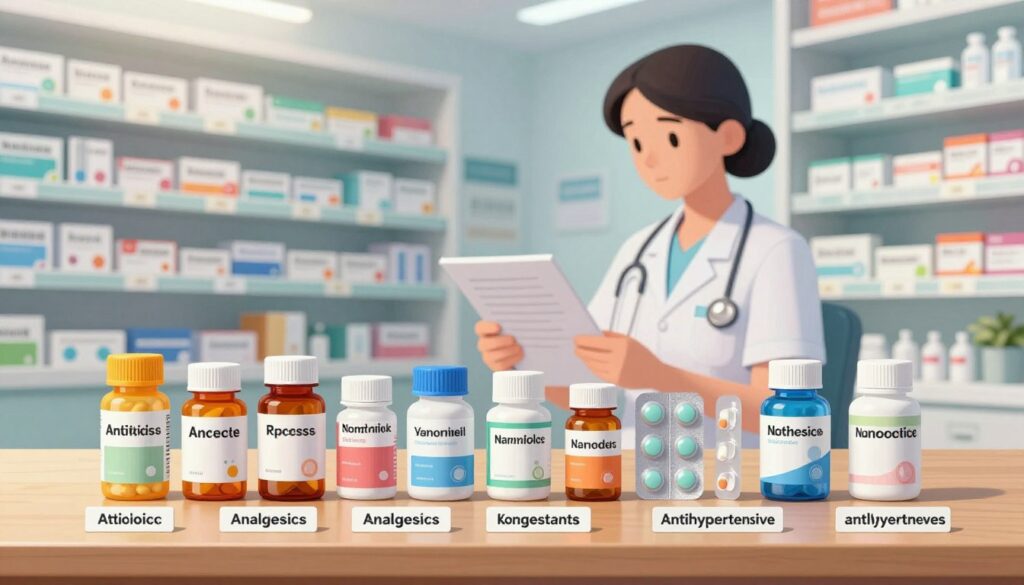
Grouping drugs helps us predict their effects in the body. When studying, focus on the suffix or the drug’s main action. For a quick review, check out this NCLEX medications cheat sheet.
- Antihypertensives: Drugs like ACE inhibitors often end in “-pril.”
- Antibiotics: Classes such as penicillins or cephalosporins target specific bacterial structures.
- Analgesics: These range from non-opioids to potent narcotics used for pain management.
Side Effects and Interactions
Every drug can have unwanted effects. We must watch patients closely for these side effects. Always check for drug-drug or drug-food interactions before giving the drug.
| Drug Class | Common Side Effect | Nursing Priority |
|---|---|---|
| Anticoagulants | Increased bleeding | Monitor PT/INR levels |
| Diuretics | Electrolyte imbalance | Check potassium levels |
| Beta-Blockers | Bradycardia | Assess apical pulse |
High-Risk Medications
Certain drugs need extra care because of their narrow therapeutic index. These medication classifications require precise dosing and frequent checks to avoid toxicity. For example, when giving Digoxin, we must check the apical pulse for a full minute before the dose.
If the heart rate is too low, we should not give the drug and tell the doctor. Patient safety is our main goal when using these strong medicines. By following these steps, we show our clinical judgment and professionalism.
Signs and Symptoms of Common Conditions
Learning to link symptoms to their causes is a game-changer. It helps us spot patient problems fast and right. Knowing these connections lets us tell apart similar scenarios on the test.
Cardiovascular Issues
Heart health demands we watch for key signs of trouble. Look for jugular vein distention in right-sided heart failure. Also, crushing chest pain that spreads to the left arm or jaw is a big warning for heart attacks.
Respiratory Disorders
Chronic lung problems show up in specific ways. A barrel chest hints at emphysema from air trapping. Wheezing or soft breath sounds point to airway blockages or severe asthma.
Gastrointestinal Problems
Gut issues often have unique signs. An olive-like mass in the upper belly is a sign of pyloric stenosis in babies. Spotting these symptoms helps us quickly figure out complex questions.
| Condition | Primary Symptom | Clinical Significance |
|---|---|---|
| Pyloric Stenosis | Olive-like mass | Requires surgical intervention |
| Emphysema | Barrel chest | Indicates chronic air trapping |
| Heart Failure | Jugular vein distention | Sign of fluid overload |
| Myocardial Infarction | Radiating chest pain | Medical emergency |
Infection Control and Safety Protocols
We must focus on infection control to keep our patients and ourselves safe. Mastering these protocols is a fundamental requirement for success on the NCLEX. It directly affects patient outcomes and safety. By preventing disease spread, we show we’re ready to give top-notch care.
“Safety is not just a protocol; it is a mindset that guides every decision we make at the bedside.”
Standard Precautions
Standard precautions are the base for all patient care. We use them for every patient, no matter their health status. This means we treat every body fluid and non-intact skin as possibly infectious.
We use the right personal protective equipment (PPE) for each situation. This includes gloves, gowns, masks, and eye protection. Consistency is key; we never skip these steps, even for quick tasks.
Isolation Guidelines
We also follow specific isolation guidelines for known or suspected pathogens. These guidelines are based on how the pathogen spreads:
- Contact Precautions: For infections spread by direct or indirect contact, like MRSA or C. diff. We wear gowns and gloves upon entry.
- Droplet Precautions: For pathogens like influenza or pertussis that spread through large respiratory droplets. A surgical mask is needed for anyone within three feet of the patient.
- Airborne Precautions: For diseases like tuberculosis or measles. We use a N95 respirator and place the patient in a negative-pressure room.
Hand Hygiene Practices
Hand hygiene is the single most effective way to stop the spread of infections. We must wash our hands before and after every patient interaction. We also wash after touching contaminated surfaces and immediately after removing gloves.
Alcohol-based hand rubs are great for most situations. But, we need to use soap and water when our hands are visibly dirty. This is true for patients with Clostridioides difficile, as alcohol doesn’t kill these spores. Keeping our hands clean is a simple yet vital habit that saves lives every day.
Patient Care and Prioritization
Prioritization and delegation are key in nursing. As we get ready for exams, we learn to manage our time and resources. This way, we provide the safest care possible. Mastering these nursing principles helps us handle pressure with confidence.
ABCs of Patient Care
The ABC approach is our main framework: Airway, Breathing, and Circulation. We tackle these first to keep the patient stable. If a patient’s airway is blocked, we act fast.
After clearing the airway, we focus on breathing and then circulation. This order helps us make quick decisions when we have to help many patients. By following this systematic approach, we ensure critical issues are addressed first.
Delegation Principles
Effective delegation is a skill we need to understand our limits. Only Registered Nurses (RNs) can do the EAT tasks: Evaluate, Assess, and Teach. These tasks can’t be given to unlicensed staff.
When we give tasks to others, we must follow the Five Rights of Delegation. This includes the right task, the right situation, the right person, the right supervision, and the right communication. For more support, check out online classes to help you prepare for the CNA exam.
| Task Type | Registered Nurse (RN) | LPN/LVN | UAP/CNA |
|---|---|---|---|
| Assessment | Yes | No | No |
| Patient Teaching | Yes | No | No |
| Stable Vitals | Yes | Yes | Yes |
| Basic Hygiene | Yes | Yes | Yes |
Time Management Strategies
Effective time management is key for high-quality care. We start by reviewing our patient list and identifying urgent needs. Prioritizing tasks based on urgency helps us stay focused.
We also group similar tasks to reduce movement. By staying proactive and clear in communication, we uphold nursing principles for safe patient care. Regular practice with these strategies will help us pass our certification exams.
Developmental Stages and Milestones
Pediatric assessment is all about knowing normal growth patterns in kids. We use these markers to spot when a child is not following the usual path. This skill is essential for giving top-notch care and guiding families well.
Growth and Development Theories
To ace the exam, we need to know the key theories of child development. Jean Piaget’s cognitive development theory shows how kids learn at different ages. Erik Erikson’s psychosocial development stages help us see the emotional hurdles kids face as they grow.
These theories guide our clinical decisions. When we see a patient, we use these theories to check if their actions match their age. Spotting these patterns lets us give anticipatory guidance to parents, helping them get ready for their child’s next stage.
Age-specific Health Considerations
Every age of childhood has its own health needs. From the fast growth in infancy to the big social changes in adolescence, our focus changes. We must always watch for safety, nutrition, and developmental checks at each visit.
The table below lists key milestones we often test to spot any delays or worries:
| Age Group | Physical Milestone | Psychosocial Focus |
|---|---|---|
| Infancy | Rolls over, sits with support | Trust vs. Mistrust |
| Toddler | Walks independently, climbs | Autonomy vs. Shame |
| Preschool | Draws circles, uses scissors | Initiative vs. Guilt |
| School-Age | Refined motor skills | Industry vs. Inferiority |
| Adolescence | Puberty, sexual maturity | Identity vs. Role Confusion |
By remembering these milestones, we can better help our pediatric patients. Always keep in mind that individual variation is normal. But big differences need a detailed clinical check.
Critical Thinking and Clinical Judgment
Developing strong clinical judgment is key to safe and effective nursing. We study hard to memorize facts. But, the exam tests how well we apply that knowledge in real situations. We must learn to combine complex data to give the best care to our patients.
Decision-Making Models
We use structured models to make decisions in high-pressure situations. These models help us focus on the most urgent tasks. For example, the Glasgow Coma Scale helps us quickly make clinical judgment calls in neurological emergencies.
By following these protocols, we lower the chance of mistakes and improve patient care. Using these models consistently builds our confidence to handle unexpected patient changes.
Effective Communication Skills
Clear communication is essential for safety in healthcare teams. We must share information accurately with doctors, colleagues, and patients to avoid misunderstandings. Tools like SBAR (Situation, Background, Assessment, Recommendation) help us share our clinical judgment clearly during handoffs.
Listening actively is also key in our daily work. When we truly listen to patients, we get insights that help us plan better care and build trust.
Reflection on Practice
Reflecting on our daily work sharpens our analytical skills. After a shift, we should review our decisions and think about what worked well or what could be better. This habit of self-assessment improves our clinical judgment over time.
By reflecting on complex patient data, we get better at spotting subtle health changes. This continuous learning keeps us competent and ready for any challenge.
| Model/Tool | Primary Purpose | Key Benefit |
|---|---|---|
| SBAR | Structured Handoff | Reduces communication errors |
| Glasgow Coma Scale | Neurological Assessment | Standardizes level of consciousness |
| Nursing Process | Patient Care Planning | Ensures holistic care delivery |
| Prioritization Matrix | Task Management | Optimizes time and safety |
Essential Ethical and Legal Principles
Professional nursing practice is built on ethics and law. We must follow these rules to give safe, quality care and respect our patients. Learning these is key for passing the exam and our careers.
Patient Rights
Every patient deserves respect and dignity in healthcare. We act as patient advocates by ensuring they know their rights. This includes refusing treatment, privacy, and compassionate care.
Keeping patient information private is vital. We follow strict rules to protect health info. This trust helps patients feel safe sharing their health details.
Informed Consent
Informed consent is a legal process. It ensures patients understand their medical care choices. We check if patients can make informed decisions and if they have all the information.
If a patient seems unsure, we stop and tell the doctor. We never force a patient to sign anything. For more on these rules, check out online courses to help you prepare for the USMLE.
Scope of Practice
Knowing our limits is key for safety and law. Each state tells us what we can do. We must strictly operate within these limits to avoid mistakes.
If a task is not our job, we ask or delegate. Being accountable is part of our job. By knowing our state rules, we protect our licenses and patients.
Resources for NCLEX Preparation
Passing the nursing board exam needs a smart learning plan. We can reach our goals by using top NCLEX study materials. These materials break down hard topics into easy parts.
Recommended Study Guides
Great resources like the Saunders Comprehensive Review for the NCLEX-RN give us a strong start. They explain Lab values and Medication classifications clearly. This helps us remember important details. A good NCLEX study guide makes sure we cover all test areas.
Online Practice Questions
UWorld and Archer Review offer real practice tests. They help us improve our Clinical judgment. It’s key to use these tools to get used to the exam’s question style. Regular practice boosts our confidence.
Support Groups and Forums
Joining groups on AllNurses or Reddit forums gives us emotional support. Sharing our journey with others keeps us motivated. With these resources and a study plan, we’re set to pass the exam.